There's a surprising number of Biblical pictures in the works these days; there's a Noah movie in production, there are at least two Moses pictures in the works and now Paul Verhoeven is developing a Jesus film.
Signs of change, perhaps? Hollywood developing a new-found respect for the faith that built Western Civilization?
Ah, gentle reader, you are laboring under the misapprehension that if someone is making a film about something, that means he's interested in his subject. Perhaps that was true once upon a time, but not today! No, today it more often means that the director in question is interested in a completely different subject and thinks this particular story can be twisted into a useful piece of propaganda for it.
The Noah film looks to be a good example of this: director Darren Aronofsky apparently thinks the best way to deal with the classic flood story, held sacred by three major religions and rich in tradition, meaning, and history is...to make it into an environmental allegory.
Paul Verhoeven's Jesus picture sounds even worse. Apparently, he's hit on the brilliant idea that Jesus wasn't the Son of God but merely a political radical and moral teacher (wow, that's original). Couple this with non-scholarship (he's basing it upon a book he wrote himself, apparently based entirely upon personal speculation) and you have a winner! It's a shame, since Verhoeven is responsible for one of my favorite movies - Robocop - so it's disappointing to see him sink so low.
Not much word on the Moses films yet, apart from some vague rumors that Speilberg will be directing one of them and that at least one will look at the story from a 'demythologized' point of view. Oh, joy.
The thing is, when you take on a project like this you really shouldn't be just sticking your own personal biases or politics onto them. Obviously your private beliefs and preferences will shape the final product, but this sort of work includes a certain responsibility as well: these are ancient, venerable stories that have inspired artists, philosophers, theologians, and ordinary men and women for millenia. A large chunk of the world's population holds them to be divine revelation. Simply deciding you can throw out what you don't like and reinvent them in your own image shows a rather gruesomely narcissistic attitude. Compare, for instance, the Lord of the Rings films, where the filmmakers, while generally not sharing Tolkien's Catholic worldview, respected the author and the work enough to largely allow it to remain in the finished works.
Besides which, it doesn't make much financial sense anyway; who do they expect these films to appeal to? The Christians, Jews, etc who have just been mocked and insulted on the big screen? The atheists who would be skeptical of the whole project from day one? It truly amazes me how Hollywood keeps making high-profile adaptations only to kneecap them by alienating their ostensible target audience (shades of the 1998 Godzilla, which in addition to being loud and stupid was actively insulting to fans of the character). Who, exactly, would be both interested in a Noah film and be pleased to hear that it's been turned into yet another environmentalist scare story?
In conclusion, allow me to summarize my feelings by paraphrasing Pvt. Dick Simmons from Red vs. Blue:
"Hollywood, maybe you should stop making Biblical movies, because you seem to suck at it."
Friday, June 22, 2012

Monday, June 18, 2012
Things to do at Comic-Con
Another Comic Con has come and gone (actually several weeks
ago, but there was a delay in getting the photos), and my walls are now a
little more cluttered. This was my second such convention, and I’m starting to
get the hang of them at last: bring a lot of money, prepare to be crushed with
semi-hygienic people, and really think before making a purchase (this year I
was sorely tempted by a Portal
cookie-jar, but decided I didn’t want to be carrying a ceramic companion cube
around with me for the rest of the day).
Now, I know what some of you are
thinking: Tanaka, you oddly charismatic fellow, why would anyone go to such a
convention? What is there to do there? Well, there’s quite a bit to do. If
you’re confused or overwhelmed, however, here are some starter ideas:
1. Meet celebrities your friends have never heard of: this
year I had the pleasure of meeting Tom Savini; the make-up and effects artist
behind such films as Dawn of the Dead,
Friday the 13th, and Friday the 13th Part IV: The
Final Chapter (spoiler: it wasn’t). I’ve always been fascinated by special
effects and special effects artists, and Savini is one of the best of his
generation. I got his autograph, shook his hand (to put it another way, I shook
the hand that made Jason), and was so excited I almost forgot to pay. He came
across as a very friendly, good-natured guy, laughing and smiling the whole
time. When I almost forgot to pay for my poster he noted that it ‘happens all
the time.’

Meeting Bumblebee in person, on the other hand, was a
disappointment.
2. Admire the cosplay: there are some very good cosplayers
at these things, ranging from the professionals of the 501st Legion
(who do charity work all around the world like visiting children’s hospitals
dressed as Darth Vader) to some amateur, but very talented fans. The best I saw
were one fellow dressed very elaborately as the Scarecrow (the Batman villain,
not the Wizard of Oz character) and a couple of young ladies dressed as Chell
and GLaDOS. Then there’s the joy of seeing things like Deadpool, Lara Croft,
and Batman all posing for a photo together, or having a diminutive Death Star
gunner remove her helmet to reveal an adorable girl of about eight.
3. Abhor the cosplay: Ladies, if you want to go as Poison
Ivy, please keep the following points in mind: a). there are a number of Poison
Ivy costume possibilities, and some are not well suited to certain body types.
And b). there is a fine line between ‘cosplaying’ and ‘showing up in your
underwear.’
4. Misread the “Concessions” sign and unveil your deepest,
darkest secrets to the poor young man trying to serve you over-priced food
before realizing that what you thought was an ‘f’ was actually a ‘c’ and that
you’re not getting absolution any time soon.
*Note: I didn’t actually do this (this year), but it’s a
possibility.
5. Eat overpriced food: as alluded to above, the food at
these places is absurdly expensive: single hot dogs were $3.00 a piece, curly
fries $3.50, and so on. It’s become something of a standing joke in the geek
community how pricey the food can be at Conventions like this.
6. Admire the artwork: there’s a lot of very good artwork on
display at these conventions, mostly by professional or semi-professional
artists. You can pretty easily find something that caters to your precise
tastes with minimal trouble, such as this ‘Alien vs. Predator’ picture that
currently adorns my wall.
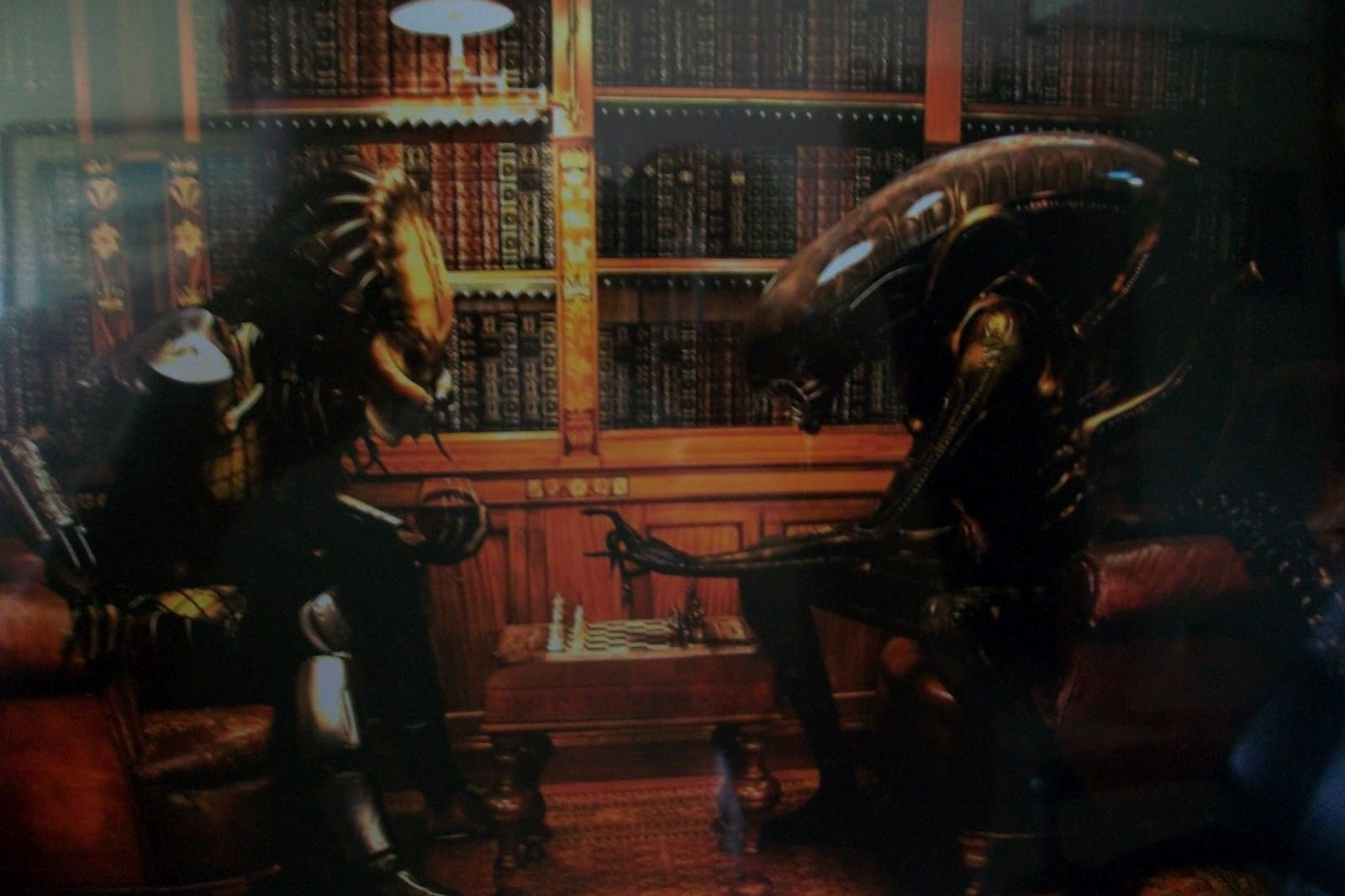
7. Be horrified by the artwork: a substantial amount of the
‘art’ on display is of the kind you ordinarily have to click “I certify that I
am 18 years old and no minors are present with me” in order to view.
8. Realize just how darn many different toys are out there:
there are lots and lots of toys on
display at these things, ranging from small action figures with half the pieces
missing (one booth had, among other things, a single arm of a particular
figure. The figure itself was long gone, but the right arm was for sale) to
foot-high, high-quality figures costing several hundred dollars a piece (oddly
enough, a ‘Rocky Balboa’ figure at one booth was about a hundred dollars more
expensive than a much-more-complex ‘Predator’ figure right next to it). That
Alien Queen Statue would sure look good on my bookshelf…
9. Bask/cringe in the sheer geekiness: you see all sorts at
these conventions, from attractive young people (like me) to middle-aged
parents and their little kids, to the weird, tattooed-and-pierced types. But
here we all speak the same language and when someone makes a ‘Resident Evil’
joke, everyone gets it.
10. Have fun: above all, these conventions are a lot of fun. You laugh at the hilariously
on-target motivational posters (“Expendability: Spock, Kirk, McCoy, and Ensign
Jones have landed on the planet. Guess which one isn’t coming back.”), toy with
the idea of shilling fifty-bucks over for a replica of the Master Sword, pose
for photos with your favorite voice actor, chuckle at the idea of a plush chestburster,
and just overall relish the fact that you have a whole day (or three) to
indulge in your rather-precise interests with thousands of people who share
them.
Bonus: for those so inclined, you can plan your elaborate
cosplay idea for next year’s convention. Like, oh, I don’t know, a Gordon
Freeman outfit that includes a crowbar-sheath, a storage-area for notebooks and
purchases, and which is strong enough to possibly defend you incase a Resonance
Cascade Scenario should occur during the convention…
See ya next year, folks!
Monday, June 4, 2012
Reviews: For Greater Glory

For Greater Glory is a film so providentially well timed in terms of current events that it’s almost painful that it isn’t better. Oh, it’s not bad: it’s emotionally engrossing, beautifully shot, and thrilling as you please, but it’s frustratingly crippled by an unfocused story and a script that ranges from competent to wince-inducing.
Basically, the movie suffers from the same problems that plague so many faith-based films, which may be summed up in a rather desperate desire that the audience ‘get it.’ The writers know the message they want their audience to receive and spare no effort making sure the message is received. Thus it’s not enough to, for instance, depict Catholics being murdered: every single Catholic has to die forgiving his murderers and serenely submitting to his martyrdom. Likewise, points of character development are hit again and again (how many times, for instance, did we need to be reminded that the general leading the Cristeros was an atheist?). Even in the very first moments of the film the same points are covered twice in quick succession, first by the opening text and the in a speech by President Calles (Ruben Blades), his attacks on ‘subversive forces’ being played over shots of peaceful, happy Catholics being blessed and attending Mass just to make sure we ‘get’ that he’s a fanatical psycho.
The dialogue too is generally stilted and occasionally atrocious. Either characters wax a little too flowery and poetic, or else they seem to struggle to get out clunky pieces of oversized exposition (the worst example of this comes when a general responds to an insult with a brief summary of his own career in a manner so clunky the actor seems to have trouble getting it all out).
Though these are serious flaws, the story is strong enough to carry the film past them. The film tells the tale of the Cristeros War in Mexico from 1926 to 1929. We open with Mexican President Calles announcing the strict enforcement of the anti-clerical laws in the Mexican Constitution, among others being that priests were forbidden from criticizing the government or wearing their vestments in public. Catholics protest, peacefully at first (with marches and a boycott), but Calles merely steps up the persecution, using the protests as ‘evidence’ of the subversive intentions of the Church (one thing that always strikes me when I read or hear about government persecutions of Christians is how pointless they seem: like here, what, exactly, does Calles suppose will happen if priests wear vestments in public?). As the situation escalates, the government begins executing priests and, in response, Catholics rise up in armed resistance.
The film then follows the resistance movement (dubbed “Christeros” after their battle cry “Viva Christo rey!” or “Long live Christ the King!”) through the eyes of several key players:
There’s Father Jose Reyes Vega (Santiago Cabrera), a priest who forms a thousands-strong force to conduct guerilla raids; Anacleto Gonzalez Flores (Eduardo Verastegi) a lawyer who spearheads the peaceful protests against the government; Victoriano Ramirez AKA El Catorce (“The Fourteen,” after a ill-fated posse that was sent to kill him), played by Oscar Isaac as a rather brutal rancher who is a curious mix of noble motives and thuggish behavior; Adriana (Catalina Sandino Moreno), a young woman and friend of Flores who represents the many Catholic women who supported the movement by, among other things, smuggling ammunition under their clothing; Jose Luis Sanchez (Maurici Kuri), a fourteen-year-old boy who joins after his beloved pastor is executed; and most importantly, Enrique Gorostieta Velarde (Andy Garcia), a famous and accomplished (though retired) general whose belief in Religious Freedom causes him to accept command of the Cristeros army despite being personally an atheist.
There’s also U.S. Ambassador Dwight Morrow (Bruce Greenwood), who was sent by President Coolidge (Bruce McGill) to ensure America’s oil rights, but who eventually comes to realize the enormity of what’s happening (he gets one of my favorite scenes in the film, where his gentle prodding of the local bishops to condemn the war is interrupted when he sees a row of hanged bodies alongside the train) and subsequently helps negotiate an agreement (as a side note, I suppose it would be possible to find an actor who looks less like Calvin Coolidge than Bruce McGill, but you’d really have to work at it).
Did the above seem a little overwhelming? Unfortunately, the film is like that: there are so many characters running around, and their names are often delivered so quickly that, at least at first, it’s hard to keep track of who is who and what they are doing. It gets better as the film goes on (and the cast starts thinning a little), but the first, say, half-hour or so is rather confusing. Even later on, characters frequently drop out of the film for long stretches, only to rather jarringly pop up again (Morrow is probably the worst offender in this case, as there’s frequently so much time between his appearances that you almost forget he’s still in the movie).
Part of the problem also is that there isn’t much of a unifying ‘arc’ to the story beyond the war itself, which renders the whole thing rather meandering and unfocused; we can jump from Morrow talk with Calles to Sanchez leaving his parents to Velarde leading a battle all in quick succession, leaving us rather confused as to how much time has passed, what the status of the war is, or even who is planning what move. There’s a moment, for instance, when Velarde is being recruited to lead the Cristeros where he mentions that he’s been following their ‘victories and defeats,’ which is (as far as I could tell) the first time the Cristeros were even mentioned as a coherent unit rather than independent bands of raiders. Basically, the film wanders all over itself without a clear time frame or sequence of events. Something as simple as subtitles indicating when and where we are at key stages would have helped tremendously.
On the other hand, I appreciate the film going for an epic scope and trying to tell as much of its story as it could. The many disparate characters eventually coalesce into a single core group (which nicely mirrors their coming together to form an actual army), and by the time the film is over I felt I had gotten to know most of them well enough.
General Velarde serves as the film’s strong center and the calm eye of the storm. Garcia gives a strong performance (allowing for the weakness of the script) as a man who is fighting for a cause he initially doesn’t really believe in, but who slowly starts to imbibe the faith and beliefs of the men he leads (his conversion, unlike most such found in explicitly religious works, is actually pretty well-done and convincing, proceeding as it does from the principle that man becomes what he pretends to be).
Young Jose Sanchez (later beatified by Pope Benedict XVI) is probably the next closest thing to a protagonist the film has after Velarde. He’s a likable figure, particularly in a scene where he and his friend camp out on their way to join the Cristeros and fall to talking about Jesus, in a way that actually feels like how two boys would discuss the subject. His martyrdom, meanwhile, is as heartbreaking as you could wish for (though his final words were perhaps a little too on-the-nose).
Fr. Vega is an interesting figure (though apparently much more pious and less bloodthirsty than his real-life counterpart, who was dubbed a “black-hearted assassin” by his Cardinal, which adds a slightly uncomfortable tone to his scenes) as the priest-turned-general who still insists that he’s a priest first and foremost (and during the climax has to hold to that claim). El Catorce, meanwhile, very nearly steals the whole show with his sheer badassery. He also gets a couple of moments to show that, for all his brutality, he is genuine believer who is capable of repentance and humility.
President Calles is a largely unreconstructed villain (though he does have one or two scenes of humanity). Flores…well, I’ll admit, I kept loosing track of Flores. He makes some impression in the beginning, but then largely disappears until it comes time for his own martyrdom (he was also beatified by Pope Benedict along with Sanchez).
This review is starting to sound a little more negative than I intended, so let me go ahead and start listing some things the film does well:
First and foremost, it’s an emotionally gripping story from beginning to end as we follow the revolution from its unintentional beginnings through its triumphs and disasters (and plenty of both), all the while watching the characters coming to trust and rely on each other and seeing their faith in God grow, change, and deepen as they devote their lives to Him. Again and again we’re made aware of the immense courage of the various characters: the soldiers facing off against superior troops, the women smuggling information and ammunition (a tense scene on a train emphasizes just how dangerous this task was), and everyone involved risking their whole lives and fortune for the sake of their faith and freedom.
The martyrdoms depicted, for all their simplification, are almost all heartbreaking and edifying, just as martyrdoms should be. Bl. Jose Sanchez’s is, obviously, the most wrenching (I was grateful that we don’t have to actually see what happens during his torture, since the implications and his screams are quite agonizing enough), but earlier executions of people like Sanchez’s pastor, Father Christopher (Peter O’Toole, always a welcome presence) or another priest whose name I didn’t catch are also moving (O’Toole’s wide eyed terror as he mouths his last prayers stands out as one of the only signs of fear or reluctance in any of the film’s martyrs). As a tribute to modern-day martyrs, the film excels.
The cinematography is gorgeous, with the rugged wilds of Mexico on full display, from the towering stone peaks surrounding the Cristeros camp to the wide, almost unnaturally flat plain that serves as a meeting place for Calles and Velarde to discuss terms. Christian imagery is also well in evidence, from the gorgeous interiors of churches and cathedrals to the paintings and crucifixes that adorn the walls of homes and tents to a simple cross traced in the sand that soon fills with a pool of blood. The film manages some strikingly unique images, such as the moment when a priest and his murderer end up hanging side-by-side, or the slow build up to an ambush with dozens of armed men watching an oblivious army column pass in utter silence.
Furthermore, there are the refreshing signs that remind us that this is not a Hollywood film. The rugged masculinity of the main characters, for instance, as they tersely size each other up, swagger, and grimace behind bushy mustaches is the kind of thing that one almost never sees in a contemporary Hollywood film (for one thing there aren’t many actors left in Hollywood who can so convincingly play an honest-to-goodness man). At times the movie feels like an old-style Western, which, it should be noted, is all to the good. This is one of the most genuinely ‘manly’ film I’ve seen in theaters in a long time (I particularly like a scene where El Catorce challenges Velarde’s authority and Velarde, in response, allows him to make the mistake he had been trying to warn him against while quietly preparing to come to his rescue).
Another sign that this isn’t a Hollywood production is that the characters actually talk and act like real Catholics. This is so rare to see in movies that it’s actually a little startling when Velarde and Vega have a discussion about why God allows evil and Vega actually provides a decent answer, or when, during the same conversation, Velarde asks whether Vega can still be a priest after all he’s done and Vega answers (correctly) that he will always be a priest. Most movies and shows (and even news outlets) seem so utterly incapable of understanding or correctly depicting Catholicism that this movie feels like a bracing draft of fresh air, reminding us of just what we’ve been missing (I particularly appreciated a scene where the Cristeros enter a massacred village and become “an army of gravediggers” in an oblique reference to the corporal works of mercy).
I also like the way that, while they’re clearly meant to be the heroes (and are certainly cleaned up and more virtuous than their historical counterparts), the film does show that not all the Cristeros are saints and that they were capable of committing atrocities. El Catorce in particular has a number of morally-dubious moments (such as a scene where he shoots a fleeing enemy in the back after apparently letting him go). A historical incident where a train robbery ends in a massacre is here softened into a mistake, though the perpetrator later defends it as an act of vengeance and gets (justly) called out for it (though after that the incident is mostly forgotten and only referred to obliquely). Unfortunately, the same concern isn’t really shown to the federales troops, who are pretty much cardboard targets who are never allowed to show any reluctance or hesitation to murder priests and children (a brief moment where one offers to help Sanchez on his via dolorosa is an isolated throwaway and doesn’t really help much).
The action scenes, meanwhile, are somewhat mixed. On one hand, they’re generally thrilling enough, with the scene where El Catorce earns his nickname being simply superb from start to finish, but they’re also mostly a little prosaic and uncreative. There’s also the problem, possibly brought about by budgetary restrictions, that there never seem to be as many men as we’re told there should be. One battle, for instance, seems to involve at best a hundred or so government troops, but we’re later told the army lost five or six thousand. It’s not a huge problem, but it’s one of the things the film could have done better.
That’s the thing: the film is engrossing and moving, but it really should have been much better. If only a little more care were taken with the script, a little more nuance and subtlety allowed (for instance, perhaps some of the federales troops could have been shown refusing to carry out executions, or one of the priests could have been a little less pious), the film could have approached something like greatness.
The actors do what they can, but they’re hampered by the thudding, unwieldy script. Most of the best acting moments come when the characters aren’t actually talking, and so don’t have to work around the dialogue. Garcia in particular does a good job of showing the complexities of his character as he shouts rallying cries to his men which he himself doesn’t actually believe in, though that becomes called into question more and more as time goes on. My favorite scene with him is the aforementioned ‘alpha-male’ confrontation with El Catorce, where you can see the machinations working behind his inscrutable face even before the conversation ends (the fact that the filmmakers felt the need to have Sanchez actually draw attention to this is emblematic of the film’s problems).
Newcomer Maurici Kuri gives a surprisingly strong showing as Bl. Jose Sanchez; he overacts a little during the emotional scenes, but that can be excused as the heightened emotions of a teenager. His best scene is his martyrdom, where he shows both serenity in the face of death and the agony and grief he feels as his life is cut short.
The other standout performance is Oscar Isaac as El Catorce. His role mostly involves swaggering around acting tough (which he does very well), but late in the film he gets a moment where he finds himself standing almost numb with shock after inadvertently allowing another character to be captured. His evident grief and attempts to justify himself, culminating in his stumbling into Mass and kneeling in contrition, are among the best acting in the film.
Beyond these three, the acting generally is competent but not spectacular. As noted, the actors struggle with the poor script and so often come across as broad or cartoonish (the scene where Velarde and his wife discuss his joining the Cristeros is particularly wince-inducing). For the most part it’s possible to look past these problems, but they are annoying and occasionally take you out of the film.
That the film takes some notable liberties with historical fact is to be expected, though it’s occasionally troubling. I mentioned the softening of Fr. Vega’s character and the train massacre, but even more so is that the movie rather quietly skips over the tragic end of the Cristeros movement, which resulted in Calles giving few if any concessions and even going back on his promise of amnesty, executing more Cristeros than had actually died in the war itself. On the other hand, the film ends with a series of historical photographs and even video footage of the real-life men and women depicted in the film, which lends enough of a tragic, historical feel to almost make up for the unconvincingly triumphant ending.
Much has been said of the film’s timeliness, with President Obama taking the first steps down the same path President Calles trod. There is, indeed, a lot of disturbingly contemporary elements to Calles’s persecution, such as his dismissal of any opponents as ‘religious fanatics’ (the law against priests wearing vestments in public, meanwhile, is frighteningly similar to the recent ruling in England that Christians don’t have the right to wear crosses in public). As I watched I found myself considering what my response would have been to the various outrages that the government enacts against the Church in this film. The frightening thing is that I could very easily see many of these same laws being enacted in the near future (though today it wouldn’t be for fear of ‘destabilizing the government’ but in the name of ‘antidiscrimination’). Quite apart from any qualities or flaws it has, this is a sobering and thought-provoking film.
At the moment, the United States isn’t yet on the same level as Calles, and as Obama’s mandate hasn’t yet made it past the courts it’s uncertain whether even this first step will amount to much. However, the fact that someone – a U.S. President – has even tried to take that first step should be enough to give us pause. The fact that England, Spain, and other European countries are even further along the path that led to the Cristeros War should likewise make us nervous. This isn’t a great film, but it’s an important one, since it serves as a reminder that the same sequence of events that has started in Europe, Canada, and the United States has happened before in Mexico, where it led to a war. If nothing else, this film should serve as a warning sign.
But even considered apart from its real-world context, it’s a worthwhile experience. It’s beautifully shot, epic in scope, exciting, and emotionally gripping from start to finish. It has a number of very real flaws, and some viewers may find them insurmountable, but even non-believers may find enough manly excitement and emotional resonance to make the film worth their time. For Catholics and other Christians, meanwhile, it’s a must see.
Final Rating: 3/5. Recommended to Christians and those who enjoy an epic, exciting, emotionally engrossing film despite a poor script and meandering story.
Memorable Quotes:
Velarde: “If you start living in your memories, you’re already dead.”
Fr. Christopher: “There is no greater glory than to give your life for Christ.”
(distributing Communion, Fr. Vega comes to Velarde)
Fr. Vega: “You need to Confess first.”
Velarde: “Wouldn’t He already know?”
(beat)
Fr. Vega (moving on): “…You need to Confess.”
(during the attack on Ramirez’s ranch)
First Soldier: “He must be dead by now. Let’s go in.”
Second Soldier: “Right. You go first.”
Velarde (introducing himself): “I have been in two wars. I was twice decorated for bravery…”
El Catorce: “And he’s humble too!”
Tuesday, May 29, 2012
Reviews: The Avengers

The Avengers is everything you wanted and more. It hits almost all the beats that we wanted to see, joins itself effortlessly and convincingly to all five preceding films, and actually manages to take the familiar characters we’ve come to know to something like the next level. It's a thrilling, funny, and utterly satisfying crossover. I can’t remember the last time I’ve had so much fun in a movie theater.
We open with the arrival of Loki (Tom Hiddleston) on Earth in the middle of a S.H.I.E.L.D. base where Dr. Eric Selvig (Stellan Skarsgard) is studying the Tesseract, under the watchful eyes of Clint Barton, AKA Hawkeye (Jeremy Renner), Agents Maria Hill (Coby Smoulders) and Phil Coulson (Clark Gregg) and Director Nick Fury (Samuel L. Jackson). Loki quickly declares his intent to conquer the Earth, steals the Tesseract, and destroys the base with one fell swoop.
In light of the attack, and the threat posed by Loki, Fury decides to enact the Avengers initiative by assembling a response team made up of the world’s superheroes. Coulson and Natasha Romanov AKA Black Widow (Scarlet Johansson) are thus dispatched to recruit Tony Stark AKA Iron Man (Robert Downey Jr.) and Dr. Bruce Banner, sometimes the Hulk (Mark Ruffalo, ably replacing Edward Norton) respectively, while Fury approaches the recently thawed-out Steve Rogers AKA Captain America (Chris Evans).
Hmm…don’t really want to say much more, except that they’re soon joined by Loki’s brother, Thor (Chris Hemsworth) who has returned to Earth to try to talk some sense into his brother or, failing that, bring him back to Asgard to face justice. Oh, and Loki is backed by the Chitauri: a race of reptilian creatures who have agreed to give Loki dominion over Earth in exchange for the Tesseract, which will allow them to conquer the galaxy.
You might be able to tell that this is a fairly simple plot: Loki wants to conquer the world, Fury assembles the Avengers to stop him. That’s really all we need: we’re not here for big plot twists (though there are a few), we’re here to see the Avengers get together and kick ass…and we do. Oh, do we ever!
The film is neatly divided into three acts: the first is the gathering of the team, the second their meeting each other and having personality clashes onboard the SHIELD Helicarrier (flying aircraft-carrier, which is every bit as cool as it sounds), the third a massive, extended battle royal against Loki and his army in New York City.
Crossovers are a relatively rare genre of film, and even rarer is one that actually works as well as The Avengers does (I can only think of two: Freddy vs. Jason and the animated World’s Finest Superman/Batman crossover). More often, you’ll get things like, say, Alien vs. Predator, which, despite a few flashes of inspiration, failed to capture the spirit of either character and ended up being an uncreative, thudding mess (and the less said about the sequel, the better), or the other Universal monster-match-ups like Frankenstein Meets the Wolf-Man or House of Dracula that sidelined one or more of the characters in favor of a particular ‘star.’
What really stands out about The Avengers, and what might be its signature strength, is how well it juggles all six of its heroes. It actually manages to give each character a surprising amount of screen-time, and no one feels like they could have simply been cut without taking away from the story (well, Maria Hill is a borderline case, but she’s a supporting character so it’s not as noticeable) The filmmakers thankfully didn’t forget that they were making a sequel as well as a crossover, and all the characters we’ve been getting to know over the past five films are allowed to grow, continue, and move on from where they were the last time we saw them. In other words, the film doesn’t just bring all these characters together; it continues their stories from where they left off. We see Captain America trying to adjust to the modern world, we see Tony Stark continuing his transformation from selfish dick to honest-to-goodness hero, we learn more about Bruce Banner’s relationship with his other half, and we get to see Thor and Loki finally have the conversation they were too busy to have last time: the one where Loki tells Thor exactly why he’s doing all this.
Most importantly, none of the six heroes overwhelms the others: Cap and Iron Man are, fittingly, probably the closest thing the film has to ‘stars’ in terms of impact and screen-time, but no one is forgotten and each gets their chance not only to shine, but to grow and develop.
Robert Downey Jr. as Tony Stark is as much fun as ever; tossing off ad libs and smart-alecky quips with his usual aplomb. He seems more stable this time around though, less socially dysfunctional and more at peace with himself. This may have something to do with the fact that he and his long-suffering assistant Pepper Potts (Gwyneth Paltrow, welcome as ever) are now officially a couple, and we get a very charming moment with the two of them near the start of the film to emphasize this (and to finally let us see the romance that the two Iron Man films were leading up to). Their banter is as witty and lovable as ever, and helps us to realize that Tony is growing and maturing; he’s not the neurotic wreck we once knew, though he’s not completely different either and evinces some notable insecurity in his interactions with Captain America. Downey also excels at saying one thing while letting us see that Stark really thinks something different: one scene with Cap has Stark toss off a rather nasty and patently untrue insult, but a brief aside glance shows us that he knows he’s firing blanks.
Chris Evans as Steve Rogers/Captain America is the same good-guy he was, though now his decency and heroism is tempered by an edge of sadness and disillusion: he’s a man out of time, whose lost pretty much everything he’s ever known and is unsure how he fits in to this new world. I particularly like the way they acknowledge the fact that an idealistic hero from the Greatest Generation would probably be disappointed with the twenty-first century without getting too specific (which would certainly have alienated viewers). Evans is still great at portraying Cap’s essential virtuousness and decency, and he gets a number of good moments that emphasize this (particularly his meeting with Dr. Banner). Cap’s the leader of the team, and the film makes sure to show it.
Chris Hemsworth as Thor is recognizably still the more humble and selfless figure he became at the end of the last film, though like Stark he’s not a completely different person and still has moments of hotheadedness (particularly his meeting with Iron Man). He’s in somewhat of the opposite position to Cap, in that while both are outsiders, Thor knows and loves this world and has friends here (his friendship with Dr. Selvig is acknowledged, and while Natalie Portman was unable to appear in person, Jane Foster is briefly present in a very sweet moment that is among the many things the film gets exactly right). Hemsworth gets some particularly good scenes with Hiddleston, as he tries to come to terms with what his (still beloved) brother has become.
Mark Ruffalo as Bruce Banner just might be the stand out performance of the film. Banner is a very different person than he was when we saw him last (and not just because he’s played by a different actor); he’s become more-or-less resigned to his curse, and while he still travels the globe in secret, trying to do good for people (we meet him tending plague victims in Cambodia), he’s developed a rather alarming confidence about himself, as well as a somewhat self-deprecating sense of humor about his condition. Basically, he knows that in any situation he finds himself in he holds the trump card. At the same time, he lets us see that Banner is still hurting, still resentful, and still keenly aware of how his condition sets him apart from his fellow men. There are a number of little details in his performance that I loved, such as the way he instinctively hides his face from passing SHIELD agents even after he’s joined the Avengers, or the way he keeps casting glances over his shoulders as though expecting attacks from any corner. Ruffalo gives a complex, multi-layered performance that I’d rank as the best portrayal of the character since Bill Bixby defined the role. The Hulk itself, meanwhile, very nearly steals the whole show with a series of brilliantly conceived maneuvers that puts it to better use than any previous film and makes one eager to see what it might do in another solo adventure.
(On the subject of the Hulk, the movie deserves credit for a very rare achievement: it actually removed one of my complaints from The Incredible Hulk. In my review, I noted both that the ending shot made no sense and that Bruce Banner didn’t really have any kind of character arc. Well, with the conception of the character in The Avengers we have not only a satisfying explanation of the final scene in Hulk but also, retroactively, are able to read some real development of Banner’s character into the events of the previous film. I don’t want to say anymore, as it would give away some of The Avengers’ most delightful surprises.)
Scarlet Johansson as Natasha Romanoff AKA Black Widow was something of a surprise for me. She really comes into her own in this film, making us realize just how little we knew her in Iron Man 2. Here she’s a curious mixture of coldness, deceitfulness, bravery, and emotional turmoil that let us know that this is a woman who, for all her skills, really hasn’t come to terms with herself. On the one hand, she casually lies to Banner’s face when she comes to collect him and alludes to horrible deeds in her past, on the other she’s a brave and selfless team member, one who does her best to try to keep the team together as the varying personalities start taking their toll and who puts herself on the line numerous times for the sake of her companions (including, at one point, engaging in a battle of wits with Loki himself). I particularly like how her particular skills of infiltration, interrogation, and so on are actually put to good use, making her seem like a valued and important member of the team (no mean feat, considering she’s basically a normal woman fighting alongside super-powered men).
There’s also an ambiguous relationship between her and Hawkeye that the film sets up just enough of to make us interested while simultaneously understanding that this really isn’t the time or place to explore in depth. It isn’t quite a romantic relationship, but it certainly is close friendship and trust that might hint at something more, however much Black Widow herself denies it (though frankly I’m still hoping for a Captain America-Black Widow romance).
Jeremy Renner as Clint Barton AKA Hawkeye doesn’t really have as much to do as the others (partially due to a first-act twist that effectively isolates him from the team for much of the film), but he does at least get off some good moments. He’s the hero that is least developed either in previous films (he only had a blink-and-you’ll-miss-it cameo in Thor prior to this) or in this one, being little more than a rather snarky sidekick and motivating force for Black Widow. He doesn’t really come into his own until the end fight, during which he pulls off a number of excellent maneuvers, but he at least holds his own and feels like he contributes something to the film, despite his limited character.
Tom Hiddleston as Loki, meanwhile, isn’t quite the same complex character he was in Thor. He still has shades of it, particularly whenever he and Thor have a scene together, but he’s basically a straight-up bad guy this time, with little sign of the contradictory emotions and neediness he had in the previous film. Still, he’s certainly an effective villain, blasting his way through S.H.I.E.L.D. guards and heroes with terrifying ease, showing himself to be a threat truly worthy of the Avengers. He’s also a delight to watch as he confidently manipulates and blasts his way towards victory, usually with a good dose of sarcasm or boastful speeches thrown in. Loki this time around is a villain you truly love to hate, and Hiddleston again shows his mastery in the role.
Samuel L. Jackson as Nick Fury finally gets a chance to be front and center, and does a typically good job in the role, though with so many other characters flying around he sometimes gets a little overwhelmed for all of Jackson’s charisma. Clark Gregg is back as Agent Coulson, here showing more of a personal side as he chats with Pepper or has a gushing fan-boy moment with Cap. Coby Smoulders doesn’t really have much to contribute as Agent Maria Hill, serving mostly as someone for Fury to talk to, but she handles herself well enough, particularly in the opening action sequence. Paul Bettany is back as JARVIS, and as snarky as ever. Stellan Skarsgard as Dr. Eric Selvig has a rather compromised role this time around, but is a welcome presence nonetheless. Meanwhile, Harry Dean Stanton (of Alien fame) has a brief but amusing cameo as a janitor who gives Banner a hand after one of his Hulk episodes (“You have a condition, son”).
One of the key ingredients to making a good crossover is the question of how these characters will react to each other. In almost every case, The Avengers absolutely nails the interactions that, say, Thor and Captain America, or Tony Stark and Bruce Banner, might be expected to have. Stark and Banner in particular have surprisingly good chemistry, bonding over their shared love of science (“Finally! Someone who speaks English!” “Was that what just happened?”). Most of the inner-team rivalry centers around Cap and Stark, and it must be said that while their verbal battles are entertaining, it sometimes feels like Cap isn’t being allowed to push back as hard as he should against Tony. Stark is allowed to have the last word a few times too many for my taste, including a couple times when he really shouldn’t. It’s not a major problem, just something that might have been improved.
Something that almost completely makes up for it, however, is the way that they drop their bickering immediately when the chips are down. Once the time has come for action, Cap and Iron Man work surprisingly well together, better than anyone would have expected given their vastly differing personalities (I’m reminded of a similar dynamic among the three men in Jaws). The way they actually grow to respect and trust each other is engaging, and the two of them serve as the heart of the team (and the film).
There is also real heart and sweetness in the team’s treatment of Banner, who is clearly rather nervous at meeting so many other people, and unused to the simple respect and friendship they show him. As noted, his scenes with Stark are particularly good as Stark essentially tries to cheer him up and give him a new perspective on his condition (one funny moment has him playfully jabbing Banner in the side to ‘test’ his control…while at the same time letting Banner know that Stark isn’t afraid of him).
As you might have gathered, The Avengers is a furiously action-packed film, though it’s never confusing and never feels overstuffed (surprisingly enough). The action always seems to serve the story, rather than vice-versa. Even an exhibition match between Thor and Iron Man feels like it fits in both with what’s going on in the story and with the personalities of the two characters (kudos also for the choreographers for making the fight believably even). There’s a great creativity to these scenes, giving the moments we wanted to see, while also giving us a number of surprises along the way. The action sequences are face-paced, outsized, and utterly thrilling, from the opening assault on the S.H.I.E.L.D. base, to the battle on the Helicarrier, to the epic final confrontation in New York City. Sprinkled throughout are perfect “crossover” moments: moments that fans of the characters would demand to see in any decent match-up between them. Thus we have moments like Iron Man reflecting his repulser rays off of Cap’s shield, or the Hulk trying to pick up Thor’s hammer, or the glorious moment when the team assembles as a complete unit for the first time and Cap begins ordering them to their places.
I really can’t think of too many flaws for the film, and they’re mostly ones of omission. I mentioned that characters like Nick Fury and Maria Hill get somewhat overshadowed or lost in the shuffle, though there doesn’t seem like a whole lot that anyone could have done about that. Also, I wish they hadn’t stacked the deck quite so much against Cap’s idealism: he never drops it, but he has it challenged more times than he probably should (though the film ultimately supports his idealism and selflessness as preferable to Stark’s cynicism). The fight between Thor and the Hulk (which I had been particularly looking forward to seeing) was far too short for my tastes. I also wish they could have fit the line “Avengers assemble!” into the film somewhere.
There are also a couple of moments where the story slips a bit: it’s mentioned a couple times that you can’t go out onto the Helicarrier while it’s in flight because of the thin atmosphere, but then several characters do so with no apparent problem. Likewise, one scene has Thor caught in a death trap that seems to pose more of a threat to him than it really should. The “World Defense Counsel” just sort of shows up without much explanation and doesn’t really serve much purpose apart from making Fury look good by comparison. I was also rather disappointed that Black Widow’s fighting style (which I praised in Iron Man 2 for its relative restrain and realism) has been simplified to precisely the rather prosaic punches and kicks I was so pleased the previous film had avoided. She’s still persuasive in the action scenes, but not as much as she was before.
Fortunately, there aren’t too many such moments. On the whole, The Avengers is the most fun I’ve had in a theater for a very long time and one of the most satisfying crossover films I’ve ever seen.
Final Rating: 5/5 Everything you wanted it to be: not only highly recommended, but it’s worth seeing the previous five films just to fully enjoy this one.
Memorable Quotes:
Nick Fury: “We have no quarrel with your people.”
Loki: “An ant has no quarrel with a boot.”
Bruce Banner: “Are you here to kill me, Agent Romanoff? Because that’s…not going to work.”
Black Widow: “We need you to come in.”
Banner: “What if I say no?”
Black Widow: “I’ll persuade you.”
Banner: “And what if the Other Guy says no?”
(regarding his new Stark Tower in Manhattan)
Tony Stark: “This is your baby. Give yourself…twelve percent of the credit.”
Pepper Potts: “Twelve percent?”
Stark: “An argument could be made for fifteen.”
(after being interrupted by Coulson)
Stark: “I thought we were having a moment.”
Pepper: “I was having twelve percent of a moment.”
(about the Helicarrier)
Steve Rogers: “Is this thing a submarine?”
Banner: “Do they really want me in a compressed metal tube?”
(the Helicarrier takes off)
Banner: “Oh, this is much worse.”
(to a crowd in Germany)
Loki: “In the end…you will always kneel.”
(an old man stands up)
Old Man: “Not to men like you.”
Loki: “There are no men like me.”
Old Man: “There are always men like you.”
(during an encounter with Thor, Cap suits up)
Black Widow: “You might want to sit this one out, Captain. Those guys are alien beings, they’re basically gods.”
Captain America: “There’s only one God, ma’am, and I’m pretty sure he doesn’t dress like that.”
Thor: “We were raised together, we played together, we fought together! Do you remember none of that?”
Loki: “I remember a shadow. I remember living always in the shade of your greatness.”
Cap: “Big man in a suit of armor. Take that away, what are you?”
Stark: “Genius, billionaire, playboy, philanthropist.”
Cap: “I know guys with none of that who are worth ten of you.”
Banner: “Last time I was in New York I sort of broke…Harlem.”
Thor: “You people are so petty! And tiny!”
Loki: “I have an army.”
Stark: “We have a Hulk.”
(fighting the invading aliens)
Black Widow: “Just like Budapest all over again!”
Hawkeye: “You and I remember Budapest very differently.”
(giving the team their orders)
Cap: “And Hulk…smash.”
Wednesday, May 23, 2012
Trailers: The Great Gatsby
Just
saw the trailer for the new The Great
Gatsby adaptation and dear God in Heaven it looks bad! Laughably, mind-numbingly bad. It looks so unspeakably,
maniacally misconceived that I hardly know where to begin.
Well,
let’s start with the cast: Leonardo DiCaprio stars as the titular Gatsby, Tobey
Maguire as Nick Carraway, and Carey Mulligan as Daisy Buchannan.
First of all, who the heck cast
Tobey Maguire as Nick? That’s just…wrong. Nick, as the book’s narrator, is the
story’s moral center: the one genuinely decent person in Gatsby’s tragic life,
and the sensible, observant eye-of-the-storm. Maguire can certainly be
likeable, but in a rather dorky, boy-next-door kind of way rather than an
intelligent, morally solid kind of way. In what’s supposed to be a
roaring-twenties society party, Maguire looks like a time-travelling 90’s teenager
who snuck in through the back door (shades of Shia LaBouf in The Greatest Game Ever Played, except
that here it’s not intentional). To put it bluntly, they cast an actor who has absolutely
no sense of maturity about him as the only mature character in the story. Hearing
him say, “who is this ‘Gatsby’?” in his nasally,
I-didn’t-quite-make-it-through-puberty voice is enough to make me laugh.
DiCaprio isn’t as horrendously
miscast as Maguire, but from what we see of his performance he’s almost even
more of a misfire. For instance, in a conversation with Daisy he looks less
like a man talking to the love of his life and more like a man who really needs
to eat more fiber, if you get my drift. Frankly, I think he would have been a
better choice for Nick, and, I don’t know, someone else could have taken
Gatsby.
Mulligan looks incredibly vapid and
blank as Daisy, though whether that’s the performance or the character is,
admittedly, hard to tell at this point. Still, even Daisy ought to change her
expression sometimes…
Then there’s the whole look and
style of the film, which is bright, artsy, artificial, and nauseatingly
self-indulgent. This doesn’t look like the Jazz Age, this looks like a 90’s
music video with lasers and weird camera angles. It’s like the director (Baz Luhrman) wants to remind the
audience every second of the film
that he is an artist and a bold, visionary director. The result it looks like
Las Vegas threw up on Fitzgerald’s novel. The computer-generated 300-style look of the whole thing fits
in with Fitzgerald about as well as an extended rap number would fit in with
Charles Dickens.
Which brings me to the soundtrack,
which is so aggressively non-1920s in style that it makes me wonder if the
whole thing was meant as a parody. We get a kind of pseudo-rap type thing in
the opening, then a mewling pop ballad for the second half. Each one says
“Fitzgerald’s jazz age!” about as much as an iPod.
The
Great Gatsby is a really wonderful book, all about pride, vanity, passion,
unworthy love, and genuine friendship. Its overwhelming feelings are of
sadness, longing, and despair, with brilliant flashes of genuine human
kindness. This latest adaptation, apparently, is all about “look what a
brilliant, bold artist Baz Luhrman is!”
Friday, May 4, 2012
Reviews: Captain America: The First Avenger

Captain America: The First Avengers is probably the best film of the Marvel Cinematic Universe. It’s the grandest in scope, the most complete in its storyline, and contains some of the most thrilling action sequences of the whole series. It’s a war movie, superhero film, and old-fashioned adventure story all wrapped up in a surprisingly epic storyline.
We start off (following a brief opening in the modern-day arctic) in Norway, 1942, where Nazi Agent Johan Schmidt AKA the Red Skull (Hugo Weaving, channeling Werner Herzog) is searching for the Tesseract: a glowing Cube containing unlimited power (“And the Fuehrer digs for trinkets in the desert…”). Meanwhile, in Brooklyn, we meet 97-pound asthmatic Steve Rogers (Chris Evans) in a movie theater, telling off an obnoxious jerk for jeering at a patriotic newsreel. He takes a beating for his troubles, but is saved by his best friend, Bucky Barnes (Sebastian Stan), who has one night left before he leaves to serve in Europe, which he and Steve spend at a fair showcasing future technologies being developed by Howard Stark (Dominic Cooper, looking very much like a younger John Slattery). Steve, we learn has applied for enlistment at least five times in different cities and been classified 4-F every time. “There are men laying down their lives,” he says. “I’ve got no right to do any less than them.” Taking advantage of an enlistment booth at the fair, he tries again, but this time he catches the eye of Dr. Abraham Erskine (Stanley Tucci), who believes that Steve has exactly the qualities he needs for a special project.
Recruited under Col. Chester Phillips (Tommy Lee Jones, effortlessly stealing every scene he’s in) and British agent Peggy Carter (Hayley Atwell), Rogers is chosen to participate in a new super-soldier program; a technique developed by Erskine that supposedly will turn even skinny little Rogers into the peak of human perfection. The technique is a success, but a Nazi agent infiltrates the facility, kills Erskine, and destroys the equipment, leaving Rogers as America’s only super-soldier. With Phillips unable to find much use for a single such solider, Rogers is sidelined into a USO act. Until, that is, he discovers during a tour in Italy that Bucky had been captured, together with a good part of his unit. With Carter and Stark’s help, he conducts a daring raid behind enemy lines to rescue the prisoners, in the process coming face-to-horribly-scarred-face with Schmidt, who by now has split off from the Nazis to form his own cult-like group organization known as HYDRA.
Having demonstrated his potential, “Captain America” (named after the character he played in the USO shows) is equipped with a new, bullet-proof circular shield and given command of an elite commando unit tasked with finding and destroying HYDRA installations, while Schmidt perfects his plans for world domination…
The above is a very cursory summary: there is a LOT going on here. That doesn’t mean it’s an overstuffed tangle like Iron Man 2, however: it just means that the film covers a lot of story over its running time. We follow Steve Rogers all the way from his recruitment, through basic training, the super-soldier procedure, the USO, his raid on HYDRA, then finally his emergence as Captain America. As such, the film can feel like it’s taking a long time to really get going, though its almost never boring.
As the final film before The Avengers there’s a kind of micro-tour of the MCU woven seamlessly into the storyline. We have Howard Stark representing the Iron Man films (and reminding us more than a little of his future offspring), while the super-soldier procedure itself is recognizable as a more perfected version of what Blonsky went through in The Incredible Hulk (a reference to ‘vita rays’ during the procedure, meanwhile, is a nod to Bruce Banner’s unwitting attempt to recreate the procedure). Meanwhile the Red Skull’s weapons and technology are all powered by the Tesseract (or Cosmic Cube as fans call it), which he describes as “The jewel of Odin’s throne room” and which made a brief appearance in Thor. Yggdrasil is referenced at one point and even makes a brief appearance at the climax. These elements are so well woven into the storyline that I honestly didn’t even register most of them until this last viewing.
But Captain America isn’t just a preparatory film for The Avengers; it’s its own story, the story of Steve Rogers, a skinny boy from Brooklyn who desperately wanted to serve his country and winds up becoming one of its biggest heroes. It’s a story the film tells very well, particularly considering how much ground it has to cover. Unlike the tangled Iron Man 2 or the multi-world, character, and plotline Thor, Captain America is a very straightforward film for all its epic scope. There is Captain America and there is the Red Skull: the only two super-soldiers in the world. Red Skull wants to conquer/destroy the world, Captain America wants to defend his country/the world. That’s really the extent of the plot at its most basic form, and the film greatly benefits from its focused storyline: an attempt to juggle too much would have been fatal.
This is the first film in the series that has too many action scenes to do my usual run-down: there’s Cap’s introductory chase of a HYDRA agent through the streets of Brooklyn, his raid on the HYDRA facility, a montage of he and his men attacking HYDRA plants, and the climactic battle aboard a giant flying wing bound for New York. Those are just the major ones, there are others scattered throughout. This is the most action-packed film of the MCU. The action itself is frenetic, well choreographed, and as exciting as any you’ll ever see. There’s tremendous creativity throughout, in the HYDRA weapons, in the way the fights play out, in Cap’s applications of his powers and, once he gets it, his trademark circular shield, which is a seriously cool weapon for all its simplicity. The climactic confrontation between Cap and Red Skull is, I would say, one of the best, if not the best, villain-hero showdowns in the entire series; it’s only possible rival being the Hulk-Abomination battle. But even that, outsized and brutal as it was, didn’t have the same sense of climax, of two nemeses having their epic final meeting that this one does.
The film’s primary strength is its protagonist: Steve Rogers, who is that rarest of cinematic beasts, the genuinely good person. He’s polite, brave, empathetic, noble, a born leader, and almost painfully self-sacrificing. Rogers is exactly the person you would want as your country’s hero, the epitome of everything good about America. He sets out to do his duty and lets nothing stand in the way of his doing it, even if it costs him everything.
Likeable as Bruce Banner was, noble and brave as Thor was, and well-intentioned as Tony Stark was, Steve Rogers bests them all in the hero department. He’s quite simply the most heroic superhero yet on screen…possibly ever. I can’t recall a single superhero who makes a comparable sacrifice, in cold blood, that Cap makes here, a move that, far from being a last-minute development or isolated incident, is exactly what we have come to expect of Captain America.
Chris Evans really surprised me in this film. I had only seen him previously in the awful Fantastic Four, wherein he was the very worst thing about a very bad movie. Here, though, he couldn’t be more different. He inhabits the role of Cap as though born to play it, coming across as earnest, polite, and good-hearted as you could wish for. Not only that, but his acting is really quite good, measured and moderately reserved, as though he is disciplined enough to hold back his feelings when necessary, but not so much that we can’t see and understand what he is feeling. Cap is our best hero yet, and much of the credit for making him so must go to Evans.
He’s well matched in Hugo Weaving, who takes to his roll with much scenery-chewing gusto. He’s the most ‘pure’ villain we’ve had so far: he’s not complex, he doesn’t have a deteriorating character arc, he’s just a crazed Nazi with a red head and a god complex trying to take over the world. And you know what? That’s all he needs to be. Weaving is a delight to watch as he hams it up for all to see, while still maintaining a definite air of menace and cruel genius. He’s fun, but he’s still a very credible threat to our hero. I’d place him just behind Loki as the second-best villain in the MCU.
The makeup that creates the Red Skull is surprisingly effective: at first glance it appears rubbery and fake, but once he starts speaking it isn’t long before we grow accustomed to it. It’s certainly a vivid image, his blood red, skull-like visage rising out from the black leather SS Uniform, like some inhuman demon.
Hayley Atwell as Peggy Carter gives some surprisingly good support to Evans. Their relationship and inevitable romance progresses gracefully and believably, though for the viewer it’s rather sad to watch as we know that it’s doomed from the start to be cut short. Atwell also does a pretty good job of portraying a strong, tough woman: almost a precursor to Black Widow. She has a number of very good moments, as when she pegs a driver from city-block away, or when she enacts her frustration with Rogers in an impromptu test of his shield’s durability. She’s a likeable, self-possessed character whom we could easily see ending up with Rogers, had things gone differently.
Sebastian Stan, meanwhile, is likewise a strong supporting character, and his friendship with Steve is portrayed with care and feeling. The two obviously care for each other and feel like they’ve got each other’s backs (literally in a couple of scenes). For all that Bucky doesn’t have a whole lot of screen time, he makes a surprisingly strong impression. He also gets a number of very funny lines (seeing the Red Skull for the first time he nervously asks Steve “You don’t have one of those, do you?”).
Dominic Cooper, as noted, does a good job of both matching the Howard Stark character we met in Iron Man 2 and letting us see just where Tony got his attitude from. I am glad, however, that while Stark is obviously his son’s father, he isn’t the same person: he comes across as more well-adjusted and less neurotic, as though he lacks the personal demons that plague Tony.
Stanley Tucci is quietly enlightened and kind as Dr. Erskine, and makes the most of his relatively short role. He and Steve make a believable connecting during their brief time together, and we can see how much Erskine’s death affects Steve. His best moment is a brief speech he gives describing how Hitler came to power, noting “people forget that the first country the Nazi’s invaded was their own.”
Tommy Lee Jones, as noted, just oozes charisma as Col. Chester Phillips, effortlessly dominating every scene he’s in and getting some of the very best lines in the film. Jones is an actor cut from a different cloth than most of his co-stars; an older, more rugged generation, and had he been allowed more screen time would probably have dominated the entire film. As it is, he’s merely a welcome presence and another piece of the movie’s quality.
Other roles include Toby Jones as the diminutive, amoral Dr. Arnim Zola, Red Skull’s right hand man and chief scientist, who seems constantly out of his depth amid the guns and explosives he himself invented (he even makes this point directly to Red Skull at one point, complaining that “I only make the weapons: I cannot fire them!”). Then there’s the rag-tag band of commandos Captain America assembles (Neal McGonough, Derek Luke, Kenneth Choi, JJ Field, and Bruno Ricci), none of whom, unfortunately, have the time to become actual characters. Samuel L. Jackson, meanwhile, makes another cameo as Nick Fury, this time showcasing a more sympathetic side than he has in the past.
Effects wise, the film is typically good: not groundbreaking, but serviceable. The best effect in the movie, oddly enough, is the pre-super-soldier Steve Rogers, who is created by grafting Chris Evan’s head onto a short, skinny frame. The effect is startlingly persuasive, with only a few scenes where it doesn’t quite work, but even these are really only visible if you are looking for them. On the other end of the spectrum, the one effect that doesn’t really work is the fair at the beginning, which looks a little too much like a blue-screen effect (ironically enough, as only yesterday I was praising Thor for so persuasively placing its characters into much more fantastic and strange worlds than a 1942 New York fairground).
Most of all, the movie is fun. Sheer, unapologetic fun: the closest anyone has come to recapturing the spirit of Raiders of the Lost Ark since…well, Raiders of the Lost Ark. The filmmakers just take the idea of Nazi superweaponry and run with it, giving us laser guns, laser tanks, massive two-turret tanks, helicopter-jet machines, and, most impressive of all, an enormous flying wing that serves as the setting for the climax. The movie knows that a rag-tag band of soldiers running around Europe blowing up Nazi installations while riding motorcycles and outwitting snipers is an almost fail-proof recipe for a good time at the movies.
At the same time, though, the film doesn’t shy away from harsher realities. There are a surprising number of deaths among the heroes, more so, I believe, than in any of the previous films (let’s see, we’ve had Yinsen, and…uh…). This makes sense, of course, since it is a war movie, even though it’s a comparatively light-hearted, comic-book war movie. Still, there are deaths, and we are allowed to feel the impact of those deaths on our remaining heroes.
In terms of flaws, one of the most notable is that, as noted, the movie feels like it takes too long to get to what we really want to see; Captain America fighting Nazis (HYDRA). While I appreciate the filmmakers for taking their time and trying to craft a coherent and emotionally resonant story, I wish they had found a way to do so without eating up so much running time. In particular, I thought the USO sequence went on much longer than it needed to.
The vast amount of story to cover likewise occasionally overwhelms, making one feel like there is simply too much here for one movie and that it easily could have been split into at least too. It’s easy enough to follow, and as I mentioned it’s an enjoyable ride, but its also more than a little overwhelming.
I’m not entirely sure how I feel about splitting HYDRA off into its own organization as distinct from the Nazis. While it retains many of the Nazi trappings (storm-troopers, SS style outfits), it spoils a bit of the ‘America vs. Nazis’ fun, and besides it just feels a little weird: were they worried about the Nazi anti-defamation league or something? On the other hand, it allows Red Skull more room to maneuver and become an existential threat without us wondering why the Nazis aren’t using this technology on the front lines.
Another aspect about that decision, the one that makes me feel most reconciled to it is this; whenever superheroes are shown fighting WWII, there’s a somewhat problematic implication that they are the only reason the Allies won, which is a little bit of a snub to the real-life heroes who actually fought the war and gave their lives to stop two of the most evil empires in history. By shifting its focus to HYDRA, the film neatly sidesteps the issue, allowing Cap to save the world without overshadowing the men who actually did.
The biggest problem for me is that Captain America isn’t allowed to evince much patriotic fervor. Steve makes a couple of references to ‘serving my country,’ but he never is given the chance to talk about why he thinks his country is worth serving. He never really gets the chance to say anything about America, or being an American, or what either means to him. In short, Cap just isn’t allowed to be as patriotic as he ought to be. A brief line during the climactic battle goes some way towards rectifying this situation, but it’s not quite enough to remove the sensation that the filmmakers were uncomfortable with the whole idea of a patriotic superhero. It’s not a huge problem, and your mileage will vary on how much it bothers you, but it’s annoying and definitely takes away from the experience.
On the other hand, Americana is evident throughout the film's design: from the Brooklyn Bridge and Statue of Liberty in the background of New York to the star-spangled costumes of the USO girls, to the Norman Rockwell-style red, white, and blue credits. Along the way, it manages to fit in trips to the movies, fairs demonstrating new and exciting technology, Army life, ginger-haired kids who of course know how to swim, New York taxis, and baseball. On the other hand again, would it really have been that difficult to fit "The Star Spangled Banner" into a Captain America movie, even briefly?
On the other hand, Americana is evident throughout the film's design: from the Brooklyn Bridge and Statue of Liberty in the background of New York to the star-spangled costumes of the USO girls, to the Norman Rockwell-style red, white, and blue credits. Along the way, it manages to fit in trips to the movies, fairs demonstrating new and exciting technology, Army life, ginger-haired kids who of course know how to swim, New York taxis, and baseball. On the other hand again, would it really have been that difficult to fit "The Star Spangled Banner" into a Captain America movie, even briefly?
But, as you may have gathered, these are pretty minor flaws. Captain America is the best film of the MCU to date; fast-paced, exciting, funny, and creative. It’s got humor, action, romance, superpowers, weird advanced technology, and a deformed Nazi for the villain: what more could you want?
Final rating: 4.5/5. Recommended to pretty much anyone who doesn’t have an aversion to superhero/fantasy films in general.
Memorable quotes:
Recruit: (reading a newspaper) “A lot of guys getting killed over there. Kinda makes you think twice about enlisting, huh?”
Steve Rogers: “Nope.”
Dr. Erskine: “Do you want to kill Nazis?”
Steve: “I don’t want to kill anyone. I don’t like bullies, I don’t care where they’re from.”
Captain America: “I thought you were dead.”
Bucky: “I thought you were smaller.”
(Regarding Steve’s transformation)
Bucky: “What happened to you?”
Steve: “I joined the Army.”
Col. Chester Phillips: “If you have anything to say, now would be a perfect time to keep it to yourself.”
Red Skull: “Captain America! How exciting! I am a great fan of your films!”
(Investigating a tiny piece of the Tesseract)
Howard Stark: “Hard to see what all the fuss is about…”
(The piece explodes, blasting him back and destroying the test chamber)
Howard Stark: “Write that down!”
HYDRA soldier: “I am sorry Herr Schmidt! We fought to the last man!”
Red Skull: “Evidently not.”
(Shoots him)
Red Skull: “What makes you so special?”
Captain America: “Nothing. I’m just a kid from Brooklyn.”
(Red Skull hits him repeatedly)
Captain America: “I could do this all day!”
Red Skull: “Oh, I know you could, but I, unfortunately, am on a tight schedule…”
(Pulls out his gun to shoot him)
HYDRA Soldier: “Cut off one head, two more…”
(Phillips shoots him)
Phillips: “Let’s go find two more!”
(Cap is about to jump onto the flying wing)
Peggy Carter: “Wait!”
(She kisses him)
Peggy: “Go get him!”
(Stunned by the kiss, Cap looks over at Col. Phillips)
Phillips: “I’m not kissing you!”
Red Skull: “I have seen the future, Captain! There are no flags!”
Captain America: “Not my future!”
Subscribe to:
Posts (Atom)