Showing posts with label Reviews. Show all posts

Friday, July 19, 2013

Reviews: Pacific Rim


Pacific Rim is the most fun I’ve had at the movies since The Avengers. It is one of those rare films that knows exactly what it’s supposed to do and is committed to doing it. There’s nothing deep or important about it; it’s just a story about giant monsters fighting giant robots, and that’s enough.
The story: in the near future, a rift opens deep in the Pacific ocean, bringing forth gigantic creatures dubbed kaiju, who begin ravaging cities along the Pacific coast. In response, humanity creates enormous machines called Jaegers (German for ‘hunter’), piloted by two humans via a mind-melding technique called “drifting.” At first the Jaegers are successful enough that people stop taking the kaiju seriously, but then new and more powerful kaiju begin appearing and the Jaegers suddenly become outclassed, causing the world governments to abandon the program and pour their resources into a giant wall project. The story proper begins when Marshall Stacker Pentecost (Idris Elba) recruits retired Jaeger pilot Raleigh (Charlie Hunnam) to join a last-ditch effort to end the kaiju threat once and for all.
After a seemingly endless series of grim, self-important blockbusters all trying to be as ‘realistic’ and serious as possible (Man of Steel, Iron Man 3, etc.), Pacific Rim is unabashedly out to entertain. Director Guillermo Del Toro knows perfectly well that no one goes to a movie about giant robots fighting monsters expecting a serious, thoughtful drama about, I don’t know, environmental stewardship, or the military-industrial complex, or race relations, or what have you. They go because they want to see monsters and robots beating the snot out of each other! Del Toro delivers on that promise with a number of epic showdowns, the most notable being a two-on-three battle in Hong Kong featuring such conceits as a Jaeger picking up shipping crates to use as brass-knuckles and swinging a huge ship like a baseball bat, and a kaiju suddenly unveiling wings and flying into the stratosphere. The action is frenetic and occasionally brutal, but all done with a fairly light touch. Despite the PG-13 rating, this might be the most kid-friendly action film of the year; there’s no sex or nudity and very little swearing. Besides, I think all but very young children (especially boys) will love it; it’s the kind of movie that was made for them, which is something we don’t see very often these days.
Mixed in with the spectacular action are a number of very entertaining jokes (Charlie Day and Burn Gorman as the comic-relief scientists are a scream) and some surprisingly old-fashioned heroism. For instance, at one point Raleigh’s jerk-jock rival, Chuck (Robert Kazinsky) crudely insults him and his female co-pilot, Mako (Rinko Kikuchi). Raleigh responds by beating the ever-loving crap out of the guy to force him to apologize to her (remember that scene in Man of Steel that I complained so much about? This is how that scene should have played out!). Yeah, most heroes would beat up the arrogant jock, but how many would do it to make him apologize for insulting a woman? That’s the kind of hero I can really root for! It reminded me of Douglass Fairbanks’s The Mark of Zorro from all the way back in 1922. How many blockbusters remind you of Douglass Fairbanks?
There’re also some nice father-son moments between Chuck and his more pleasant and honorable father, Hercules (Max Martini, and yes, that is his character’s real name), and even an early scene with an unnamed father and his son beach-combing in Alaska conveys a sense of the unassuming masculinity that is so often lacking in today’s films.
There’s even a charmingly understated love-story. Since the pilots share minds and memories, Raleigh and Mako can’t help but grow close to each other. Refreshingly, however, with the fate of the world at stake, they stay focused on the mission and only occasionally address their growing attachment to one another. This also pays off in a few delightful moments, as when Mako catches sight of a shirtless Raleigh through his open door, closes her own in embarrassment…and keeps watching him through the peephole.
In short, Pacific Rim has pretty much everything you might want from a summer blockbuster. That doesn’t mean that it’s perfect, however. In particular, the characters are (with one exception) all pretty flat and unremarkable. They’re pleasant company, but they’re pretty much just types: the hero, the female sidekick, the mentor, the rival, the nerds, etc. You can pretty much predict exactly what’s going to happen to each of them from the moment you meet them. This may have been a conscious choice (let’s face it; sometimes you just want unremarkable ‘type’ characters), but it limits the film nonetheless.
Similarly, the movie takes the time to establish four separate Jaeger crews and set them up as uniquely powerful and talented warriors…and then wipes out two of them in quick succession. I was unpleasantly reminded of a similar dynamic in Alien vs. Predator, where the three Predators were reduced to one within about five minutes of their encountering the Aliens. It’s not as big a problem here (since we’re supposed to understand how dangerous the kaiju have become), but it is kind of annoying.
Pacific Rim reminded me at times of two films I particularly love: Independence Day and The Avengers, but in both cases I’d say it suffers from the comparison. Independence Day, for instance, did a much better job of suggesting a world-wide crisis bringing many disparate people together in a desperate bid for survival. There we had the President, a Marine, a crop-duster, and a cable repairman among the leads. Here we pretty much just have a group of soldiers, some of whom come from different countries, but all of whom have more or less the same goal and background. And, honestly, Charlie Day, Rinko Kikuchi, and even Idris Elba just can’t compete charisma wise with Jeff Goldblum, Will Smith, and Bill Pullman (that, and Pullman got a much better rousing, climactic speech than Elba, whose big speech left me kind of cold).
The Avengers, meanwhile, benefited from a large cast of established characters, all played by immensely charismatic actors reading dialogue from one of the wittiest writers in Hollywood. This meant that the scenes of them just hanging out and bickering were as much fun as the scenes of them fighting an alien invasion. The human scenes in Pacific Rim are pleasant and entertaining enough, but it knows better than to trust them too long without a monster-robot fight.
The monsters themselves, while cool, just didn’t grab me. Maybe I’m spoiled from all the vivid, character-rich kaiju of the Godzilla and Gamera films, but none of these kaiju made much of a lasting impression. The one that comes closest is a giant, acid-spitting bat-creature named Otachi, but she just can’t match the raw power of, say, Gyaos (whom she most closely resembles). In the end the heroes are confronted with a ‘Category Five’ kaiju; the biggest on record. But even it fails to do more than mildly impress, partly because we hardly even get a good look at it.
Anyway, such are the notable flaws I found in Pacific Rim, but none of them amount to anything like a serious problem. It’s not as good as The Avengers or Independence Day, but it is in the same spirit and you might say a worthy companion to both. It’s just good, clean, old-fashioned fun. You remember ‘fun’? That thing that summer action movies were supposed to be before they got all edgy and relevant?
On that subject I should mention the one character I alluded to above who stood out as the most memorable of the cast: a black-market trader called Hannibal Chau (Del Toro veteran Ron Perlman), who is so hammy, so over-the-top badass that he very nearly steals the show. And in a show about monsters fighting robots, that’s saying something. I like Perlman in pretty much anything, and here he’s an absolute scream from the moment he appears to his final (post-credits) bow.
I once read a review of the Ultraman series saying that it was “about as much fun as you’re likely to have legally…and even among illegal pleasures, it rates pretty high.” That’s pretty much what Pacific Rim is like. This is definitely one of the most satisfying film experiences I’ve had this year (at the moment I’d say only Monsters University rivals it): the kind of wonderful, wholehearted movie that comes from a talented group of filmmakers just kicking back and having fun with a subject they love.

Final Rating: 4/5. Not perfect, but the most fun you’ll have this summer, guaranteed.

Wednesday, June 19, 2013

Reviews: Man of Steel


                Zack Snyder’s Man of Steel gets so much right that it makes it that much more frustrating when it fumbles the most basic elements. It’s a frenetic, thrilling exercise in style and outsized-action, but I can’t help feeling that somewhere along the way they missed the point.  
                On the dying planet, Krypton, chief scientist Jor-El (Russell Crowe) sends his infant son, Kal-El (played as an adult by Henry Cavill) to Earth, after downloading the ‘Cortex’ into his DNA and shortly before he (Jor-El) is killed by General Zod (Michael Shannon), the military commander of Krypton who intends to conquer another world to preserve their race. After Krypton explodes, Kal-El’s little ship lands in Kansas, where he’s raised by farmers Jonathan and Martha Kent (Kevin Costner and Diane Lane). Developing god-like powers from Earth’s sunlight, young Clark Kent (as he’s now named) travels the Earth searching for a purpose. Meanwhile, General Zod and his followers have survived Krypton and are searching for Jor-El’s son to continue their plans…
                First, I suppose, we should talk about what the film gets right. It’s marvelously cast: Henry Cavill makes a fine Superman/Clark Kent. He doesn’t redefine the role, like Christopher Reeves did, but he’s certainly a good fit. Even better is Amy Adams as Lois Lane, who is easily the best big-screen version of the character to date (even though her Lois is much less feisty and sarcastic than most depictions). Russell Crowe brings his effortless dignity and sympathy to the role of Jor-El (which here is greatly expanded, more on that below), and Lawrence Fishbourne, despite his reduced screen-time, is an absolutely perfect Perry White. Diane Lane and Kevin Costner are good choices for the Kents, and Christopher Meloni more or less steals the show as the distrustful Colonel Hardy.
                The only cast member I’m not sure of is Michael Shannon as General Zod. His performance varies wildly from hammy over-the-top scenery chewing to cold, calculating menace. How much of that is Shannon’s doing and how much Snyder’s is open for dispute, but I’d say he’s probably the weakest of the main cast. He’s at his worst in the early scenes and improves as the movie goes on.
                On the other hand, taking the character simply as a character, Zod makes an imposing villain, and I applaud the filmmakers for saving Lex Luthor for a possible sequel.
                The action is excellent; just the kind of huge, outsized combat we have always wanted from a Superman movie. Previous films have either been too hampered by technology or by a curiously reluctant script to give Superman his due, but here the filmmakers cut loose and show us just how powerful he and the other Kryptonians really are. Characters fly through the air, smash through skyscrapers, hurl locomotives, and blast each other with eye-beams.
                Some revisions to the classic storyline make sense, especially their decision to drop the much-mocked inability of Lois to recognize Clark because he puts on a pair of glasses. Here they meet before Clark joins the Daily Planet and he doesn’t really try to hide his identity from her. This leads to a nice moment where they talk about why Clark hides his identity and Lois decides to drop her investigation into him and leave him be. I also like the idea of Clark drifting from place to place like David Banner in The Incredible Hulk, though the film doesn’t make of this what it might have (contrast Clark’s rather impersonal interactions with Bruce’s familiar, friendly relationship with his foreman and fellow workers in Letterier’s Hulk). In particular, an interaction with a bullying trucker plays out all wrong and makes Clark out to be much pettier than he ought to be.
                What happens is this (I’m going to describe it in detail because it’s a good sample of how this version goes wrong); Clark’s working as a bus-boy at a diner when he sees a drunk trucker harrassing a waitress. He stands up for her, asking the man to leave, and the trucker gets in his face and dares Clark to make him. Clark responds by turning in his apron and walking away, even after the guy hits him and throws a beer bottle at his head on the way out. Later, the trucker comes out to find his truck smashed and impaled on the logs he was hauling.
                There is so, so much wrong here. First of all, how does destroying the man’s truck an hour later teach him any kind of lesson? Would the man even connect it with his treatment of the waitress? And it gets worse the more you think about it; the man didn’t own that truck or those logs, they were someone else’s property, which he was only employed to transport, and which Clark just destroyed in what appears to be a temper-tantrum. How is destroying something that belongs to an uninvolved third party any morally superior to beating up a lewd bully to defend a woman? Clark can’t be worried about losing his job: he quits. If he’s worried about keeping a low profile, I think a semi-truck impaled by logs is going to attract more attention than a run-of-the-mill bar-fight. Moreover, Clark ought to have the control to beat the guy enough to teach him a lesson without either seriously injuring him or revealing his powers. Any other version of Clark would know which was the right choice without hesitation (heck, the Christopher Reeves version did it even without his powers. He got beaten up for it, but still).
                And that’s the biggest problem here: the framework – set-up, casting, etc. – is great. It’s the details that are wrong. The filmmakers took on one of the most morally-centered and honestly-good superheroes in the world, but it’s pretty obvious they had no clear idea of what an honestly good person would look like. A truly good person, like Clark ought to be, would either have fought the jerk to protect his coworker, or just walked away entirely. One thing he wouldn’t do is take out his anger in an act of petty vandalism. Throughout the film Clark keeps making morally dubious choices; stealing clothes, for instance, or making no effort to move the cataclysmic battles out of populated areas. It doesn’t feel like the filmmakers were consciously trying to compromise him, but that they honestly didn’t stop to consider these factors.
                On that note the character of Jonathan Kent is particularly troublesome. Kevin Costner gives a good performance, and he has some of the most moving scenes in the film (especially when he reveals to Clark his true heritage) while also projecting exactly the kind of honest, simple masculinity that the character requires, but he also has some of the movie’s worst moments as well. I’m sorry, but I cannot accept any version of Jonathan Kent who would suggest that it might be better for Clark to let innocent people die than to reveal his true nature. Or any version of Clark who would follow such advice. Pa Kent’s exit is the film’s nadir and threatens to derail the whole thing.
                Contrast this with Captain America, which also featured an iconic moral hero its center. In that movie Steve Rogers did things like demanding respect for soldiers serving overseas or trying to keep civilians out of harm’s way, even if meant possibly failing in his mission. Clark never does anything like that here; the closest he comes is yelling to people to get inside as he battles the evil Kryptonians. Clark’s still a nice and polite guy, but he’s not the icon of goodness that he needs to be.
                Oddly enough, there is a character here who evinces just the kind of selfless heroics that Clark should; Col. Hardy. I must say, it’s wonderfully refreshing to see a mainstream Hollywood movie – and one in which the military is often at odds with the hero – that presents a prominent soldier character who evinces real heroism, honor, and even chivalry. In one scene, when the Kryptonians come to take Superman to meet with Zod, they unexpectedly demand to take Lois as well. Hardy unhesitatingly steps in front of her and says that’s not happening. When the Kryptonian envoy threatens to tell Zod that the humans aren’t cooperating, Hardy looks her in the eye and says “I don’t care what you tell him.”
                It’s only the first of several times that Hardy shows the kind of courage and moral fiber that Superman, alas, never really gets the chance to. On the one hand that’s to be expected: Hardy’s an ordinary man who can die, Superman is effectively invulnerable, so Hardy has more scope to demonstrate true courage and self-sacrifce. But it doesn’t really help Jor-El’s claim that Superman will be an ideal for humans to strive for when humanity already seems to be producing heroes of at least equal moral caliber. I’m not saying I wanted humanity to be presented more unfavorably, but that Superman needed to be better to create some contrast.  
                I do like that Clark embraces and seems proud of his American heritage. When a high-ranking general asks how he knows Superman won’t act against America’s interests, Clark answers “I’m from Kansas, General; I’m as American as it gets!”
                Though, in light of the rest of film, this assertion falls somewhat flat. Clark’s alienation and sense of not belonging are highlighted so much here that he loses most of his small-town, boy-next-door charm. I don’t mind Clark being bullied at school, or feeling restless and disconnected from normal humans, but those can’t be his only – or even his primary – attributes. Those are the feelings that come out when he’s alone or isolated, or when he has to done the suit and go into action. In normal, everyday life he ought to have more friends, be more outgoing, fit in better. Clark as a complete social-misfit is, to my mind, a terrible misstep. It loses the idea that Clark represents the best of both worlds: Kryptonian power coupled with a small-town American character. Here he keeps the power, but loses the character.
                Compare this displaced, introverted outcast with, say, Christopher Reeves in the original films. Or the animated version, yelling for Ma Kent not to put the star on top of the Christmas tree because “that’s my job!” and lamenting that all the presents are wrapped in lead so he can’t peak. Or even Dean Cain from TV’s Lois and Clark gushing about the Smallville corn-festival. I understand that this is supposed to be a reinterpretation of the character with specific emphases, but, well, there’s good and bad reinterpretations, and this version is, to me, much less interesting and likeable than most. There’s too much alien and not enough human. In short, I think, in the midst of all the style and action and angst and all the rest, they missed the essentials of who their protagonist is.
                On the other hand, the Christological themes of the Superman story are presented here in a respectful and fairly intriguing manner. Pa Kent’s line about Clark having “another father” could, as other critics have pointed out, been said by St. Joseph himself. Early on, during his wandering days, Clark wears a beard that gives him a Christ-like appearance, and at one point he even goes to a priest for advice, his face framed by a depiction of Gethsemane (the priest himself is well-portrayed, especially his deliberate non-reaction to Clark’s confession that he’s the alien everyone’s talking about). Likewise, repeated speeches about Superman being the ‘ideal to strive for,’ being sent to ‘elevate’ humanity, and so forth can’t help but remind one of humanity’s true Savior.
                The expanded back-story of Krypton gives an intriguing critique of ‘designer babies’ and artificial reproduction. Jor-El rightly points out that such things infringe upon the rights and freedom of the children so produced, because it removes their ability to choose their path in life. Here Kal-El is presented as the first natural Kryptonian birth in centuries, something that Zod decries as ‘heresy!’ The pro-life angle, with natural conception and birth contrasted favorably with artificial conception and the evident love and care that Kal-El’s parents have for their infant son, is well-done and much appreciated.
                On Earth, I really liked Diane Lane’s Martha Kent and her relationship with Clark (furthering the Christological resonances, I couldn’t help thinking of Our Lord and His Blessed Mother). There’s a touching scene in which Clark tells her about meeting Jor-El, and she tries to be happy for him, though is clearly saddened by the new complication in their relationship. She also has a great scene where she faces down General Zod himself, which not only showcases her steely courage, but also gives Clark a rare and satisfying opportunity to really go berserk.
                I mentioned some of this before, but I do like that almost all the characters – Ma and Pa Kent, Jor-El, Lois, Perry, Hardy, and even Richard Schiff’s Dr. Hamilton – get opportunities for heroics. One of the complaints of the Superman story is that he’s simply too powerful and the other characters – especially Lois – just have to sit around and wait for him to save the day. On the other hand, here it’s almost the reverse, with Superman nearly getting lost in the sea of heroism and the only thing separating him from anyone else is his powers. There were times when I caught myself wishing for a movie featuring the adventures of Hardy, Hamilton, and Nameless-Cute-Female-Captain without bothering about Superman.
                Regarding Jor-El, his role has been broadly and rather clumsily expanded, either because they wanted to make use of Russell Crowe, or for some other reason. Here Jor-El not only gets action scenes in the opening on Krypton (riding a giant dragon-fly, sword-fighting Zod, etc), but even later, after his death. He even rescues Lois at one point! While I’m the last person to complain about Russell Crowe’s presence, I think this somewhat revisionist decision was a mistake. It further lessens Superman’s impact (what kind of ultimate hero needs his dad to come up with his master plan for him?) and, honestly, just feels kind of silly.
                I’m also not sure how I feel about the style of the film; the repeated artsy close-ups and flashbacks. Non-linear storytelling worked wonderfully in Batman Begins, but I’m not sure if it works here, at least coupled with Snyder’s directorial style. Christopher Nolan shot the flashbacks essentially the same as the rest of the movie. Snyder goes for a dreamy series of extreme close-ups, silent imagery, and haunting music. I’m not a big fan of this type of direction at the best of times, and in a superhero adventure – especially a Superman adventure – it feels jarringly out of place.
                All this makes me wonder whether Zack Snyder, whose films are often more stylish than substantive, was really the right director for a Superman movie. His direction feels too self-indulgent, too consciously artistic for the material, which I think demands a lighter, or at least a different touch. Someone like Jon Favreau, Joe Johnston, Brad Bird, or even Nolan himself would probably have been a better fit.
                Then there’s the fact that the scope of the villain’s threat is so large that I really have to question where a sequel could possibly go. What could Lex Luthor do that would be a larger threat than what Zod does here? How could anything the next movie provides be anything but a let-down without just blowing up the planet? I’m not saying it isn’t possible, but certainly the filmmakers have left themselves a very difficult task if they plan to turn this into a series (which they obviously do).
                Finally, at the very end of the movie, Superman does something that fans of the character will find extremely problematic. The act is arguably both moral and necessary, given the circumstances, but it doesn’t feel apiece with who Superman is and ought to be. Besides, even if (like me) you don’t find what he does morally suspect, you can’t help thinking that Superman really should have been clever and resourceful enough to resolve the situation by some other means.
                I don’t want to sound too negative. Even with all its flaws, Man of Steel is a worthwhile experience, filled with well-executed set-pieces and clever conceits. The sensory overload that Clark – and later Zod – experiences when his powers first begin to manifest is a good example of the thoughtfulness the film put into his powers. I also like the fact that when he first tries flying, he ends up plowing through a mountain. The interrogation room scene, where Superman obligingly goes along with such obviously inadequate measures as hand-cuffs and a one-way mirror, is smartly written, as is the first meeting between Clark and Lois, where he (of course) saves her life, though he has to perform a little cringe-inducing first-aid to do so (Lois seems to have a truly staggering ratio of ‘danger-to-actual-injury’ in most other versions, doesn’t she?). Lois herself is one of the highlights of the movie; driven, courageous, a little foolhardy, but ultimately honest and self-sacrificing. It’s easy to see why Clark is so taken with her (and, traditionalist that I am, I was cheered by the fact that they made Lois a strong, independent woman while still requiring her to be rescued quite a lot).
                But the great Superman movie remains to be made. The first attempts had a perfect Clark Kent/Superman in Christopher Reeves, but were too light and cheesy and hampered by miscasting among the supporting players. This one has a good cast and spectacular action, but is too dark and grim and misses who Clark Kent is and ought to be. Somewhere in between lays the essential Superman adventure. For now, Man of Steel is an entertaining enough attempt, but I’ll take it as a signpost directing future filmmakers to something better.

Final Rating: 3/5. Entertaining and occasionally spectacular, with much-appreciated themes, but fumbles the character and his story at their core.

Monday, May 6, 2013

Reviews: Iron Man 3


                Superhero film series traditionally fall apart on the third installment. The general rule is a good first film, a better second film, and a horrible third film. See Superman (though I didn’t care for the first two films either), X-Men, and Spider-Man (though I liked the third film better than most). The most obvious exception to date is Christopher Nolan’s Dark Knight trilogy, which ended on a spectacular high note.
Iron Man 3 is a partial exception. It isn’t a disaster. It’s even successful in its own way, but it’s definitely disappointing. Put it that it succeeds, but not how we wanted it to.
Following his near-death experience at the end of The Avengers, Tony Stark (Robert Downey Jr.) has been suffering from nightmares, anxiety attacks, and insomnia. He counteracts this by feverishly building more and more suits. He’s now living together with his girlfriend, Pepper Potts (Gwyneth Paltrow), who apparently didn’t resign as CEO of Stark Industries at the end of Iron Man 2. In this capacity she turns down a sales pitch by scientist Aldrich Killian (Guy Pearce) for a project to ‘upgrade’ humans out of fears that it could be weaponized.
Meanwhile, a fearsome Bin Laden-like terrorist mastermind dubbed the Mandarin (Ben Kingsley) begins to broadcast a series of anti-American propaganda videos while bombing targets around the globe. In response, the U.S. calls on Stark’s best friend Cl. James ‘Rhodey’ Rhodes AKA War Machine (Don Cheadle), now redubbed Iron Patriot, to track down the Mandarin. But when his latest attack puts Stark’s friend and former bodyguard Happy Hogan (Jon Favreau, gamely mocking his former role as director) in a coma, Stark publically challenges the Mandarin, an act that backfires horrifically and leaves him stranded hundreds of miles away with a malfunctioning suit.
The question on everyone’s mind is whether any individual hero could have worthwhile adventures following the epic spectacle that was The Avengers. The set-up for Iron Man 3 promised a knock-out to assuage our fears. But a staggeringly ill-conceived twist mid-way through squanders the potential so horribly that the film almost can’t recover. In the end what could have been an awe-inspiring duel that pushed Tony to his very limits abruptly drops to a middling adventure that, while enjoyable in itself, doesn’t come close to what it could have been.
First the good news. Robert Downey Jr. inhabits Tony Stark as perfectly as ever, and he’s still fresh and entertaining in his fourth time around (contrast the way Johnny Depps’ Jack Sparrow routine started getting old by the end of the second Pirates film). Even better, Tony hasn’t lost the progress he’s made over the past three movies: he’s less neurotic and unstable, even as he begins to suffer anxiety problems, and he’s honestly committed to his relationship with Pepper (to the point that he greets an old hook-up by saying he doesn’t do that kind of thing anymore). He still makes poor choices and acts immaturely, but he owns up to them and actually apologizes (and even then he doesn’t do anything close to his drunken birthday celebration in the second film). In short, Tony Stark isn’t perfect, but he’s clearly made a lot of progress over the years.
Don Cheadle as Rhodey is better utilized here than in either of the previous films (including the first one where he was played by Terrance Howard). He doesn’t get to use the Iron Patriot armor very much, but, surprisingly enough, this works in his favor as the fact that he’s fighting without armor makes his action scenes all the more engaging and his badassery consequently more impressive (he nearly steals the show with a climactic stunt involving exploding barrels and a pair of high-tension wires). It’s also nice to see he and Tony pretty much working together harmoniously throughout rather than repeating the falling-outs of the first two films.
Gwyneth Paltrow’s Pepper Potts, alas, doesn’t have as much to do as any of the previous films (including The Avengers, sadly enough). But, like Downey Jr., she’s very comfortable in the role and we appreciate the little time we have with her (especially a bit where she unexpectedly finds herself in the Iron Man suit). The little we get to see of her and Tony’s relationship is enjoyable and romantic enough (“I’m going to take a shower.” “Good, sure…” “And you’re going to join me.” “That’s more like it!”).
The action this time around is fast-paced and refreshingly dangerous, with Tony facing a large collection of enemies who pose honest threats to him (contrast in the first two movies where there was pretty much just one genuine threat and a lot of disposable cannon-fodder). Here he’s constantly going up against baddies who are truly a match for him in and out of armor, which makes the action scenes all the more tense and innovative as Tony has to find ways of battling them. A ‘Superman’ style scene with Tony having to catch a large number of people falling from an airplane is a film highlight: posing a seemingly impossible problem and coming up with an straightforward-yet-ingenious method of overcoming it.
There’s a wealth of humor throughout, courtesy of Downey Jr.’s trademark snark. I particularly enjoyed a bit with a captured Tony threatening/warning his guards about his impending escape, which will happen any minute now, I’m warning you! A kid who befriends and helps Tony at a crucial moment serves as one of the very best ‘awed child sidekicks’ in superhero film history, serving up a lot of great moments with the decidedly not child-comfortable Tony. JARVIS (Paul Bettany) is still Tony’s AI and still as snarky as his creator (“I do enjoy watching you work, Sir” he says when an early test leaves Tony flat on his back). And the traditional after-credits Stinger is probably my favorite ever, featuring the return of a familiar face in a hilarious and unexpected way.
Finally, there’s just something very special about a movie that has you thinking “No! They’re not really going to kill off the inanimate mechanical arms, are they?!”
So, basically it’s a good movie: entertaining, engaging, and thrilling enough. But it’s horribly marred by a stunningly bad decision at the heart of the story.
This is the aforementioned twist, which is so ill-conceived, so anti-climactic, so just flat out bad that it threatens to derail the entire film. Some people have called it “daring.” Undercutting the foreign terrorist in favor of an American grown conspiracy involving (of course) corporate greed is about the least ‘daring’ thing imaginable in today’s film industry. So you copped out on a character that might have damaged your overseas box-office: hoo-flipping-ray for you.  
I also have to add that an action fantasy movie that lays terror bombings both abroad and on American soil at the feet of the U.S. Government and military is especially crass in light of recent events. Though I suppose you can’t blame the filmmaker’s for that, except that they could have easily avoided the issue entirely and made a stronger film to boot.
This one flaw isn’t enough to derail the film, but it certainly leaves it shaky and unsatisfying. The simple fact is that Iron Man vs. Guy Pearce: Yet Another Evil Capitalist With Superpowers is not and could never be as engaging, fun, or interesting as Iron Man vs. The Mandarin: Terrorist Mastermind. The epic showdown we were promised and that the film spends half its run time building up to is jarringly kicked aside midway through and replaced by a run-of-the-mill conspiracy plot, as though director Shane Black cared more about subverting our expectations than in making a worthwhile sequel. It's incredibly frustrating and even a little insulting, not to mention how painful it is to see the great Ben Kingsley (who has been crying for a good role for ages) wasted in such a humiliating manner.
Basically, the effect is like when some joker gets his girlfriend a box of chocolates for Valentine’s Day, but when she opens it up it’s just a bunch of spring-snakes. It was certainly a surprise and she might even laugh, but she’d much rather have had the damn chocolates.
There are other flaws. Tony’s new suit technology doesn’t seem to play by the rules established in the previous films, in that it works even without being powered to his arch reactor. A number of times it does things are stretch our suspension of disbelief to the breaking point, like when it flies from Tennessee to Florida at his command (Tony being in Florida and his suit in Tennessee, if you follow). Poor Pepper is separated from Tony for most of the film, depriving us of her delightful down-to-earth influence, and even when she isn’t they don’t have a lot of time together, meaning that the relationship we’ve waited two films to see is almost entirely confined to The Avengers. A third-act maneuver is very cool, but creates a giant plot hole by making us wonder why Tony didn’t do it before when it clearly would have been very useful. The bad guys’ powers are ill defined, particularly their apparent ability to shut down the suits, which doesn’t seem to follow from what else we’re shown. A last minute saving throw trying to mitigate the damage of the aforementioned twist comes so out-of-nowhere that you can feel the desperation on the part of the writers. Finally, the denouement packs a little too many life-altering decisions into a couple of minutes of voice-over, leaving us saying “wait, what?!” Oh, and the movie’s repeated satires of patriotism and the War on Terror were NOT appreciated.
I will say, though, that Guy Pearce’s villain is effective enough on his own merits (he reminded me a lot of Kevin Bacon’s Sebastian Shaw from X-Men: First Class, which is a good thing). I especially appreciate the fact that he became a bad guy in part because Tony was jerk to him years ago (before his transformation), reinforcing the running theme of Tony’s past sins catching up with him. A cameo by Shaun Toub as Yinsen in the opening flashback is appreciated and fits well into the context of the first movie. Also, the movie does a good job of selling itself as a post-Avengers world in which people have seen aliens and monsters and superheroes and are still trying to process it all (though this does rather beg the question of where the heck are Cap and SHIELD during all this?!).
In summary, I have mixed feelings about Iron Man 3. I enjoyed it and I’m glad I saw it, but it wasn’t the movie I expected or wanted. It was less the ultimate battle taking Tony Stark to his limits and more an exercise in the filmmakers’ showing off how clever they thought they were. I’m recommending it, but with a warning to not expect the movie you probably wanted it to be.

Final Rating: 3/5. Strong characters and thrilling action save it from a mind-numbly bad twist that turns what could have been the spectacular climax of the Iron Man trilogy into “just another sequel.”

Tuesday, April 30, 2013

Reviews: The Lost World: Jurassic Park


                  You know something has gone horribly wrong with your action-adventure movie when you’re left thinking how much better it would have been if they had just cut out the ‘heroes’ entirely and made the entire movie about the ‘villains.’
                  The story: four years after the events of Jurassic Park we find Ian Malcolm (Jeff Goldblum) visiting John Hammond (Richard Attenburough). Malcolm, we learn, has hit hard times due to his insistence on telling the truth about what happened on Isla Nublar, which InGen, Hammond’s company, preferred to cover up, an effort headed by Hammond’s snooty nephew, Peter Ludlow (Arliss Howard). Hammond then tells Malcolm that there was another island, Isla Sorna, in which the animals were actually bred before being shipped to the island. After the events on Nublar, Sorna (Site B) was abandoned and the animals left to die in the wild. Instead, they survived and formed their own ecosystem on the island, an ecosystem Ludlow intends to ‘exploit’ to recoup the loses from Jurassic Park. To counter him, Hammond intends to send a team to document the dinosaurs to build up public opinion to keep their habitat untouched. Malcolm is initially adamant against this idea, until he finds out that his girlfriend, Sarah Harding (Julianne Moore) is already on the island.
                  Rushing the team – comprised of photographer/ecoterrorist Nick Van Owen (Vince Vaughn) and field equipment specialist Eddie Carr (Richard Schiff) – to the island to rescue her, Malcolm finds Sarah studying stegosaurs and casually dismissing all his concerns, implying that they’re outdated and sexist (!). The argument is interrupted first by the appearance of Malcolm’s semi-estranged daughter Kelly (Vanessa Lee Chester), who turns out to have stowed away in their high-tech trailer, and then by the arrival of another team from InGen, this one led by Ludlow and commanded by Roland Tembo (Pete Postlethwaite giving what is easily the film’s best performance). This one has come to capture the dinosaurs and rounds up a number of herbivores. That night, Nick and Sarah sabotage their camp and release the dinosaurs, destroying most of their equipment. They also find an injured infant tyrannosaurus and decide to take it back to their trailer for medical attention…

A brain the size of a walnut, just like the stegosaurs you can see in the background.
                  Now, I’m sure you can see the main flaw just in that brief description. Honestly, didn’t anyone involved in this picture stop to think “wait a second; ever single death in the movie is the direct fault of our supposed heroes!”
                  They don’t even try to disguise it; Sarah and Nick sneak into the camp and release the dinosaurs, who proceed to trash all the high-tech equipment InGen brought (you’d think at least some of it would have survived). This is what strands the teams, this is what leads to the many horrible deaths…and they’re praised for it! Nick even tells the mercenaries that, because of their plans, they ‘have no rights’ (this, incidentally, comes immediately after the ‘bad guys’ save him and offer their assistance).
                  And what is the villains’ evil scheme? To capture some of these (extinct, artificially-resurrected) animals and put them in a zoo. Quelle horreur!
                  Let’s think about this for a second (something the writers obviously didn’t do). First of all, Ludlow’s claim that “an extinct animal that’s been brought back to life has no rights” is not at all unreasonable. It could be argued with, and I don’t think I’d agree, but it’s not unreasonable. InGen made these creatures, and made them specifically to show and turn a profit. Why is it so unconscionable for them to try to follow through on that plan?
                  For those who aren’t convinced by the above, there’s this. We’re talking about the most endangered creatures in the world here; a single ecosystem of a dozen different species isolated on a small island. Most of these species have double or even single digit populations. All it would take is a small plague to hit the island and suddenly brachiosaurus is back in the museums. Heck, it wouldn’t even take that! If the T-Rex population starts expanding (you know, beyond the current three), it’s going to be bad news for some of the prey species.
The simple and obvious fact is that a life in captivity is the best chance of survival for most of these species. Not only would it give those particular individuals protection from predators, natural disasters, and disease, but they could be then bred and either reintroduced into the wild (on another island, or back on that same one) or sold off to other zoos. That way, not only would the overall populations increase, but the temptation to take animals off the island – i.e. the very thing the heroes are trying to prevent – would be consequently reduced. If it’s a choice between a very expensive and dangerous recovery mission and a very expensive living animal, most people will choose the latter.
Then again, the heroes’ plan makes no sense. Hammond wants to rally public opinion to preserve Isla Sorna as is and leave the dinosaurs in peace (by documenting the dinosaurs in their “natural habitat,” conveniently forgetting that their natural habitat has been gone for sixty-five million years). But documenting living dinosaurs is probably more likely to produce the desire to go and see them in person, so far from preventing InGen’s plans he’s more likely to be encouraging them (“look at these awesome dinosaurs! Don’t you agree they should be left completely isolated so that you’ll never actually see them?”).
Not only that, but say they succeed; say he manages to stop InGen from capturing and displaying the dinosaurs (which, again, they created). What’s to prevent someone else from going to the island to do the exact same thing? Does Hammond intend to station eco-terrorists on the island 24-7? Once word gets out that there are living dinosaurs on this island, all the public opinion in the world isn’t going to prevent a stampede of people to capture them and put them on display…unless, of course, they have a safer and more convenient alternative, as outlined above.
Realistically, it ought to be obvious that the scenario Hammond is trying to prevent is inevitable and the best he could hope to do is control and curtail it.
In short, the ‘heroes’ are both criminally indifferent (at best, since they clearly don’t care that their actions are almost certain to get people killed) and incredibly stupid and short-sighted (since they’re making things worse for the dinosaurs long-term). So, basically your typical environmentalists. In contrast, the worst that could be said about the bad guys is that they’re a little rough with the animals. The five-ton animals that could kill them with a careless movement.
Again, neither Nick nor Sarah nor Malcolm ever express any remorse or regret over the dozens of deaths that they are directly responsible for, and the only time they are confronted with that responsibility is a single line of dialogue from Roland which is passed over almost immediately (and which Nick answers by accusing them of “strip-mining the place.” Even if that weren’t a gross hyperbole, that still wouldn’t justify him endangering all their lives!). Actually, the ‘villains’ are a lot more pleasant and forgiving towards our heroes than they have any right to be; they immediately take them into their party, offering help and protection to the very people who caused their predicament. And in return, they get nothing but smug, self-righteous accusations and continued endangerment; Nick keeps trying to sabotage their weapons and Sarah is too stupid to take off the jacket covered in blood! Meanwhile, Roland and Ludlow are nothing but solicitous, offering help and concern for their welfare at every turn.
In the original, the human characters were, if not especially deep, at least genuine and likeable enough that you worried about them. Here the most likeable characters are the ostensible bad guys, whom the so-called heroes deliberately place in danger time and time again. This represents such a gigantic misstep that it would be enough to singlehandedly sink the movie even if everything else worked.
But it doesn’t. Outside of Malcolm and Roland, the characters are almost all horrible. Sarah, as noted, is a moron. We hear all about how capable and experienced she is, but the very first thing we see her do is to go right up close to a baby stegosaurus and rub her hands all over it, sparking a stampede. Come on, Boy Scouts are taught not to do stuff like that! 

Animals just love it when their young smell like human!
Not only that, but, as noted, she keeps wearing the jacket soaked in blood while trekking through Tyrannosaur territory, even though she was the one who warned about the T-Rex’s super-powerful sense of smell (and the fact that it’s a tropical jungle! What does she need a jacket for?). Worst of all, even in the midst of all this, she still takes it upon herself to lecture everyone else about how they can’t disturbed the animals, about how she’s right and everyone else is wrong and she gets praised for it! She’s the worst kind of self-righteous asshole, and she’s supposes to be the heroine. 
Nick’s even worse, seeing as he’s the one who gets everyone else killed. He’s literally plays the exact same role as Nedry did in the original, except he does it for ‘environmental’ reasons so no one blames him for it. Add in that when he’s not playing the nature hero he acts like a frat-boy, and that the first thing he does after getting rescued by the mercenaries is to insult them and pick fights with them, which he continues to do throughout the movie (Roland, for his part, is unfailingly polite, making the whole thing even more obnoxious).
Kelly, meanwhile, is pretty much everything that Lex and Tim weren’t: obnoxious, whiney, and entitled. Worst of all, while poor Lex and Tim were simply caught in a bad situation through no fault of their own, Kelly got herself into this mess, which makes her presence even more infuriating.
Ludlow’s an unreconstructed caricature of an evil capitalist. The trouble is that, apart from being snooty and obnoxious, he never actually does anything evil. Almost none of the deaths of the film are his fault (except the ones in San Diego, which are, again, partially Nick and Sarah’s fault as well), and apart from some vague accusations that he helped cover up the first film’s accident he’s really guilty of nothing except wanting to build a zoo for profit. And in the end, he actually does show some remorse for his actions, more so than Nick or Sarah ever show. That’s right: the villain evinces more regret and sorrow over the consequences of his actions than the heroes do for their far greater culpability in many more horrible deaths.
One quasi exception is Eddie, who at least is amiable and decent enough and doesn’t participate in any of the, you know, terrorism. So, of course, he gets subjected to the most horrific death in the film due to the stupidity of his compatriots (whom he dies trying to save from a disaster that, again, they caused). Then there’s Roland’s friend Ajay, who’s perfectly decent but since almost all of his scenes got cut he barely counts as a character. He dies horribly too. 

"I can't think of any possible ways this could go wrong, can you?"
 Remember how I complained that in the first film characters sometimes did really stupid things just because the script wanted them to die? The same thing happens here, except worse. For instance, if you have a secure, armored trailer to protect yourself from eight-ton predators, would you park it, say, in a nice defendable position near the beach, or right next to a hundred foot cliff overlooking the ocean!? Similarly, if you are going on a very dangerous expedition to a remote island, whether to hunt or to observe, would you a). arrange regular check-ins and an automatic pick-up should you lose contact, or b). just assume that nothing will go wrong with your equipment and that the one person in your team who speaks the same language as your rescue boat will always be around?
Even otherwise intelligent characters like Roland do stupid things just because the script says so; like the fact that Roland apparently doesn’t carry any extra rounds for his elephant gun, which he carries barrel-up in a driving rainstorm and leaves unattended next to the known-saboteur.
The supposedly hardened mercenaries go off to use the bathroom and get lost. They sleep without setting a watch (to the point that they don’t notice a Tyrannosaur entering their camp until someone wakes up and starts screaming) and move on without doing a head count. They leave their guns lying around and don’t check them afterwards (survival skills aside, that’s basic gun usage) and panic as soon as anything goes wrong. I mean, granted InGen is near Chapter 11 at this point, but you’d think they’d splurge a little here, rather than hiring the lowest bidder.
You know, between these guys, Nedry, and whoever was in charge of designing the park, I’m starting to think InGen’s problems all stem from their HR Department. An examination of their hiring policies would seem to be in order here.
It’s not totally worthless. The dinosaurs themselves do what they can to class up the joint. The first scene with the stegosaurs is suitably impressive and Spielberg wisely settles for honoring rather than trying to repeat the grandeur of the first film’s brachiosaurus. There are some undeniably cool sequences, such as the big round-up scene where the ‘hunters’ chase and capture several herbivores, including a pachysephalasaurus and a parasaurolaphus.  A late sequence involving the velociraptors is overlong, but has its moments, including a darkly slapstick bit where Malcolm and a raptor end up knocking out all the windows of a shed as it tries to get at him, and a scene with Malcolm trapped in a car that tells me someone working on the movie had just seen Friday the 13th Part 3. This sequence is also preceded by perhaps the most striking image of the film; an overhead shot of the raptors approaching their prey through the long grass like torpedoes streaking through the water. As for the infamous San Diego sequence, on the one hand it’s arguably one of the stupidest bits in any major studio picture of the 1990s (which is saying something), but on the other it’s about the only time in the whole movie that the filmmakers appear to be having any fun. For that, I’m willing to give it a pass (right up until the needlessly cruel death they serve up for Ludlow – one of the few scenes lifted directly from the book, except there it happened to someone who actually deserved it).
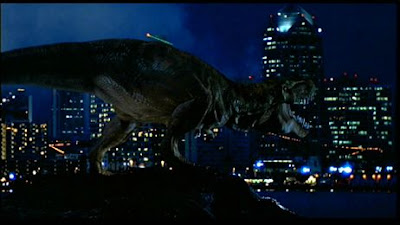
"Now to find Jack Horner's house..."
And that’s another thing; the deaths here (and there are a lot of them) are almost all a lot meaner than the ones in the first film. There’s more vitriol, more “take that!” than we had last time, compounded by the fact that, with one exception (Roland’s asshole second-in-command, Dieter, played by Peter Stormare), all the characters who die here are basically ordinary people just doing their jobs. In contrast, consider the deaths in the first film; Nedry and Gennaro both at least crossed a moral line and so their horrific deaths could be said to represent a kind of ‘poetic justice.’ And while Muldoon and Mr. Arnold didn’t do anything wrong, they were both killed by the velociraptors: the ‘villain’ dinosaurs. Now, there really aren’t any ‘villain’ dinosaurs this time around; we’re still supposed to root for the T-Rex. This makes the fact that the dinos slaughter people by the dozen, usually in long, drawn-out ways, a lot more, well, uncomfortable than the deaths in the first film. Eddie’s death is a particularly dramatic example of this; it lasts a good minute or so, is especially gruesome, it’s directed against one of the most decent guys in the film, and it happens at the, er, hands of the dinosaur we’re supposed to ‘like.’ It’s practically a guide on how not to do a monster movie encapsulated in one scene.
Even the dinosaurs have lost some of their bite (sorry). The velociraptors are reduced to practically a cameo and none of the herbivores come close to the grandeur of the brachiosaurus. The Tyrannosaurs are front and center almost the whole time, but despite (or perhaps because of) a jacked-up body-count they never create the same impact as the one from the first film.
Let me explain: in the first film, when the Tyrannosaurus knocked over a car it seemed to take her some effort. She had to hit it a couple times before it flipped. Here, the Tyrannosaurs introduce themselves by sending an armored jeep flying with, apparently, a single blow. Do you see the problem? In the first film, we never doubted that the Tyrannosaur could do what she does, in part because we saw that it took some doing. She was believably powerful because the car was believably heavy. Here, where cars go flying when the T-Rex nudges them with his foot (seriously, that’s not an exaggeration; it happens), all we see is a bunch of CGI. It’s a similar dynamic to the fact that the stunts in classic Jackie Chan movies are much more impressive than the ones in, say, The Matrix because we believe that they could actually be done.
The only new dinosaurs who come close to having the impact that the ones in the first film did are, ironically enough, the tiny procompsognathus (‘compies’). They succeed due to the fact that they seem so cute and harmless, being about the size of a chicken and squeaking and chirping like birds. Then, before you know it, you’re being swarmed by dozens of them at once, like piranha. They’re genuinely unsettling creatures and, consequently, a film highlight. 
This is where the "please do not feed the dinosaurs" sign really comes in handy
There are really only two characters with any real meat to them: Jeff Goldblum provides a small window of likeability, relying on the audience good-will he has left over from the previous film. The fact that Malcolm is the only one who seems even remotely aware of how dangerous this whole thing is and keeps frantically trying to warn the others (especially Sarah) to take the damn dinosaurs seriously earns him a lot of audience surrogate points, enough that we are willing to overlook his tacit consent to the, you know, negligent homicide. I also like an early (and easily missed) line of his in which he angrily tells Ludlow that "There are no 'versions' of the truth!"
On the other hand, Malcolm has undoubtedly lost his edge. He’s no longer a ‘rock-star’ mathematician, swaggering around and lording his intelligence over everyone else. He’s…well, pretty much just Jeff Goldblum; he might as well have been reprising his role from Independence Day, the unique features of his character from the first movie almost all gone. I mentioned in the previous film that Malcolm acted as though he thought he was the hero. Here he actually is the hero, but doesn’t seem aware of it. Malcolm doesn’t mention Chaos Theory once, and only mentions mathematics or science at all a couple times in passing. Pretty much all he does is snark and try to get the idiots he’s saddled with to understand the situation they’re in. Granted, it’s reasonable that Malcolm would be considerably subdued by the events of the first film (and there are some fairly well-done allusions to that idea without making it specific), but if you’re going to strip so much of the character away, why bother bringing him back in the first place?
The other enjoyable character is Pete Posthlethwaite’s Roland, a classic aging Great White Hunter who is bored with hunting, feels out-of-step with the modern world, and has pretty well resigned himself to a quiet retirement until he is met with the prospect of one final hunt pitting his skills against “the greatest predator who ever lived:” Tyrannosaurus. Posthlethwaite is sadly underwritten, and a key establishing scene was unfortunately left on the cutting room floor (possibly because the scene – which featured him beating up some tourists for harassing a waitress – would have had him overshadowing the ‘hero’ characters even more than he does), but he plays the role so well that we immediately understand this man and are invested in his story. That, of course, makes it all the more frustrating that we don’t get to see more of it. There are a lot of themes that could be drawn on here: contrast of old-school men with modern businessmen like Ludlow, the grandeur and folly of great achievements, parallels between Roland the outdated hunter and the Tyrannosaurus itself, etc. But Spielberg isn’t really interested in making any of them. He doesn’t seem to know what to do with Roland except have him acting cool all the time. Here he has a great actor in a role that could have an honest-to-goodness poetry to it, and he’s content to simply have him hang around in the background.
This points to an interesting facet about Spielberg; that he seems to have lost his ability to make movies like this. The younger Spielberg made perhaps the greatest monster movie of all time (Jaws), the greatest adventure movie of all time (Raiders of the Lost Ark), and one of the greatest science fiction movies of all time (Close Encounters). These movies – along with his other masterpieces like E.T. and the first Jurassic Park evinced an enthusiasm, a delight in the material, a sense that he was having just as much fun as anyone else, that The Lost World does not. It seems as though Spielberg were, well, tired of this kind of movie, or was just going through the motions trying to recapture something he had lost. Perhaps it had something to do with the fact that, in the meantime, he had made Schindler’s List and had simply lost his taste for adventure films. His later efforts in that direction – i.e. War of the Worlds, Kingdom of the Crystal Skull – have all been middling, sloppy efforts at best that tell me his heart wasn’t in them (the only time he seems to have been having any fun recently was the lighthearted Catch Me If You Can). For better and for worse, Spielberg had made the transition into a ‘serious’ director and now there was no going back.
In short, The Lost World: Jurassic Park is not a good movie. It could have been a good movie. It had all the elements in place for a good movie: talented actors, a great director, masterful special effects, dinosaurs, etc. But the apathy on the part of the writers and director are palpable, in depressing contrast to the enthusiasm that was so evident in the first film, and leaves us with a pile of wasted possibilities strung together with poor writing.  

Final Rating: 2/5. The still-spectacular visuals and talented cast might make it worth seeing, if you can stomach the bad writing and mostly horrible characters. 

"See y'ah next time, folks!"

Saturday, March 9, 2013

Reviews: Oz the Great and Powerful


            If you must do a prequel to The Wizard of Oz, the Wizard himself is the obvious starting point. How did he get to Oz? How did he manage to convince the people of Oz that he was indeed their wizard? How do the witches of Oz figure in, if at all? Most importantly, is he actually, as he claims to be, a "very good man, just a very bad wizard?"
            Sam Raimi’s Oz the Great and Powerful is an uneven, but fairly satisfying attempt to answer these questions. It gets a lot right, though it also fumbles a number of crucial elements rather badly.
            In turn-of-the-century Kansas, small-time magician/inventor Oscar Diggs (James Franco) performs in a travelling carnival, styling himself as “The Great and Power Oz.” He’s, to put it nicely, a shallow, opportunistic jerk. He casually flirts with/seduces his assistants (whom it’s implied he basically just picks up off the street), is callously unfeeling towards his long-suffering partner, Frank (Zach Braff), whom he explicitly tells “we are not friends,” and grumbles about how his talents are wasted in a cheap outfit like this. The only person he isn’t a jerk towards is Annie (Michelle Williams): a sweet Kansas girl whom he honestly cares about…enough that when she tells him another man proposed to her, he recommends she accept.
            Then, following an unfortunate collection of events involving the circus strongman, a hot air balloon, and a tornado, Oz unexpectedly finds himself in a strange, dream-like land which shares his name. Not only that, but he’s informed by the beautiful witch Theodora (Mila Kunis) that she and her sister, Evanora (Rachel Weisz) intend to make him the king of Oz…at least, as soon as he slays the wicked witch.
            You see, Oz refrained from informing Theodora that he’s not actually a wizard, and a few slight-of-hand tricks manages to convince her. Evanora, however, is less impressed and hatches the idea to ‘test’ him by sending him to slay the wicked witch, Glinda (also played by Michelle Williams), who murdered the old king and now holds the whole of Oz in her terror.
            Along the way, he picks up a couple friends: there’s Finley, the flying monkey (voiced by Zach Braff), who becomes his assistant and confidant. Later they’re joined by the small, fragile China Girl (Joey King in the film’s best performance). And, unless you have absolutely no knowledge of the original film or American culture in general, you can probably guess that he finds Glinda to be not so wicked after all.
            The film’s greatest strength is its visuals, which are breathtaking. Raimi imitates the original by having the opening act in Kansas filmed in sephia tone, before switching to color for the Oz scenes, making our first glimpse of Ozian flora and fauna all the more incredible. There’s a wonderfully dream-like quality to the imagery that fits well with the word of Oz; huge flowers ring like bells, flocks of hummingbirds in the shape of fish dive in and out of the water, emerald-flowers open up to reveal ruby petals. Moreover, Raimi doesn’t simply deploy all his visual artistry upfront, but throws ever more unique and arresting sights at us throughout the film.
            As a filmmaker, Raimi excels at imaginative conceits and unexpected images, which makes him a excellent choice for the world of Oz. He also has a very sly sense of humor which is evident throughout, such as the scene where one character asks another in all sincerity “So just because she jumped off a cliff that means you will too?!” Or an impromptu planning session that might have come straight from Army of Darkness.
Raimi and his fellow writers do a pretty good job of meshing their film with the one everyone remembers and loves. The Emerald City and Yellow Brick Road especially are just as we remember them (except we get to see more of them). Glinda’s bubble gets a well-conceived CGI update, as does the Wicked Witch of the West’s fiery entrance and smoking broomstick, and the Flying Monkeys return in a spectacular and nightmarish fashion. Then there are a bunch of unspoken little nods to the original; my favorite of which is an unacknowledged cameo by, of all things, the horse of a different color. Dorothy herself, meanwhile, receives a subtle and emotionally resonant allusion in a touching early scene.
            One of the nice things about these references is that for the most part they actually revolve less around repeating scenarios or lines of dialogue and more around trying to capture tones or expanding on specific elements. For instance, the scene where the heroes venture into the “dark forest” is clearly a nod to the “I do believe in spooks” bit in the original, but none of the characters ever actually says the line, or any other one of the classic lines. Instead, they go about it more subtly by trying to recapture the type of humor used in the original scenes (“Ah! Something’s got my tail!””). Contrast this with the clumsy, forced repetitions in, say, the Star Wars prequels. 
As for laying the foundations of the classic story, the results are more mixed. Oz’s character arch is fine, if somewhat unoriginal and predictable. In particular, the manner in which he becomes the smoke-and-flame wizard that Dorothy and her friends meet is done almost perfectly, making for a spectacular climactic declaration of himself as “The Wizard of Oz!”
On the other end of the spectrum, the sequence of events that leads to Theodora becoming the Wicked Witch of the West is a disappointment. That it’s much better than the scenario envisioned in Wicked goes without saying, but it still feels cheap and shallow. Part of the problem is that Mila Kunis simply doesn’t have anything like the gravitas of Margaret Hamilton, especially in her early scenes, where she comes across as nothing more than a naïve teenager. She’s a little better once she becomes the wicked witch, but she never comes close to the iconic figure Hamilton created in the original. Remember how you spent all of the Star Wars prequels thinking “this tool became Darth Vader?” It’s a little like that. 
There are, however, a number of interesting and fairly exciting ‘seeds’ planted throughout the story. That is, small details that foreshadow or point to events in the original. The best of these is the way the film wordlessly establishes just what the Ruby Slippers did and why the Witch of the West was so keen on getting them (though the slippers themselves don’t appear in the film).  
            James Franco does his best as Oz, but honestly I think he was miscast. Franco is one of those actors who is almost incapable of seeming like he’s from anything but his own time, and his Oz never acts or talks like someone from the 1900s (actually, the overly modern dialogue is a problem throughout. It’s less of a problem in Oz, which is a fantasy world, but it’s jarring in the Kansas sequence and whenever Franco opens his mouth). Also, he’s never as charismatic or charming as he needs to be until the very end, meaning the fact that he’s able to smooth-talk Theodora into believing him comes off more as an indictment of her intelligence than an example of his showmanship. Once you get passed that, however, he does a fair job as the swindler who isn’t quite as bad as he thinks himself. His best moments are when he finds himself actually being a good guy, where he manages to project some real emotion. His scenes with the China Girl are the best, but he also has a great early moment when, during his Kansas magic show, a wheelchair-bound girl begs him to use his magic to heal her.
            Michelle Williams isn’t the regal figure I remember from the original, but that can be excused by the fact that she’s a much younger version of the character. I like the fact that she’s allowed to be honestly sweet and good, rather than being turned into a snarking tough-girl or something. She and Franco have some chemistry, though their relationship doesn’t really jell as much as it probably should. There’s not a whole lot of reason for Glinda to trust Oz, except that he’s there and he’s “the only wizard they have.” While the actual sentiment is rather nicely done, it doesn’t make Glinda look as wise or in control as she probably should. She does, however, get to show a stronger side of her character in a climactic duel (which almost makes up for her playing damsel in distress not long before. Almost).
            Rachel Weisz actually gives one of the film’s standout performances as Evanora, the future Wicked Witch of the East. With the Witch of the West still a work in progress, she serves as the chief villain of the picture (though there are hints that the Witch of the West is both stronger and wickeder than she is). It’s fitting that the Witch of the East gets her due, and she makes for a formidable villain. Weisz plays her wickedness with great gusto and seems to be having the most fun of pretty much anyone in the cast.
            I already talked about Mila Kunis, but I would like to reiterate that she does improve upon becoming the Wicked Witch. While nowhere near Margaret Hamilton’s level, she at least manages to project an insane cruelty that contrasts nicely with Weisz’s more restrained, manipulative evil.
            The best character and performance in the movie comes courtesy of Joey King as the China Girl. She’s both sweetly tragic and honestly adorable, and it isn’t long before she has Oz wrapped around her little china finger. Most of the heart that is in the film comes courtesy of her, and she’s the key figure that makes Oz’s transformation believable. Plus, she gets some of the best lines in the movie (“now bring forth the covers” she commands as Oz tucks her in during a particularly sweet scene). The circumstances the lead to her joining forces with Oz, meanwhile, are an almost textbook way of establishing how evil the Wicked Witch of the East is without making the movie too grim or frightening for children.
            Zach Braff also contributes a lot of heart (and humor) as Finley, who ends up being Oz’s (semi-reluctant) sidekick. Their relationship’s growth into genuine friendship is another major part of the reason why the story arch works as well as it does. Moreover, Finley gets any number of great lines, especially in his reaction to being told that Oz isn’t actually a wizard…and his subsequent attempt to pretend otherwise.
            Outside of these characters, there is also Bill Cobbs as the “Master Tinker,” who doesn’t really stand out as a character, but provides some much needed support at a crucial juncture, and Tony Cox as the Munchkin Knuck, who frankly feels much too much like just Tony Cox wandering around Oz. Fortunately, he doesn’t have too much screen time (and it must be said, he becomes less obnoxious as the film approaches its climax). And of course, Bruce Campbell has his inevitable cameo, unrecognizable in Winky get-up. Fittingly for a Sam Raimi film, he gets gratuitously smacked around throughout his scene.
            Obviously, we all have some idea of how the story’s going to end up. Raimi, typically, throws us some nifty curveballs along the way. For instance, at one point, one famous element of the wizard’s persona seems to be set into place, but then the film suddenly veers in another direction. Also, the precise sequence of events that leads to Oz ending up in that balloon and being swept into that twister are both clever and a nice foreshadowing of future events.
            Regarding that balloon ride, Raimi’s most interesting and exciting conceit might be the fact that the trip to Oz is explicitly the result of a desperate prayer. This, combined with later comments about how the wizard was clearly meant to end up in Oz lends the adventure a surprising sense of Grace and divine providence. Both Oz the man and Oz the land are set on the path to redemption at the same moment and find it at the same time, and there’s a definite sense that some benevolent force is behind these events.
            Actually, Raimi manages a couple of fairly well-conceived Biblical references throughout, including a Garden of Eden shout-out during the Witch of the West’s transformation, and even a kind of “death and resurrection” arch for its hero. It’s not much, but I appreciated it all the same. He also includes a nifty shout-out to Thomas Edison, Oz’s hero and inspiration, which is kind of wonderful in its paean to invention and creativity. 
            Other themes are much less interesting; consisting mostly of generic nonsense about ‘belief’ and “if you believe, anything is possible.” There is also, however, a nice counterpointing of goodness and greatness which doesn’t come in much, but pays off nicely.
            I’m also impressed that the movie managed to be an epic adventure fantasy with a big climactic battle...in which no one gets killed. Glinda explicitly says that the Ozmites won’t kill, even in battle, and the movie, surprisingly enough, honors that. Of course, it would have been horrifying to feature a blood-soaked climax to an Oz movie, and this forces both the characters and the filmmakers to be rather more elegant about the whole thing (it’s also kind of amusing to have a Sam Raimi movie which specifically declares itself blood-free).
            I’ve already mentioned most of the film’s flaws: miscasting, jarringly modern dialogue, and a limp backstory for the Wicked Witch of the West. There's also a few plot holes, including a bizarre moment where Oz packs up to leave, and no one (including him) seems bothered by the question of where exactly he intends to go.
              On the whole, though, Oz the Great and Powerful is an inventive, delightful, and thrilling adventure story. It manages to both honor one of the great films of cinema and have a quirky character all to its own. As a fan of the original, I found this a mostly-satisfying and take on the untold story of the Wizard, and the wit, heart, and creativity throughout make it a worthwhile experience.  

Final Rating: 3.5/5. Despite miscasting and some ill-conceived writing, the striking visuals, sweet characters, and nostalgic references make it well worth seeing.