Showing posts with label Movies. Show all posts

Saturday, October 19, 2013

Mst3k – 310: Fugitive Alien

*Somewhere along the line I messed up the episode order: Amazing Colossal Man was actually episode 309.

                  So, yeah; after another very long delay, we’re back. I’m not going to even attempt to guess whether we’ll continue regularly now.
                  Anyway, Fugitive Alien. A super-human “Wolf Raider” named Ken defects from his evil alien overlord (read: they wear wigs and slightly different makeup) during an attack on Earth, killing his best friend in the process. Trapped on Earth, he joins up with the crew of “Earth’s oldest spaceship: the Bacchus 3.” They then have some unconnected adventures on a faux-Arabian-knights planet and Ken ends up killing his old girlfriend as well. Then the movie ends.
                  Like Time of the Apes this was actually a short-lived Japanese TV show stitched together as a single movie. For what it’s worth, the stitching is much better here, as characters don’t simply teleport around the countryside and plotlines have actual set-ups and conclusions. It’s episodic, but not fever-dream-esque.
                  Actually, this might be considered one of the better Sandy Frank-Japanese flicks they viewed; the special effects are at least decent at times (not always, but sometimes), the characters are generally well distinguished and likeable, and there’s some effort to elicit genuine emotional conflict among them. It’s all cheesy, poorly dubbed, and goofy as all-get-out but at least you feel like they were trying to make a real movie here.
                  Riffwise, it’s mostly amusing, with only a few real laugh-out-loud moments. Jokes on the goofiness of the plot and the bombastic music are fun, and the guys get a lot of humor out of the different characters (though that will really take off when they do the sequel). Host segments likewise are generally entertaining, with the highlight being Mike’s first appearance as the Brains’ version of Jack Perkins, a character that will recur a number of times later on (in an increasingly off-the-rails fashion) and is always hilarious. All in all, a solid, if unspectacular episode.

Opening: Joel is pretending to be a dairy farmer from Southern Wisconsin. The bots are farm animals. It’s surreally funny, especially Crow as a chicken (some great puppetry from Trace) and Servo (“Help us!”)

Invention Exchange: The Mads have a combination of all ear, nose and throat drops you’ll ever need (Frank nearly drowns). Joel has the musical chair: a chair that doubles as a Xylophone (something you could actually see someone making). They’re both pretty amusing. Then Jack Perkins (played by Mike Nelson in some really well-done make-up). Mike’s hilarious!

Crow: “Sandy Frank presents our own personal hell!”

(on the title)
Joel: “Starring David Jansen of Mars in the hunt for the one armed alien.”

Crow: “Originally produced for the stage by the royal Shakespeare Company.”

And we open with some spaceships attacking a city.

I have to say, for a cheap Japanese TV show, the effects of this sequence aren’t bad.

Villain: “Raiders…attack!”
Servo: “Uh, we’ve already started, sir.”

Joel (on the villain): “It’s Heckraiser!”

And the alien raiders start…stealing jewelry in between shooting people and doing summersaults. This in response to orders to “destroy the Earth and its inhabitants.” Okay…

We meet Ken, one of the aliens (he will be our titular fugitive). He’s the only one not wearing clown-white. Some dialogue establishes that he is superhumanly strong even for an alien.

Joel: “It’s an intriguing mix of genocide and modern dance.”

Servo: “When Josie and the Pussycats go bad.”

And a little kid shows up with a toy gun. He’s also named Ken, so Ken has an attack of conscience (by the way, should the kid really be unaware that there’s a war going on?).

Joel: “Planet of the Kens.”

Ken’s friend is shouting at him to kill the kid, then runs forward to do it himself.

Ken stops his friend, accidentally kills him. The other aliens attack him.
Crow: “You’re a disgrace to all Kens!”

Servo kisses the villain!

Ken gets back to his spaceship…

Servo (on Ken’s erratic steering): “Woah, gotta get that steering column fixed.”

Ken: “I’ll get [home] if it’s the last thing I do!”
Servo: “Probably will be.”

The effects, by the way, are really bad in these scenes: the ships are transparent, and the ‘str field’ looks like a magnified sneeze.

All (on the chorale music): “MONKS! IN! SPACE!”

Ken bails out. In space. Basically by putting on his space suit and walking out the door. No word on what he was planning to do next in the void of space.
Servo: “Some people will do anything to get to Mass on Holy Thursday.”

We meet the crew of an Earth spaceship: the Bacchus III. They pick up Ken by going out into space to retrieve him.

Servo makes a reference to ‘Marooned,” which they’ll view next season.

(as one of the astronauts makes contact with Ken)
Servo: click “Uh, Dr. Livingston I presume.”

They note that Ken was out without a space-suite, when he clearly had one.

Ken starts attacking the crew.

Ken (thinking): “Can’t afford to lose control…”
Crow: “What do you call that, then?”

Ken claims to be an astronomer.

By the way, they talk about Ken’s ‘strength’ when Captain Joe has just subdued him and is currently holding him down with little effort.

And the ship is attacked by the ‘Wolf Raiders’

First Host Segment: Crow and Servo make some hair-helmets like in the movie. Mildly amusing, especially Dr. F, Frank, and Jack Perkins in Deep 13 joining in.

Back in the movie, Ken assumes control of the spaceship and evades the Wolf Raiders.

Crow: “Well, we can’t fight ‘em, but we can confuse the heck out of them.”

Obvious rip-off of Empire Strikes Back where Ken flies into an asteroid field.

Captain Joe lays Ken out for hitting Rocky (shortly before noting that Ken is ‘ten times’ stronger than they are).

Back on Earth, the crew hears about the attack (Ken is still unconscious: how hard did Captain Joe hit him?)

Oh, Rocky gave him a tranquilizer.

Captain Joe runs to the hospital, finds wife and daughter dead. Actually kind of affecting scene.

On the way in, they interpret every time he stops to talk to a nurse as him asking for dates.

Shock-zoom on a pendant:
Servo: “The Geometric Nucleus!”

Crow: “I’ll just rifle the dead’s stuff here…”

Wife: “Where’s Maryann?”
Crow: “Dead-uh-d-downstairs.”

And Ken wakes up and basically just murders his doctor before making his break through the roof, then through a forest, across some dunes…and I guess into a dump or something.

Then he spots a spaceport and decides to highjack one of the ships.

He sneaks into the Bacchus III, but finds Captain Joe waiting for him.

Captain Joe disarms Ken with the old “check if it’s loaded” trick, then chews him out for being a Wolf Raider.

Joe: “My wife just died in my arms!”
Crow: “Hey, you were way over by the window!”

Joe: “What have you got to say?”
Servo: “Uh, oops? I’m sorry?”

Ken recounts the story of the beginning of the film (yeah, the thing we saw less than twenty minutes ago).

Joe: “I never keep any bullets in my gun.”
Crow: “Like Barney Fife!”

 So, Joe and Ken relax with a cigar, and Joe offers Ken a job on the Bacchus III.

Odd moment where Joe laughs maniacally before yelling “You’re stuck here!”

Then we cut back to the evil alien planet, with a narrator filling us in on what we’re looking at.

And Ken’s blond girlfriend Rita shows up (she was the sister of the guy Ken killed).

Villain: “He’s a coward and a traitor!”
Servo: “I forbid you to see him!”

Villain: “It is a law on Valna Star that the murderer must be killed by the victim’s next of kin.”
Servo: “No offense, oh wise one, but can I see the book on that rule?”

And Rita suddenly starts wandering a desert landscape.

Cut back to Earth, where Joe is in conference about aiding their allies on Kararu.

And they run through the crew: Rocky, Dan, Tammy, Billy, and Ken.

Cut to Ken running through a field. The camera flips upside down:
Servo: “Ah, I’m in China! I’m in China! Oh.”

Ken flashes back to frolicking with Rita…in the desert. What’s the deal with these people and deserts?

Second Host Segment: Crow and Servo are dressed up as the crew members, while Joel is Captain Joe, complete with mustache. Joel gets really into it, Crow and Servo can’t get into it. It’s mildly amusing.

Back in the movie, Ken runs into Tammy.

Tammy: “You looked so angry, I was afraid I was gonna get strangled.”
Servo: “Still time for that.”

Tammy tries to make small talk, Ken yells at her and she storms off.

The crew are receiving a briefing, Tammy makes a quip about Captain Joe needing whiskey for excitement.

They aren’t happy about having Ken along, but agree to trust Joe.

As the ship is prepared for the mission, inexplicably goofy music plays.
Servo: “What, are Ma and Pa Kettle going on this mission?”

Later that night, Ken is wandering around the hanger, brooding in voice-over.

Rocky attacks Ken with a forklift!
Crow: “Eat fork, buddy!”

Ken holds the machine off with his bare hands. I’m sorry, if he can do that, there’s no way Captain Joe could’ve laid him out with one punch.

Rocky mentions that he did it because he suspected Ken was a Wolf Raider. So, what would have happened if he was wrong?!

And here we get the first instance of the now-famous “He tried to kill me with a Forklift!” song.

So, after Rocky saw Ken push a forklift back with his bare hands, he picks a fight with him! How stupid is this guy?!

Captain Joe apparently thinks it’s a good strategy to lie openly and transparently to his crew. Great leader.

Kind of cool: the hanger moves instead of the ship.

Captain Joe visits his family’s grave, Servo does a ‘Scrooge’ line.

Ken spies on him

This is another actually kind of affecting scene.

Cut to them having dinner.
Crow: “Hey, they’re having a jumpsuit party, and his is the grandest of all!”

Rocky rejoins the crew (I…guess he left earlier):
Dan: “You old space mug!”
Crow: “You pile of space crap!”

Servo inexplicably goes into a long-winded Disney Copyright joke.

Goofy bit where Captain Joe tests some new equipment, causing the crew’s faces to distort.

And they immediately land on another planet.

Captain Joe looks directly into the low-angle camera:
Servo: “Hey, trouser cam! Hi there.”

Some humorless guards greet them, instruct everyone to stay on board except Captain Joe and one other crew member. So the immediately try to leave.

Anyway, Joe and Rocky ride in on a jeep (perfectly ordinary jeep) to the local palace.

Ken randomly decides to leave. Billy and Dan try to go out too, but Tammy pulls a gun on them! Go Tammy; these are awful soldiers!
Servo: “She’s management material.”

Ken stops jumping and playing around in the desert, up to and including making ‘bang-bang!’ noises while pretending to shoot things.

Back in the palace, we get an actually pretty good line from the movie itself:
Guard: “His Excellency will be with you shortly.”
Rocky: “I believe you said that two hours ago.”

Anyway, the vaguely sultan-like Lord Odenga shows up at last.

Servo (as Odenga): “Now bring me some pudding.”

And Ken wanders into a Bazaar. He doesn’t exactly blend with his shiny pleather jumpsuit.

He wanders around a bit, swipes some fruit, and walks into a bar.

Joel (noting the stainglass windows): “Totally new concept; it’s a church bar!”

Drunk Guard (stumbling over to Ken): “Boy, I don’t like your face.”
Joel: “I’m not a big fan either, sir.”

The guard offers Ken a drink:
Servo: “I’d rather share a needle with Keith Richards.”

The guards start beating up Ken, who snaps and beats them up in a slapstick manner.

And he kills one of them! Nice going Ken!

So Ken runs out, acting as suspicious as possible and accosting a random person into helping him. Besides, as noted, he kind of stands out.

And Ken gets caught.

Joel (as Odenga): “I tire of pudding; bring me something salty and sweet.”

Ken ends up in jail, scheduled for execution.

By the way, apparently it’s easier to push a moving forklift back with your bare hands than to bend metal bars.

So, Ken resorts to the old trick of hiding in the ceiling to make the cell look empty. The sad thing is that the guard almost falls for it (until he spots Ken’s shoe).

Rocky: “I think we should get rid of Ken.”
Servo: “Which one?”

Ken turns out to have a small radio on his shoulder that he didn’t know about, but which lets Captain Joe communicate with him.

Captain Joe wants Ken to break out an enemy officer so they can grill him for information.
Ken: “Why don’t you just ask the authorities to release us?”
Crow: “Oh, yeah? If you’re so smart, why are you in jail?”

Servo: “I’m sure the other prisoners haven’t heard a word of this.”

A guard goes by, Ken pretends to be asleep:
Servo: “Honk-shoo, honk-shoo, I’m just sleeping…”

Joe: “Your right shoulder button is a miniature nuclear device.”
Joel: “Should I have known that?”

Third Host Segment: Trying to figure out the screenplay. Joel explains that the ‘movie’ is actually just a series of TV episodes strung together. Crow wins by predicting that the film will continue as the impenetrable mess that it is. The Mads and Jack Perkins can’t figure it out either.

Back in the movie, Ken is working on his escape with his ‘miniature nuclear device’ (a firecracker).

Ken beats up and possibly kills a guard on his way out.

He finds the enemy officer, invites him to escape with him, he accepts.

For some reason, the bomb doesn’t work this time, so Ken tries again.
Crow (nervously): “Ah, some locks are…two-bomb locks…heh heh…”

Out of their cells, Ken ambushes and beats up a couple more guards, then shoots a few more (by the way, aren’t these supposed to be their allies, and Ken’s only in here because of his own stupidity?)

Anyway, they escape and pause to drink from a stream, then more guards show up and fire on them.

Ken uses another one of his button bombs, which explodes like a grenade (!).
Crow: “You’ve just gotta be sure to take them off before you do your laundry.”

Ken gets knocked out in the explosion, wakes up to find his girlfriend (who’s charged with killing him, remember), tending his injuries.

Rita says that she received a ‘radio message’ that Ken had escaped from a Kararu prison. Wait, I thought they just escaped about a minute ago!

Ken tries to clear his name with Rita by flashing back to the beginning. She claims he still deserves death, so he tells her to go ahead and do it.
Crow: “But first swallow my lapel button as, uh, a symbol of our love.”

She can’t do it.

They use the “Rita Meter Maid” every time her name is said.

Crow: “Uh, you’re crying on my bomb.”

They have a heartfelt talk, where Ken says they won’t work together and again tells her to kill him (jeeze, what a jerk).

Then, suddenly, Ken jumps up and pulls a gun. Turns out he’s shooting at some guards behind her, but she gets hit anyway and dies blaming him (oh, come on!).

The enemy officer shows up (where the heck was he all this time?!).

Cut to them climbing a slope, the officer collapses randomly and calls for help.
Servo: “Next time on ‘Twin Peaks’”

At the top they spot the Bacchus III, Ken hails it. They make gun-sounds.

Captain Joe: “I knew he could do it!”
Servo: “Break out the liquor…oh, I drank it all.”

And they all take off together. Ken gazes morosely at Rita’s neckless, then:
To be continued
Servo: “NOOOOO!!”

Final Host Segment: Joel shows off his new super-buttons. The Bots are wearing their chicken costumes again. They read a letter: an answer to the ‘cool thing’ contest from “Lost Continent.” Turns out it actually was Mexican stoplight candy.
In Deep 13, the Mads are genetically altering Jack Perkins. Frank presses the button a little early and they keep going over a blank screen.

Stinger: “AhhahahahaYOU’RE STUCK HERE!”
Perfect.

Movie Quality Rating:
1.      Godzilla vs. the Sea Monster
2.      The Crawling Eye
3.      The Black Scorpion
4.       Gamera vs. Barugon
5.      Mad Monster
6.       Lost Continent
7.       Gamera
8.       The Amazing Colossal Man
9.       Gamera vs. Gyaos
10.    First Spaceship to Venus
11.   Stranded in Space
12.    Rocketship XM
13.    Moon Zero Two
14.   Godzilla vs. Megalon
15.   The Crawling Hand
16.    Catalina Caper
17.   Daddy-O
18.   King Dinosaur
19.   Jungle Goddess
20.   Wild Rebels
21.   The Corpse Vanishes
22.   Fugitive Alien
23.   Ring of Terror
24.   Untamed Youth
25.   The Slime People
26.    Project Moonbase
27.   The Sidehackers
28.    Women of the Prehistoric Planet
29.   Robot vs. The Aztec Mummy
30.   Cave Dwellers
31.    Time of the Apes
32.   Pod People
33.   Hellcats
34.   Rocket Attack USA
35.   Robot Holocaust
36.   Robot Monster

Final Rating: 7/10. Good, solid, journeyman-like episode with some great host-segments.

Friday, July 19, 2013

Reviews: Pacific Rim


Pacific Rim is the most fun I’ve had at the movies since The Avengers. It is one of those rare films that knows exactly what it’s supposed to do and is committed to doing it. There’s nothing deep or important about it; it’s just a story about giant monsters fighting giant robots, and that’s enough.
The story: in the near future, a rift opens deep in the Pacific ocean, bringing forth gigantic creatures dubbed kaiju, who begin ravaging cities along the Pacific coast. In response, humanity creates enormous machines called Jaegers (German for ‘hunter’), piloted by two humans via a mind-melding technique called “drifting.” At first the Jaegers are successful enough that people stop taking the kaiju seriously, but then new and more powerful kaiju begin appearing and the Jaegers suddenly become outclassed, causing the world governments to abandon the program and pour their resources into a giant wall project. The story proper begins when Marshall Stacker Pentecost (Idris Elba) recruits retired Jaeger pilot Raleigh (Charlie Hunnam) to join a last-ditch effort to end the kaiju threat once and for all.
After a seemingly endless series of grim, self-important blockbusters all trying to be as ‘realistic’ and serious as possible (Man of Steel, Iron Man 3, etc.), Pacific Rim is unabashedly out to entertain. Director Guillermo Del Toro knows perfectly well that no one goes to a movie about giant robots fighting monsters expecting a serious, thoughtful drama about, I don’t know, environmental stewardship, or the military-industrial complex, or race relations, or what have you. They go because they want to see monsters and robots beating the snot out of each other! Del Toro delivers on that promise with a number of epic showdowns, the most notable being a two-on-three battle in Hong Kong featuring such conceits as a Jaeger picking up shipping crates to use as brass-knuckles and swinging a huge ship like a baseball bat, and a kaiju suddenly unveiling wings and flying into the stratosphere. The action is frenetic and occasionally brutal, but all done with a fairly light touch. Despite the PG-13 rating, this might be the most kid-friendly action film of the year; there’s no sex or nudity and very little swearing. Besides, I think all but very young children (especially boys) will love it; it’s the kind of movie that was made for them, which is something we don’t see very often these days.
Mixed in with the spectacular action are a number of very entertaining jokes (Charlie Day and Burn Gorman as the comic-relief scientists are a scream) and some surprisingly old-fashioned heroism. For instance, at one point Raleigh’s jerk-jock rival, Chuck (Robert Kazinsky) crudely insults him and his female co-pilot, Mako (Rinko Kikuchi). Raleigh responds by beating the ever-loving crap out of the guy to force him to apologize to her (remember that scene in Man of Steel that I complained so much about? This is how that scene should have played out!). Yeah, most heroes would beat up the arrogant jock, but how many would do it to make him apologize for insulting a woman? That’s the kind of hero I can really root for! It reminded me of Douglass Fairbanks’s The Mark of Zorro from all the way back in 1922. How many blockbusters remind you of Douglass Fairbanks?
There’re also some nice father-son moments between Chuck and his more pleasant and honorable father, Hercules (Max Martini, and yes, that is his character’s real name), and even an early scene with an unnamed father and his son beach-combing in Alaska conveys a sense of the unassuming masculinity that is so often lacking in today’s films.
There’s even a charmingly understated love-story. Since the pilots share minds and memories, Raleigh and Mako can’t help but grow close to each other. Refreshingly, however, with the fate of the world at stake, they stay focused on the mission and only occasionally address their growing attachment to one another. This also pays off in a few delightful moments, as when Mako catches sight of a shirtless Raleigh through his open door, closes her own in embarrassment…and keeps watching him through the peephole.
In short, Pacific Rim has pretty much everything you might want from a summer blockbuster. That doesn’t mean that it’s perfect, however. In particular, the characters are (with one exception) all pretty flat and unremarkable. They’re pleasant company, but they’re pretty much just types: the hero, the female sidekick, the mentor, the rival, the nerds, etc. You can pretty much predict exactly what’s going to happen to each of them from the moment you meet them. This may have been a conscious choice (let’s face it; sometimes you just want unremarkable ‘type’ characters), but it limits the film nonetheless.
Similarly, the movie takes the time to establish four separate Jaeger crews and set them up as uniquely powerful and talented warriors…and then wipes out two of them in quick succession. I was unpleasantly reminded of a similar dynamic in Alien vs. Predator, where the three Predators were reduced to one within about five minutes of their encountering the Aliens. It’s not as big a problem here (since we’re supposed to understand how dangerous the kaiju have become), but it is kind of annoying.
Pacific Rim reminded me at times of two films I particularly love: Independence Day and The Avengers, but in both cases I’d say it suffers from the comparison. Independence Day, for instance, did a much better job of suggesting a world-wide crisis bringing many disparate people together in a desperate bid for survival. There we had the President, a Marine, a crop-duster, and a cable repairman among the leads. Here we pretty much just have a group of soldiers, some of whom come from different countries, but all of whom have more or less the same goal and background. And, honestly, Charlie Day, Rinko Kikuchi, and even Idris Elba just can’t compete charisma wise with Jeff Goldblum, Will Smith, and Bill Pullman (that, and Pullman got a much better rousing, climactic speech than Elba, whose big speech left me kind of cold).
The Avengers, meanwhile, benefited from a large cast of established characters, all played by immensely charismatic actors reading dialogue from one of the wittiest writers in Hollywood. This meant that the scenes of them just hanging out and bickering were as much fun as the scenes of them fighting an alien invasion. The human scenes in Pacific Rim are pleasant and entertaining enough, but it knows better than to trust them too long without a monster-robot fight.
The monsters themselves, while cool, just didn’t grab me. Maybe I’m spoiled from all the vivid, character-rich kaiju of the Godzilla and Gamera films, but none of these kaiju made much of a lasting impression. The one that comes closest is a giant, acid-spitting bat-creature named Otachi, but she just can’t match the raw power of, say, Gyaos (whom she most closely resembles). In the end the heroes are confronted with a ‘Category Five’ kaiju; the biggest on record. But even it fails to do more than mildly impress, partly because we hardly even get a good look at it.
Anyway, such are the notable flaws I found in Pacific Rim, but none of them amount to anything like a serious problem. It’s not as good as The Avengers or Independence Day, but it is in the same spirit and you might say a worthy companion to both. It’s just good, clean, old-fashioned fun. You remember ‘fun’? That thing that summer action movies were supposed to be before they got all edgy and relevant?
On that subject I should mention the one character I alluded to above who stood out as the most memorable of the cast: a black-market trader called Hannibal Chau (Del Toro veteran Ron Perlman), who is so hammy, so over-the-top badass that he very nearly steals the show. And in a show about monsters fighting robots, that’s saying something. I like Perlman in pretty much anything, and here he’s an absolute scream from the moment he appears to his final (post-credits) bow.
I once read a review of the Ultraman series saying that it was “about as much fun as you’re likely to have legally…and even among illegal pleasures, it rates pretty high.” That’s pretty much what Pacific Rim is like. This is definitely one of the most satisfying film experiences I’ve had this year (at the moment I’d say only Monsters University rivals it): the kind of wonderful, wholehearted movie that comes from a talented group of filmmakers just kicking back and having fun with a subject they love.

Final Rating: 4/5. Not perfect, but the most fun you’ll have this summer, guaranteed.

Wednesday, June 19, 2013

Reviews: Man of Steel


                Zack Snyder’s Man of Steel gets so much right that it makes it that much more frustrating when it fumbles the most basic elements. It’s a frenetic, thrilling exercise in style and outsized-action, but I can’t help feeling that somewhere along the way they missed the point.  
                On the dying planet, Krypton, chief scientist Jor-El (Russell Crowe) sends his infant son, Kal-El (played as an adult by Henry Cavill) to Earth, after downloading the ‘Cortex’ into his DNA and shortly before he (Jor-El) is killed by General Zod (Michael Shannon), the military commander of Krypton who intends to conquer another world to preserve their race. After Krypton explodes, Kal-El’s little ship lands in Kansas, where he’s raised by farmers Jonathan and Martha Kent (Kevin Costner and Diane Lane). Developing god-like powers from Earth’s sunlight, young Clark Kent (as he’s now named) travels the Earth searching for a purpose. Meanwhile, General Zod and his followers have survived Krypton and are searching for Jor-El’s son to continue their plans…
                First, I suppose, we should talk about what the film gets right. It’s marvelously cast: Henry Cavill makes a fine Superman/Clark Kent. He doesn’t redefine the role, like Christopher Reeves did, but he’s certainly a good fit. Even better is Amy Adams as Lois Lane, who is easily the best big-screen version of the character to date (even though her Lois is much less feisty and sarcastic than most depictions). Russell Crowe brings his effortless dignity and sympathy to the role of Jor-El (which here is greatly expanded, more on that below), and Lawrence Fishbourne, despite his reduced screen-time, is an absolutely perfect Perry White. Diane Lane and Kevin Costner are good choices for the Kents, and Christopher Meloni more or less steals the show as the distrustful Colonel Hardy.
                The only cast member I’m not sure of is Michael Shannon as General Zod. His performance varies wildly from hammy over-the-top scenery chewing to cold, calculating menace. How much of that is Shannon’s doing and how much Snyder’s is open for dispute, but I’d say he’s probably the weakest of the main cast. He’s at his worst in the early scenes and improves as the movie goes on.
                On the other hand, taking the character simply as a character, Zod makes an imposing villain, and I applaud the filmmakers for saving Lex Luthor for a possible sequel.
                The action is excellent; just the kind of huge, outsized combat we have always wanted from a Superman movie. Previous films have either been too hampered by technology or by a curiously reluctant script to give Superman his due, but here the filmmakers cut loose and show us just how powerful he and the other Kryptonians really are. Characters fly through the air, smash through skyscrapers, hurl locomotives, and blast each other with eye-beams.
                Some revisions to the classic storyline make sense, especially their decision to drop the much-mocked inability of Lois to recognize Clark because he puts on a pair of glasses. Here they meet before Clark joins the Daily Planet and he doesn’t really try to hide his identity from her. This leads to a nice moment where they talk about why Clark hides his identity and Lois decides to drop her investigation into him and leave him be. I also like the idea of Clark drifting from place to place like David Banner in The Incredible Hulk, though the film doesn’t make of this what it might have (contrast Clark’s rather impersonal interactions with Bruce’s familiar, friendly relationship with his foreman and fellow workers in Letterier’s Hulk). In particular, an interaction with a bullying trucker plays out all wrong and makes Clark out to be much pettier than he ought to be.
                What happens is this (I’m going to describe it in detail because it’s a good sample of how this version goes wrong); Clark’s working as a bus-boy at a diner when he sees a drunk trucker harrassing a waitress. He stands up for her, asking the man to leave, and the trucker gets in his face and dares Clark to make him. Clark responds by turning in his apron and walking away, even after the guy hits him and throws a beer bottle at his head on the way out. Later, the trucker comes out to find his truck smashed and impaled on the logs he was hauling.
                There is so, so much wrong here. First of all, how does destroying the man’s truck an hour later teach him any kind of lesson? Would the man even connect it with his treatment of the waitress? And it gets worse the more you think about it; the man didn’t own that truck or those logs, they were someone else’s property, which he was only employed to transport, and which Clark just destroyed in what appears to be a temper-tantrum. How is destroying something that belongs to an uninvolved third party any morally superior to beating up a lewd bully to defend a woman? Clark can’t be worried about losing his job: he quits. If he’s worried about keeping a low profile, I think a semi-truck impaled by logs is going to attract more attention than a run-of-the-mill bar-fight. Moreover, Clark ought to have the control to beat the guy enough to teach him a lesson without either seriously injuring him or revealing his powers. Any other version of Clark would know which was the right choice without hesitation (heck, the Christopher Reeves version did it even without his powers. He got beaten up for it, but still).
                And that’s the biggest problem here: the framework – set-up, casting, etc. – is great. It’s the details that are wrong. The filmmakers took on one of the most morally-centered and honestly-good superheroes in the world, but it’s pretty obvious they had no clear idea of what an honestly good person would look like. A truly good person, like Clark ought to be, would either have fought the jerk to protect his coworker, or just walked away entirely. One thing he wouldn’t do is take out his anger in an act of petty vandalism. Throughout the film Clark keeps making morally dubious choices; stealing clothes, for instance, or making no effort to move the cataclysmic battles out of populated areas. It doesn’t feel like the filmmakers were consciously trying to compromise him, but that they honestly didn’t stop to consider these factors.
                On that note the character of Jonathan Kent is particularly troublesome. Kevin Costner gives a good performance, and he has some of the most moving scenes in the film (especially when he reveals to Clark his true heritage) while also projecting exactly the kind of honest, simple masculinity that the character requires, but he also has some of the movie’s worst moments as well. I’m sorry, but I cannot accept any version of Jonathan Kent who would suggest that it might be better for Clark to let innocent people die than to reveal his true nature. Or any version of Clark who would follow such advice. Pa Kent’s exit is the film’s nadir and threatens to derail the whole thing.
                Contrast this with Captain America, which also featured an iconic moral hero its center. In that movie Steve Rogers did things like demanding respect for soldiers serving overseas or trying to keep civilians out of harm’s way, even if meant possibly failing in his mission. Clark never does anything like that here; the closest he comes is yelling to people to get inside as he battles the evil Kryptonians. Clark’s still a nice and polite guy, but he’s not the icon of goodness that he needs to be.
                Oddly enough, there is a character here who evinces just the kind of selfless heroics that Clark should; Col. Hardy. I must say, it’s wonderfully refreshing to see a mainstream Hollywood movie – and one in which the military is often at odds with the hero – that presents a prominent soldier character who evinces real heroism, honor, and even chivalry. In one scene, when the Kryptonians come to take Superman to meet with Zod, they unexpectedly demand to take Lois as well. Hardy unhesitatingly steps in front of her and says that’s not happening. When the Kryptonian envoy threatens to tell Zod that the humans aren’t cooperating, Hardy looks her in the eye and says “I don’t care what you tell him.”
                It’s only the first of several times that Hardy shows the kind of courage and moral fiber that Superman, alas, never really gets the chance to. On the one hand that’s to be expected: Hardy’s an ordinary man who can die, Superman is effectively invulnerable, so Hardy has more scope to demonstrate true courage and self-sacrifce. But it doesn’t really help Jor-El’s claim that Superman will be an ideal for humans to strive for when humanity already seems to be producing heroes of at least equal moral caliber. I’m not saying I wanted humanity to be presented more unfavorably, but that Superman needed to be better to create some contrast.  
                I do like that Clark embraces and seems proud of his American heritage. When a high-ranking general asks how he knows Superman won’t act against America’s interests, Clark answers “I’m from Kansas, General; I’m as American as it gets!”
                Though, in light of the rest of film, this assertion falls somewhat flat. Clark’s alienation and sense of not belonging are highlighted so much here that he loses most of his small-town, boy-next-door charm. I don’t mind Clark being bullied at school, or feeling restless and disconnected from normal humans, but those can’t be his only – or even his primary – attributes. Those are the feelings that come out when he’s alone or isolated, or when he has to done the suit and go into action. In normal, everyday life he ought to have more friends, be more outgoing, fit in better. Clark as a complete social-misfit is, to my mind, a terrible misstep. It loses the idea that Clark represents the best of both worlds: Kryptonian power coupled with a small-town American character. Here he keeps the power, but loses the character.
                Compare this displaced, introverted outcast with, say, Christopher Reeves in the original films. Or the animated version, yelling for Ma Kent not to put the star on top of the Christmas tree because “that’s my job!” and lamenting that all the presents are wrapped in lead so he can’t peak. Or even Dean Cain from TV’s Lois and Clark gushing about the Smallville corn-festival. I understand that this is supposed to be a reinterpretation of the character with specific emphases, but, well, there’s good and bad reinterpretations, and this version is, to me, much less interesting and likeable than most. There’s too much alien and not enough human. In short, I think, in the midst of all the style and action and angst and all the rest, they missed the essentials of who their protagonist is.
                On the other hand, the Christological themes of the Superman story are presented here in a respectful and fairly intriguing manner. Pa Kent’s line about Clark having “another father” could, as other critics have pointed out, been said by St. Joseph himself. Early on, during his wandering days, Clark wears a beard that gives him a Christ-like appearance, and at one point he even goes to a priest for advice, his face framed by a depiction of Gethsemane (the priest himself is well-portrayed, especially his deliberate non-reaction to Clark’s confession that he’s the alien everyone’s talking about). Likewise, repeated speeches about Superman being the ‘ideal to strive for,’ being sent to ‘elevate’ humanity, and so forth can’t help but remind one of humanity’s true Savior.
                The expanded back-story of Krypton gives an intriguing critique of ‘designer babies’ and artificial reproduction. Jor-El rightly points out that such things infringe upon the rights and freedom of the children so produced, because it removes their ability to choose their path in life. Here Kal-El is presented as the first natural Kryptonian birth in centuries, something that Zod decries as ‘heresy!’ The pro-life angle, with natural conception and birth contrasted favorably with artificial conception and the evident love and care that Kal-El’s parents have for their infant son, is well-done and much appreciated.
                On Earth, I really liked Diane Lane’s Martha Kent and her relationship with Clark (furthering the Christological resonances, I couldn’t help thinking of Our Lord and His Blessed Mother). There’s a touching scene in which Clark tells her about meeting Jor-El, and she tries to be happy for him, though is clearly saddened by the new complication in their relationship. She also has a great scene where she faces down General Zod himself, which not only showcases her steely courage, but also gives Clark a rare and satisfying opportunity to really go berserk.
                I mentioned some of this before, but I do like that almost all the characters – Ma and Pa Kent, Jor-El, Lois, Perry, Hardy, and even Richard Schiff’s Dr. Hamilton – get opportunities for heroics. One of the complaints of the Superman story is that he’s simply too powerful and the other characters – especially Lois – just have to sit around and wait for him to save the day. On the other hand, here it’s almost the reverse, with Superman nearly getting lost in the sea of heroism and the only thing separating him from anyone else is his powers. There were times when I caught myself wishing for a movie featuring the adventures of Hardy, Hamilton, and Nameless-Cute-Female-Captain without bothering about Superman.
                Regarding Jor-El, his role has been broadly and rather clumsily expanded, either because they wanted to make use of Russell Crowe, or for some other reason. Here Jor-El not only gets action scenes in the opening on Krypton (riding a giant dragon-fly, sword-fighting Zod, etc), but even later, after his death. He even rescues Lois at one point! While I’m the last person to complain about Russell Crowe’s presence, I think this somewhat revisionist decision was a mistake. It further lessens Superman’s impact (what kind of ultimate hero needs his dad to come up with his master plan for him?) and, honestly, just feels kind of silly.
                I’m also not sure how I feel about the style of the film; the repeated artsy close-ups and flashbacks. Non-linear storytelling worked wonderfully in Batman Begins, but I’m not sure if it works here, at least coupled with Snyder’s directorial style. Christopher Nolan shot the flashbacks essentially the same as the rest of the movie. Snyder goes for a dreamy series of extreme close-ups, silent imagery, and haunting music. I’m not a big fan of this type of direction at the best of times, and in a superhero adventure – especially a Superman adventure – it feels jarringly out of place.
                All this makes me wonder whether Zack Snyder, whose films are often more stylish than substantive, was really the right director for a Superman movie. His direction feels too self-indulgent, too consciously artistic for the material, which I think demands a lighter, or at least a different touch. Someone like Jon Favreau, Joe Johnston, Brad Bird, or even Nolan himself would probably have been a better fit.
                Then there’s the fact that the scope of the villain’s threat is so large that I really have to question where a sequel could possibly go. What could Lex Luthor do that would be a larger threat than what Zod does here? How could anything the next movie provides be anything but a let-down without just blowing up the planet? I’m not saying it isn’t possible, but certainly the filmmakers have left themselves a very difficult task if they plan to turn this into a series (which they obviously do).
                Finally, at the very end of the movie, Superman does something that fans of the character will find extremely problematic. The act is arguably both moral and necessary, given the circumstances, but it doesn’t feel apiece with who Superman is and ought to be. Besides, even if (like me) you don’t find what he does morally suspect, you can’t help thinking that Superman really should have been clever and resourceful enough to resolve the situation by some other means.
                I don’t want to sound too negative. Even with all its flaws, Man of Steel is a worthwhile experience, filled with well-executed set-pieces and clever conceits. The sensory overload that Clark – and later Zod – experiences when his powers first begin to manifest is a good example of the thoughtfulness the film put into his powers. I also like the fact that when he first tries flying, he ends up plowing through a mountain. The interrogation room scene, where Superman obligingly goes along with such obviously inadequate measures as hand-cuffs and a one-way mirror, is smartly written, as is the first meeting between Clark and Lois, where he (of course) saves her life, though he has to perform a little cringe-inducing first-aid to do so (Lois seems to have a truly staggering ratio of ‘danger-to-actual-injury’ in most other versions, doesn’t she?). Lois herself is one of the highlights of the movie; driven, courageous, a little foolhardy, but ultimately honest and self-sacrificing. It’s easy to see why Clark is so taken with her (and, traditionalist that I am, I was cheered by the fact that they made Lois a strong, independent woman while still requiring her to be rescued quite a lot).
                But the great Superman movie remains to be made. The first attempts had a perfect Clark Kent/Superman in Christopher Reeves, but were too light and cheesy and hampered by miscasting among the supporting players. This one has a good cast and spectacular action, but is too dark and grim and misses who Clark Kent is and ought to be. Somewhere in between lays the essential Superman adventure. For now, Man of Steel is an entertaining enough attempt, but I’ll take it as a signpost directing future filmmakers to something better.

Final Rating: 3/5. Entertaining and occasionally spectacular, with much-appreciated themes, but fumbles the character and his story at their core.

Tuesday, April 9, 2013

Reviews: Jurassic Park


            As a life-long dinosaur nut, I’ve of course seen Jurassic Park more times than I can count. Yet seeing it on a big screen was a new and wonderful experience. And I’m using ‘wonderful’ in it’s most literal and correct sense; an experience filled with wonder.
            On an island off the coast of Costa Rica, billionaire John Hammond (Richard Attenburough) is creating new kind of ‘biological preserve,’ but when one of the workers is killed during the construction his investors – represented by the oily Donald Gennaro (Martin Ferrero) – threaten to pull funding over safety concerns. To assuage them, he offers to have a team of experts investigate and sign off on the island. To that end he entices paleontologist Alan Grant (Sam Neill) and paleobotanist Ellie Sattler (Laura Dern) to be his experts, while Gennaro brings the eccentric ‘rock star mathematician’ Ian Malcolm (Jeff Goldblum). Shortly after they arrive on the island, Hammond shows his guests the result of his work; a living Brachiosaurus.
            Welcome to Jurassic Park; where dinosaurs rule the Earth.  

             The awed and somewhat unnerved experts set out on a test tour, accompanied by Hammond’s visiting grandchildren, Lex (Ariana Richards) and Tim (Joseph Mazzello), and watched carefully by the park’s head technician, Ray Arnold (Samuel L. Jackson before he was the coolest man in the world) and security chief, Robert Muldoon (Bob Peck). Unbeknownst to any of them, however, Hammond’s lead programmer, Dennis Nedry (Wayne Knight) has done a deal with Hammond’s competitors to steal the dinosaur embryos that very night. But as he puts his plan into action, a tropical storm hits the island…
            Where to begin with Jurassic Park? I suppose, in inversion of my usual format, I’ll begin with the movie’s flaws, which are, unfortunately, many.
            In the first place, as has been noted many times before, there is very little character development in the film. We don’t really learn anything at all about Ellie Sattler, except that she and Alan are dating and that she’s a paleobotanist (though she only talks about plants in a couple scenes, meaning some people in the audience might not even realize what a ‘paleobotanist’ is. I suppose it’s not a subject that comes up much when running from dinosaurs). Alan is only a little better; all we know about him is that he hates children, computers, and trees. Malcolm pretty much exists to utter dire warnings and snark, while the fact that Lex and Tim’s parents are getting divorced is reduced to a single line of dialogue in a scene that they aren’t even in.
            Basically, there’s not really any ‘human’ story going on here; not a lot of growing or changing among the characters. In the end, Alan’s more tolerant towards children, Hammond’s decided not to make any more dinosaur parks, and…that’s about it. Oh, and the less said about Dennis Nedry or Donald Gennaro the better. 
            The only character with any real development is Hammond, who gets a rather touching speech reminiscing about the first attraction he ever made – a flea circus – and how what he had wanted to do with Jurassic Park was to inspire people to wonder at something that was real: “something they could see and touch…an aim not devoid of merit.”
            He’s shown to be a loving family man, both towards his grandchildren and to his daughter (judging by the fleeting reference to her divorce, we can assume he decided to invite the children to take their minds off of it). He also is simultaneously open to and dismissive of dissenting opinions; he invites people to give them, but then he tends to brush them off with a laugh and a smile. Even with the park falling to pieces about him, he still talks about proceeding. It isn’t until he finds himself listening over the phone as the velociraptors attack his friends and family that he finally gives up on his dream.
            He also seems to have an inflated sense of his own people skills. Upon meeting Alan and Ellie, he boasts that he “can tell instantly about people – it’s a gift!” But he also hired the world’s most patently untrustworthy programmer to run his park and brushed off his complaints of low pay and lack of appreciation.
            Which brings us to the other giant flaw in Jurassic Park; the fact that the script so clearly stacks the deck to get the result it wants. There’s really no getting around the fact that Jurassic Park is a disaster waiting to happen; not only is the head programmer obviously the last person you would want in a position of responsibility, but the whole park is bundled into a single huge computer program, meaning that everything from the fences to the phones to the friggin’ door locks to the control room are dependent upon this one system. A system, I might add, that doesn’t even have the memory to run and fix a bug at the same time. I mean, good God! Forget corporate sabotage: didn’t anyone ask what would happen if there was a simple power-outage? Not only that, but the circuit breakers, rather than being kept somewhere easily accessible (the control room, the emergency bunker) are stored deep in a labyrinthine maintenance shed “at the other end of the compound,” with the velociraptor pen conveniently located directly between them and the control room.
            Then there’s the design of the park itself, which has automated cars take people from cage to cage (the doors on the cars don’t even lock, as the film itself points out). Not only is this highly inconvenient (what if you want to linger at a specific paddock? What if you want to skip the protoceratops and go straight to the T-Rex?), but given that the paddocks themselves are filled with dense jungle right up to the fences, it’s a hundred-to-one chance that they’ll see anything at all (as, indeed, they don’t until they actually leave the cars and walk into one of the paddocks. See above RE: car locks). Plus there’s the total dependence upon electric fences: hadn’t anyone involved ever heard of concrete moats? How about walls or Plexiglas? Heck, how about good old-fashioned fences made of actual metal, rather than flimsy wires? Granted a simple iron fence probably wouldn’t stop the T-Rex, but it certainly would have been appreciated around the velociraptors!
            Basically, the entire park is so designed that a single problem would bring the whole thing crashing down, and then it was placed entirely in the hands of the world’s least reliable employee. Of course things went to hell! It didn’t take chaos theory or “life finding a way;” all it took was a healthy dose of human stupidity!
            Speaking of which, characters occasionally do really stupid things – things that they would never do – just so that the filmmakers get the results they want. Probably the worst instance of this is Muldoon hunting the raptors in dense brush (which he probably should know better than to try) with his gunstock still folded up, causing him to waste precious seconds trying to quietly unfold it when he gets one of the raptors in his sights. Likewise, you’d think that Nedry would have mapped out the route to the boat previously (especially since he mentions having made a ‘dry run’ of the plan). Actually, forget mapping out; he works on the island, he presumably goes back-and-forth using the boat on a fairly regular basis. Why does he suddenly have no idea which way to go?
            Nedry in general is a mess of a character; a humiliating, overdone caricature of a role. Gennaro, the other ‘asshole victim’ isn’t much better; responding to the brachiosaurus with an awed “we’re gonna make a fortune with this place!” and abandoning the children the instant the T-Rex appears. He does, however, get a couple of humanizing moments early on, especially his reaction to Hammond declaring ruefully that “the blood sucking lawyer” is the only one who supports him.
            Okay, that pretty much covers the flaws, now onto the good stuff. In the first place, though the characters are all underdeveloped, the actors are so good that they almost make up for it. This is an extremely talented cast and they inject their characters with enough life that we wonder just what they could have done with more to work with. Sam Neill and Laura Dern are particularly good at this. Neill, who was mostly known for villain roles before this, actually comes across as a fairly ordinary man thrust into a heroic role against his will (yes, ‘unlikely heroes’ are a dime a dozen, but how often do we actually buy the ‘unlikely’ part?). He invests Dr. Grant with a lot of rich little details that tell us much more about him than the dialogue does. For instance, watch him while the baby raptor is hatching; as Hammond explains about how they imprint upon the first creature they see, Grant’s silently trying to direct the raptors attention onto himself. Or when he’s trying to coax Tim into climbing down the huge tree they’re currently in he likens it to a tree house: “Did your dad ever build you a tree house?” “No,” Tim answers, to which Grant mutters “me neither.” 
            Likewise, Laura Dern, while she’s not given much to do (her biggest contribution is turning the power back on), at least plays Ellie with enough force and heart to make us realize that she really could have been a great character if the script had given her the chance.
            As for Jeff Goldblum as Ian Malcolm, well, as the saying goes, you either find him hilarious or unbearable. Fortunately, I fall into the former category. Malcolm is pretty much Goldblum’s defining role, and it’s impossible to picture anyone else in the part. Malcolm’s anti-science speeches are fortunately kept at a minimum here (there are legitimate concerns that could be made about the morality of re-creating dinosaurs via genetic tampering and then selling them as tourist attractions, but he doesn’t really make them, instead giving some guff about ‘unearned power’ and ‘life will find a way’). Instead, Malcolm serves as a one-man Mystery Science Theater for the experience, flirts, and generally acts like he thinks he’s the star of the show…until he gets proven definitively wrong halfway through and becomes notably less chatty for the rest of the film.


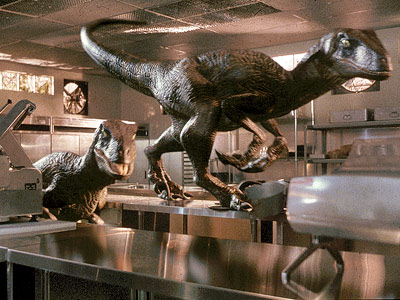
            Ariana Richards and Joseph Mazello as the dreaded kids may have relatively thankless roles, but personally I found them quite palatable characters (certainly more so than in the book, where Lex was about the most annoying brat imaginable). They play off each other nicely, and they both do a good job of acting terrified, especially in the famous kitchen sequence (look at the ‘oh crap!’ expression on Tim’s face as he realizes that he might not have the stamina left to outrun the velociraptor). My favorite moment with them comes as they’re watching the T-Rex chow down on one of the gallimimuses. As Lex begs for them to move on, Tim watches in entirely credible fascination: “Look at how much blood!” Really, how many twelve-year-old boys would want to be torn away from watching a Tyrannosaur eating?
            The great Richard Attenburough, of course, gives the best performance of any of the human stars and has the most to work with. He sells Hammond both as a canny businessman and a genuinely decent man. The rare flashes of anger he exhibits reminds us that he is the boss and knows how to lead his employees, while he also exhibits genuine tenderness and affection towards others; his employees Arnold and Muldoon (whom we understand he actually considers to be friends as well as employees), his grandchildren, and the dinosaurs themselves (he notes that he’s been present for the birth of every dinosaur on the island as he coos over the baby velociraptor in his hands).
            The late Bob Peck does what he can as Muldoon, but he’s as short-changed as anyone (though he does get some great little moments, and his exit line is one of the finest ever). Samuel L. Jackson is likewise pretty much just making do with his highly limited character. I’ve already mentioned Wayne Knight and Martin Ferrero as Nedry and Genarro, respectively. And…that pretty much sums up the cast of human characters.
            But let’s be honest: no one really cares about the human characters. We’re here for the dinosaurs!
            There are a lot of reasons why this film is so much more effective than its sequels, but one of the key factors is in how well it deploys its stars. I could do a complete point-by-point dissection of how each creature is perfectly set up and then utilized for maximum impact. And I think I will!
            Okay, okay; I’ll limit myself to summaries for most creatures and only give a full dissection of one of them: the Tyrannosaur.
            The T-Rex is first mentioned in passing by Grant, who compares its limited eyesight unfavorably to the keen senses of the velociraptors, playing off its high-profile to build up the new creatures. It’s next brought up when Alan and Ellie gaze in awe at the Brachiosaur. Hammond, glowing with pride, takes the first chance to drop the fact that the park indeed includes a Tyrannosaurus, news which the two dino experts react to with predictable delight.
             Then comes the first indication that a live Tyrannosaur might not be an entirely good thing; as the characters enter the visitor’s center, the camera briefly pauses on a close-up of the fossilized T-Rex decorating the lobby, allowing us to take note of the sheer size of its head and jaws while the music, formerly quick-paced and exciting, suddenly becomes low and threatening.
            Then comes the tour. A scene between Nedry and Hammond in the control room is interrupted by Muldoon calling for silence as the visitors approach the Tyrannosaur paddock. They switch off the automated tour guide and the visitors go silent as they pull up in front of the massive fence, which rises higher than the treetops. All is quiet as they scan the trees, which are ominously still. Hoping to show off their star attraction, the controllers summon a tethered goat to tempt the dinosaur. When even this proves unsuccessful, Grant notes disparagingly “T-Rex doesn’t want to be fed; he wants to hunt.” The tour then moves on, the visitors disappointed, but also perhaps relieved (there’s no exclamations of annoyance as there were at the dilophosaur exhibit).
            All the above, the call for silence and the nervous scanning of the tree-tops, serves to remind us that this is something unusually dangerous, in contrast to the more prosaic dilophosaurs they just left behind; dangerous, yet awe-inspiring.
            After this we have the intervening scenes with the triceratops, Nedry putting his plan into operation, and the power failing. As Mr. Arnold frantically tries to undo Nedry’s program, Hammond nervously asks where, exactly, the vehicles stopped. Cut to the same tethered goat.
            What follows is a fairly lengthy interlude where Grant and Malcolm talk about what’s going on, Tim plays around with the night-vision goggles, and everyone seems to be resigning themselves to waiting out the storm.
            Suddenly, Tim stops fiddling with the goggles as he feels a tremor in the earth. The soundtrack begins playing increasingly loud booms. As the car’s occupants watch nervously, the glasses of water set on the dashboard vibrate ominously (incidentally, nice acting by Mazello here; you can see that he, as the dinosaur-nut, realizes what this means before anyone else does). Tim then checks on the goat…but now there is no goat.
            As bits of goat drop onto the car, the terrified visitors watch as a big, two-fingered claw slides harmlessly off of the no-longer electric fence (just above the “Danger: 10,000 Volts” sign). Then the massive T-Rex looms up, her head in the tree-tops, and swallows the goat whole…before turning her attention to the cars.
            Gennaro panics and flees, taking refuge in a bathroom. The T-Rex, meanwhile, makes short work of the fence, tearing the wires off with such force that she bends the metal posts outward. Then having finished off the fence, she strides forward between the cars – which she towers over – and roars into the night.  

            What follows is one of the film’s most justly celebrated sequences as the T-Rex mauls the jeep with the screaming children inside. This provides a great demonstration for the beast’s raw power as she turns the car over with her head and begins ripping out its underbelly and tires, crushing it into the mud, and finishes up by throwing it off a cliff into a tree. The set up is similar to a bear or a lion mauling a car, only elevated to the tenth power. We are well aware throughout that no contemporary creature could do what the Tyrannosaur does here.
             From the start, the T-Rex is established as uniquely dangerous, and then when she finally appears she surpasses our expectations. The Tyrannosaur of Jurassic Park is a force of nature; before her, the only sane response is to run. It gets to the point that the mere sound of her roaring in the distance is enough to send Grant and the children into a near-panicked flight over the perimeter fence.
            Something similar is done with the velociraptors, except for the fact that they – as the film’s ‘new’ dinosaurs – get much more build-up. It’s a velociraptor that kills the worker in the opening scene. Shortly thereafter, Grant gives a long speech about how deadly they are, even compared to the T-Rex. Then, on the island, we find that they are kept in their own prison-like enclosure (again, why not just use an iron fence that’s higher than they could jump?), where the visitors watch in horrified fascination as they tear apart a cow, leaving only the bent and bloodied harness. The first thing Muldoon asks when they learn that the fences are failing is whether the raptor fences are still on…which Arnold confirms that they are. Even Nedry, who was so careless and amoral, wasn’t going to mess with the raptors.
            The movie is nicely divided into acts: the first deals with the visitors arriving at the island and discovering the dinosaurs, the second with the dinosaur’s escape, the third with the attempts to regroup and escape the island. The Tyrannosaur dominates the second act, while the raptors move to center stage for the third.
            The velociraptors of Jurassic Park are truly works of art. Their intelligence and human-like size makes them a more immediate and personal threat; more a genuine villain than the massive T-Rex. Their viciousness is established early on with the brutal (offscreen) slayings of the worker (who is dragged into the cage in a manner reminiscent of Chrissie Watkins in Jaws) and the cow. Later we see one of them – the Matriarch, whom Muldoon described early in the film as being the worst of the bunch – killing a major character, and while the scene is obscured by plants, his lingering screams, combined with what little we can see (she clearly has her jaws around his face) is more than enough, especially compared to the one Tyrannosaur victim we’ve seen, who was pretty much killed instantly. In addition to their visual strength, the raptors are the recipients of some truly inspired sound design, alternating between hisses, a kind of guttural honk or bark, and a piercing scream (shades of the Nazgul from The Lord of the Rings). This, coupled with their obvious intelligence and toothy grins, makes them almost come across as demons rather than animals.

 
            Though, of course, I risk losing my dino-nut credentials if I don’t point out that real velociraptors were pretty much nothing like this; they were turkey-sized, only relatively intelligent, and certainly couldn’t hit ‘cheetah speeds.’ The creatures in Jurassic Park are actually deinonychuses (deinonychi?); a much larger cousin of the velociraptor (velociraptors also were native to Mongolia, meaning that Grant couldn’t have been digging one up in Montana). And even for deinonychus, the things we have here are pretty exaggerated. But, really, who cares? They make great villains.
            A similar dynamic is in place with the dilophosaurus. She’s way too small, for one thing (real dilophosaurs were one of the earliest big carnivores and stood about six-feet high and twenty-feet long), though that could be excused by her being a juvenile. The venom and the frill, on the other hand, have their origins entirely in Michael Crichton and Steven Spielberg. Still, the visual effect of the small, rather cute chirping critter suddenly opening her frill and becoming a shrieking nightmare is enough to, in my mind, excuse any tampering (more problematic is the question “how did she get in the car?”).
            She’s also is involved in one of my favorite bits of dino-acting. As Nedry impatiently tells her “I don’t have any food!” the dilophosaur is clearly looking him up and down and – metaphorically at least – licking her chops.

            The brachiosaurus, of course, is the focus of the awe-inspiring first glimpse where Grant pronounces in amazement “It’s a dinosaur!” The power of that one scene, the wonder and yearning it produces in the audience, is simply incredible. It encapsulates everything that makes this movie great and is itself a genuine work of art; the closest any of us will ever come to seeing a real dinosaur.
            Occasionally a movie scene will come along that seems to encapsulate the full artistic potential of the medium. The brachiosaur scene in Jurassic Park is one of them.
            There’s not a whole lot to say about the other species present; triceratops only gets to lie around being sick, but she does feature in a great audience surrogate moment as the characters feel her all over, rejoicing in the reality, the aliveness of the animal. “She was always my favorite when I was a kid,” Alan gushes. “And now that I see her, she’s the most beautiful thing I ever saw!”

 
            The parasaurolophus only appears once, at a distance, at the end of the brachiosaur scene (to the point that you’d be forgiven for forgetting they were even in this movie), though they do prompt a moving comment from Grant that quietly reminds us of the enormous gap between our theories of how dinosaurs acted and the fact that we will never really know the truth about them.
            Finally, the gallimimus likewise appear in a single scene, but one that is justifiably famous for its incredible technical artistry as Grant and the kids end up in the middle of a stampede and the camera seems to be running right alongside them as the dinosaurs thunder past.
            Of course, everyone talks about the amazing visual effects, courtesy of ILM and the late Stan Winston. Honestly, the effects here are better than most of the effects today; they have more solidity, more texture, more…life to them. Most CGI effects feel like the artists are trying too hard, wasting time on little details so that the final effect feels overly-rehearsed and unconvincing. Here, by contrast, you can feel the enthusiasm of the filmmakers as they perfect each scene and move on to the next. You sense that they were just as eager to see the completed film as we were, and that eagerness comes off on screen. Look at the patience that went into the scene where the T-Rex first investigates the car containing the kids before trying to break in, or the curled lip on the velociraptor as she watches the children flee the kitchen. These creatures are more than convincingly real; they’re convincingly alive.
            A word on the 3D conversion. For the most part, it works very well; lending texture and depth to the already-spectacular visuals. The only scene that it became a problem for me was, alas, the one scene everyone couldn’t wait to see in 3D: the gallimimus stampede. The 3D conversion left the creatures blurred and impossible to focus on, lessening the impact of that spectacular sequence. It was an isolated moment, but a highly disappointing one.
            Thematically, the major lesson here is that man should not toy around with nature. The lesson backfires about as spectacularly as any I can think of, since the actual effect is “dinosaurs are awesome! We should absolutely bring them back! We just won’t trust Fats von Greedytreason.” The movie’s deck-stacking means that neither science in general nor genetic tampering in particular comes off as the villain here; Nedry and the horrible design of the park itself do (well, and the velociraptor Matriarch, of course). In other words, the take away is less “they tampered in God’s domain” and more “who the heck hired that guy?”
            Other than that, it’s mostly just a paean to man’s love for these long-dead beasts, and as moving a tribute to that love as you’ll ever see, despite all the running, screaming, and dying. The characters never lose their awe of the creatures, even after running for their lives from them. In the end we’re even left with the strangely comforting idea that the dinosaurs are indeed still with us through their children: the birds.
            I’ll conclude with a word on the famous ending. In the context of this strange love that we have for these long-gone creatures, it’s significant that the last act of a dinosaur in the film is a heroic act. What happens I’ll leave unsaid (just in case there’s someone somewhere who doesn’t know), except that, for all its implausibility, no ending of any film has ever made me happier. I remember hearing Peter Benchley, the author of Jaws, recount the story of that film’s ending, and how he had thought it was too implausible, to which Spielberg countered that plausibility is less important than what the audience wants. He was right then, and he was right when he designed the ending here. What happens is worth any suspension of disbelief.
            Jurassic Park is a film with very real flaws. Those flaws keep it from being all that it might have been. Nevertheless, none of those flaws ultimately matter to the final product. The talented cast, the superb directing, and the awe-inspiring visuals carry it far beyond any problems in writing or characterization. What we have here is a genuine classic; a movie worth watching over and over again.  


Final Rating: 4.5/5. The stuff that dreams are made of.