Tuesday, April 9, 2013

Reviews: Jurassic Park


            As a life-long dinosaur nut, I’ve of course seen Jurassic Park more times than I can count. Yet seeing it on a big screen was a new and wonderful experience. And I’m using ‘wonderful’ in it’s most literal and correct sense; an experience filled with wonder.
            On an island off the coast of Costa Rica, billionaire John Hammond (Richard Attenburough) is creating new kind of ‘biological preserve,’ but when one of the workers is killed during the construction his investors – represented by the oily Donald Gennaro (Martin Ferrero) – threaten to pull funding over safety concerns. To assuage them, he offers to have a team of experts investigate and sign off on the island. To that end he entices paleontologist Alan Grant (Sam Neill) and paleobotanist Ellie Sattler (Laura Dern) to be his experts, while Gennaro brings the eccentric ‘rock star mathematician’ Ian Malcolm (Jeff Goldblum). Shortly after they arrive on the island, Hammond shows his guests the result of his work; a living Brachiosaurus.
            Welcome to Jurassic Park; where dinosaurs rule the Earth.  

             The awed and somewhat unnerved experts set out on a test tour, accompanied by Hammond’s visiting grandchildren, Lex (Ariana Richards) and Tim (Joseph Mazzello), and watched carefully by the park’s head technician, Ray Arnold (Samuel L. Jackson before he was the coolest man in the world) and security chief, Robert Muldoon (Bob Peck). Unbeknownst to any of them, however, Hammond’s lead programmer, Dennis Nedry (Wayne Knight) has done a deal with Hammond’s competitors to steal the dinosaur embryos that very night. But as he puts his plan into action, a tropical storm hits the island…
            Where to begin with Jurassic Park? I suppose, in inversion of my usual format, I’ll begin with the movie’s flaws, which are, unfortunately, many.
            In the first place, as has been noted many times before, there is very little character development in the film. We don’t really learn anything at all about Ellie Sattler, except that she and Alan are dating and that she’s a paleobotanist (though she only talks about plants in a couple scenes, meaning some people in the audience might not even realize what a ‘paleobotanist’ is. I suppose it’s not a subject that comes up much when running from dinosaurs). Alan is only a little better; all we know about him is that he hates children, computers, and trees. Malcolm pretty much exists to utter dire warnings and snark, while the fact that Lex and Tim’s parents are getting divorced is reduced to a single line of dialogue in a scene that they aren’t even in.
            Basically, there’s not really any ‘human’ story going on here; not a lot of growing or changing among the characters. In the end, Alan’s more tolerant towards children, Hammond’s decided not to make any more dinosaur parks, and…that’s about it. Oh, and the less said about Dennis Nedry or Donald Gennaro the better. 
            The only character with any real development is Hammond, who gets a rather touching speech reminiscing about the first attraction he ever made – a flea circus – and how what he had wanted to do with Jurassic Park was to inspire people to wonder at something that was real: “something they could see and touch…an aim not devoid of merit.”
            He’s shown to be a loving family man, both towards his grandchildren and to his daughter (judging by the fleeting reference to her divorce, we can assume he decided to invite the children to take their minds off of it). He also is simultaneously open to and dismissive of dissenting opinions; he invites people to give them, but then he tends to brush them off with a laugh and a smile. Even with the park falling to pieces about him, he still talks about proceeding. It isn’t until he finds himself listening over the phone as the velociraptors attack his friends and family that he finally gives up on his dream.
            He also seems to have an inflated sense of his own people skills. Upon meeting Alan and Ellie, he boasts that he “can tell instantly about people – it’s a gift!” But he also hired the world’s most patently untrustworthy programmer to run his park and brushed off his complaints of low pay and lack of appreciation.
            Which brings us to the other giant flaw in Jurassic Park; the fact that the script so clearly stacks the deck to get the result it wants. There’s really no getting around the fact that Jurassic Park is a disaster waiting to happen; not only is the head programmer obviously the last person you would want in a position of responsibility, but the whole park is bundled into a single huge computer program, meaning that everything from the fences to the phones to the friggin’ door locks to the control room are dependent upon this one system. A system, I might add, that doesn’t even have the memory to run and fix a bug at the same time. I mean, good God! Forget corporate sabotage: didn’t anyone ask what would happen if there was a simple power-outage? Not only that, but the circuit breakers, rather than being kept somewhere easily accessible (the control room, the emergency bunker) are stored deep in a labyrinthine maintenance shed “at the other end of the compound,” with the velociraptor pen conveniently located directly between them and the control room.
            Then there’s the design of the park itself, which has automated cars take people from cage to cage (the doors on the cars don’t even lock, as the film itself points out). Not only is this highly inconvenient (what if you want to linger at a specific paddock? What if you want to skip the protoceratops and go straight to the T-Rex?), but given that the paddocks themselves are filled with dense jungle right up to the fences, it’s a hundred-to-one chance that they’ll see anything at all (as, indeed, they don’t until they actually leave the cars and walk into one of the paddocks. See above RE: car locks). Plus there’s the total dependence upon electric fences: hadn’t anyone involved ever heard of concrete moats? How about walls or Plexiglas? Heck, how about good old-fashioned fences made of actual metal, rather than flimsy wires? Granted a simple iron fence probably wouldn’t stop the T-Rex, but it certainly would have been appreciated around the velociraptors!
            Basically, the entire park is so designed that a single problem would bring the whole thing crashing down, and then it was placed entirely in the hands of the world’s least reliable employee. Of course things went to hell! It didn’t take chaos theory or “life finding a way;” all it took was a healthy dose of human stupidity!
            Speaking of which, characters occasionally do really stupid things – things that they would never do – just so that the filmmakers get the results they want. Probably the worst instance of this is Muldoon hunting the raptors in dense brush (which he probably should know better than to try) with his gunstock still folded up, causing him to waste precious seconds trying to quietly unfold it when he gets one of the raptors in his sights. Likewise, you’d think that Nedry would have mapped out the route to the boat previously (especially since he mentions having made a ‘dry run’ of the plan). Actually, forget mapping out; he works on the island, he presumably goes back-and-forth using the boat on a fairly regular basis. Why does he suddenly have no idea which way to go?
            Nedry in general is a mess of a character; a humiliating, overdone caricature of a role. Gennaro, the other ‘asshole victim’ isn’t much better; responding to the brachiosaurus with an awed “we’re gonna make a fortune with this place!” and abandoning the children the instant the T-Rex appears. He does, however, get a couple of humanizing moments early on, especially his reaction to Hammond declaring ruefully that “the blood sucking lawyer” is the only one who supports him.
            Okay, that pretty much covers the flaws, now onto the good stuff. In the first place, though the characters are all underdeveloped, the actors are so good that they almost make up for it. This is an extremely talented cast and they inject their characters with enough life that we wonder just what they could have done with more to work with. Sam Neill and Laura Dern are particularly good at this. Neill, who was mostly known for villain roles before this, actually comes across as a fairly ordinary man thrust into a heroic role against his will (yes, ‘unlikely heroes’ are a dime a dozen, but how often do we actually buy the ‘unlikely’ part?). He invests Dr. Grant with a lot of rich little details that tell us much more about him than the dialogue does. For instance, watch him while the baby raptor is hatching; as Hammond explains about how they imprint upon the first creature they see, Grant’s silently trying to direct the raptors attention onto himself. Or when he’s trying to coax Tim into climbing down the huge tree they’re currently in he likens it to a tree house: “Did your dad ever build you a tree house?” “No,” Tim answers, to which Grant mutters “me neither.” 
            Likewise, Laura Dern, while she’s not given much to do (her biggest contribution is turning the power back on), at least plays Ellie with enough force and heart to make us realize that she really could have been a great character if the script had given her the chance.
            As for Jeff Goldblum as Ian Malcolm, well, as the saying goes, you either find him hilarious or unbearable. Fortunately, I fall into the former category. Malcolm is pretty much Goldblum’s defining role, and it’s impossible to picture anyone else in the part. Malcolm’s anti-science speeches are fortunately kept at a minimum here (there are legitimate concerns that could be made about the morality of re-creating dinosaurs via genetic tampering and then selling them as tourist attractions, but he doesn’t really make them, instead giving some guff about ‘unearned power’ and ‘life will find a way’). Instead, Malcolm serves as a one-man Mystery Science Theater for the experience, flirts, and generally acts like he thinks he’s the star of the show…until he gets proven definitively wrong halfway through and becomes notably less chatty for the rest of the film.


            Ariana Richards and Joseph Mazello as the dreaded kids may have relatively thankless roles, but personally I found them quite palatable characters (certainly more so than in the book, where Lex was about the most annoying brat imaginable). They play off each other nicely, and they both do a good job of acting terrified, especially in the famous kitchen sequence (look at the ‘oh crap!’ expression on Tim’s face as he realizes that he might not have the stamina left to outrun the velociraptor). My favorite moment with them comes as they’re watching the T-Rex chow down on one of the gallimimuses. As Lex begs for them to move on, Tim watches in entirely credible fascination: “Look at how much blood!” Really, how many twelve-year-old boys would want to be torn away from watching a Tyrannosaur eating?
            The great Richard Attenburough, of course, gives the best performance of any of the human stars and has the most to work with. He sells Hammond both as a canny businessman and a genuinely decent man. The rare flashes of anger he exhibits reminds us that he is the boss and knows how to lead his employees, while he also exhibits genuine tenderness and affection towards others; his employees Arnold and Muldoon (whom we understand he actually considers to be friends as well as employees), his grandchildren, and the dinosaurs themselves (he notes that he’s been present for the birth of every dinosaur on the island as he coos over the baby velociraptor in his hands).
            The late Bob Peck does what he can as Muldoon, but he’s as short-changed as anyone (though he does get some great little moments, and his exit line is one of the finest ever). Samuel L. Jackson is likewise pretty much just making do with his highly limited character. I’ve already mentioned Wayne Knight and Martin Ferrero as Nedry and Genarro, respectively. And…that pretty much sums up the cast of human characters.
            But let’s be honest: no one really cares about the human characters. We’re here for the dinosaurs!
            There are a lot of reasons why this film is so much more effective than its sequels, but one of the key factors is in how well it deploys its stars. I could do a complete point-by-point dissection of how each creature is perfectly set up and then utilized for maximum impact. And I think I will!
            Okay, okay; I’ll limit myself to summaries for most creatures and only give a full dissection of one of them: the Tyrannosaur.
            The T-Rex is first mentioned in passing by Grant, who compares its limited eyesight unfavorably to the keen senses of the velociraptors, playing off its high-profile to build up the new creatures. It’s next brought up when Alan and Ellie gaze in awe at the Brachiosaur. Hammond, glowing with pride, takes the first chance to drop the fact that the park indeed includes a Tyrannosaurus, news which the two dino experts react to with predictable delight.
             Then comes the first indication that a live Tyrannosaur might not be an entirely good thing; as the characters enter the visitor’s center, the camera briefly pauses on a close-up of the fossilized T-Rex decorating the lobby, allowing us to take note of the sheer size of its head and jaws while the music, formerly quick-paced and exciting, suddenly becomes low and threatening.
            Then comes the tour. A scene between Nedry and Hammond in the control room is interrupted by Muldoon calling for silence as the visitors approach the Tyrannosaur paddock. They switch off the automated tour guide and the visitors go silent as they pull up in front of the massive fence, which rises higher than the treetops. All is quiet as they scan the trees, which are ominously still. Hoping to show off their star attraction, the controllers summon a tethered goat to tempt the dinosaur. When even this proves unsuccessful, Grant notes disparagingly “T-Rex doesn’t want to be fed; he wants to hunt.” The tour then moves on, the visitors disappointed, but also perhaps relieved (there’s no exclamations of annoyance as there were at the dilophosaur exhibit).
            All the above, the call for silence and the nervous scanning of the tree-tops, serves to remind us that this is something unusually dangerous, in contrast to the more prosaic dilophosaurs they just left behind; dangerous, yet awe-inspiring.
            After this we have the intervening scenes with the triceratops, Nedry putting his plan into operation, and the power failing. As Mr. Arnold frantically tries to undo Nedry’s program, Hammond nervously asks where, exactly, the vehicles stopped. Cut to the same tethered goat.
            What follows is a fairly lengthy interlude where Grant and Malcolm talk about what’s going on, Tim plays around with the night-vision goggles, and everyone seems to be resigning themselves to waiting out the storm.
            Suddenly, Tim stops fiddling with the goggles as he feels a tremor in the earth. The soundtrack begins playing increasingly loud booms. As the car’s occupants watch nervously, the glasses of water set on the dashboard vibrate ominously (incidentally, nice acting by Mazello here; you can see that he, as the dinosaur-nut, realizes what this means before anyone else does). Tim then checks on the goat…but now there is no goat.
            As bits of goat drop onto the car, the terrified visitors watch as a big, two-fingered claw slides harmlessly off of the no-longer electric fence (just above the “Danger: 10,000 Volts” sign). Then the massive T-Rex looms up, her head in the tree-tops, and swallows the goat whole…before turning her attention to the cars.
            Gennaro panics and flees, taking refuge in a bathroom. The T-Rex, meanwhile, makes short work of the fence, tearing the wires off with such force that she bends the metal posts outward. Then having finished off the fence, she strides forward between the cars – which she towers over – and roars into the night.  

            What follows is one of the film’s most justly celebrated sequences as the T-Rex mauls the jeep with the screaming children inside. This provides a great demonstration for the beast’s raw power as she turns the car over with her head and begins ripping out its underbelly and tires, crushing it into the mud, and finishes up by throwing it off a cliff into a tree. The set up is similar to a bear or a lion mauling a car, only elevated to the tenth power. We are well aware throughout that no contemporary creature could do what the Tyrannosaur does here.
             From the start, the T-Rex is established as uniquely dangerous, and then when she finally appears she surpasses our expectations. The Tyrannosaur of Jurassic Park is a force of nature; before her, the only sane response is to run. It gets to the point that the mere sound of her roaring in the distance is enough to send Grant and the children into a near-panicked flight over the perimeter fence.
            Something similar is done with the velociraptors, except for the fact that they – as the film’s ‘new’ dinosaurs – get much more build-up. It’s a velociraptor that kills the worker in the opening scene. Shortly thereafter, Grant gives a long speech about how deadly they are, even compared to the T-Rex. Then, on the island, we find that they are kept in their own prison-like enclosure (again, why not just use an iron fence that’s higher than they could jump?), where the visitors watch in horrified fascination as they tear apart a cow, leaving only the bent and bloodied harness. The first thing Muldoon asks when they learn that the fences are failing is whether the raptor fences are still on…which Arnold confirms that they are. Even Nedry, who was so careless and amoral, wasn’t going to mess with the raptors.
            The movie is nicely divided into acts: the first deals with the visitors arriving at the island and discovering the dinosaurs, the second with the dinosaur’s escape, the third with the attempts to regroup and escape the island. The Tyrannosaur dominates the second act, while the raptors move to center stage for the third.
            The velociraptors of Jurassic Park are truly works of art. Their intelligence and human-like size makes them a more immediate and personal threat; more a genuine villain than the massive T-Rex. Their viciousness is established early on with the brutal (offscreen) slayings of the worker (who is dragged into the cage in a manner reminiscent of Chrissie Watkins in Jaws) and the cow. Later we see one of them – the Matriarch, whom Muldoon described early in the film as being the worst of the bunch – killing a major character, and while the scene is obscured by plants, his lingering screams, combined with what little we can see (she clearly has her jaws around his face) is more than enough, especially compared to the one Tyrannosaur victim we’ve seen, who was pretty much killed instantly. In addition to their visual strength, the raptors are the recipients of some truly inspired sound design, alternating between hisses, a kind of guttural honk or bark, and a piercing scream (shades of the Nazgul from The Lord of the Rings). This, coupled with their obvious intelligence and toothy grins, makes them almost come across as demons rather than animals.

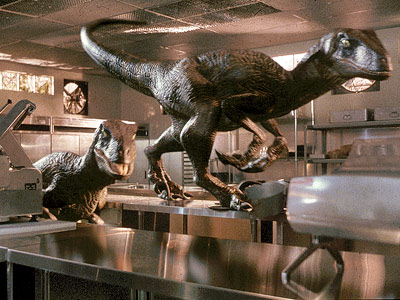
 
            Though, of course, I risk losing my dino-nut credentials if I don’t point out that real velociraptors were pretty much nothing like this; they were turkey-sized, only relatively intelligent, and certainly couldn’t hit ‘cheetah speeds.’ The creatures in Jurassic Park are actually deinonychuses (deinonychi?); a much larger cousin of the velociraptor (velociraptors also were native to Mongolia, meaning that Grant couldn’t have been digging one up in Montana). And even for deinonychus, the things we have here are pretty exaggerated. But, really, who cares? They make great villains.
            A similar dynamic is in place with the dilophosaurus. She’s way too small, for one thing (real dilophosaurs were one of the earliest big carnivores and stood about six-feet high and twenty-feet long), though that could be excused by her being a juvenile. The venom and the frill, on the other hand, have their origins entirely in Michael Crichton and Steven Spielberg. Still, the visual effect of the small, rather cute chirping critter suddenly opening her frill and becoming a shrieking nightmare is enough to, in my mind, excuse any tampering (more problematic is the question “how did she get in the car?”).
            She’s also is involved in one of my favorite bits of dino-acting. As Nedry impatiently tells her “I don’t have any food!” the dilophosaur is clearly looking him up and down and – metaphorically at least – licking her chops.

            The brachiosaurus, of course, is the focus of the awe-inspiring first glimpse where Grant pronounces in amazement “It’s a dinosaur!” The power of that one scene, the wonder and yearning it produces in the audience, is simply incredible. It encapsulates everything that makes this movie great and is itself a genuine work of art; the closest any of us will ever come to seeing a real dinosaur.
            Occasionally a movie scene will come along that seems to encapsulate the full artistic potential of the medium. The brachiosaur scene in Jurassic Park is one of them.
            There’s not a whole lot to say about the other species present; triceratops only gets to lie around being sick, but she does feature in a great audience surrogate moment as the characters feel her all over, rejoicing in the reality, the aliveness of the animal. “She was always my favorite when I was a kid,” Alan gushes. “And now that I see her, she’s the most beautiful thing I ever saw!”

 
            The parasaurolophus only appears once, at a distance, at the end of the brachiosaur scene (to the point that you’d be forgiven for forgetting they were even in this movie), though they do prompt a moving comment from Grant that quietly reminds us of the enormous gap between our theories of how dinosaurs acted and the fact that we will never really know the truth about them.
            Finally, the gallimimus likewise appear in a single scene, but one that is justifiably famous for its incredible technical artistry as Grant and the kids end up in the middle of a stampede and the camera seems to be running right alongside them as the dinosaurs thunder past.
            Of course, everyone talks about the amazing visual effects, courtesy of ILM and the late Stan Winston. Honestly, the effects here are better than most of the effects today; they have more solidity, more texture, more…life to them. Most CGI effects feel like the artists are trying too hard, wasting time on little details so that the final effect feels overly-rehearsed and unconvincing. Here, by contrast, you can feel the enthusiasm of the filmmakers as they perfect each scene and move on to the next. You sense that they were just as eager to see the completed film as we were, and that eagerness comes off on screen. Look at the patience that went into the scene where the T-Rex first investigates the car containing the kids before trying to break in, or the curled lip on the velociraptor as she watches the children flee the kitchen. These creatures are more than convincingly real; they’re convincingly alive.
            A word on the 3D conversion. For the most part, it works very well; lending texture and depth to the already-spectacular visuals. The only scene that it became a problem for me was, alas, the one scene everyone couldn’t wait to see in 3D: the gallimimus stampede. The 3D conversion left the creatures blurred and impossible to focus on, lessening the impact of that spectacular sequence. It was an isolated moment, but a highly disappointing one.
            Thematically, the major lesson here is that man should not toy around with nature. The lesson backfires about as spectacularly as any I can think of, since the actual effect is “dinosaurs are awesome! We should absolutely bring them back! We just won’t trust Fats von Greedytreason.” The movie’s deck-stacking means that neither science in general nor genetic tampering in particular comes off as the villain here; Nedry and the horrible design of the park itself do (well, and the velociraptor Matriarch, of course). In other words, the take away is less “they tampered in God’s domain” and more “who the heck hired that guy?”
            Other than that, it’s mostly just a paean to man’s love for these long-dead beasts, and as moving a tribute to that love as you’ll ever see, despite all the running, screaming, and dying. The characters never lose their awe of the creatures, even after running for their lives from them. In the end we’re even left with the strangely comforting idea that the dinosaurs are indeed still with us through their children: the birds.
            I’ll conclude with a word on the famous ending. In the context of this strange love that we have for these long-gone creatures, it’s significant that the last act of a dinosaur in the film is a heroic act. What happens I’ll leave unsaid (just in case there’s someone somewhere who doesn’t know), except that, for all its implausibility, no ending of any film has ever made me happier. I remember hearing Peter Benchley, the author of Jaws, recount the story of that film’s ending, and how he had thought it was too implausible, to which Spielberg countered that plausibility is less important than what the audience wants. He was right then, and he was right when he designed the ending here. What happens is worth any suspension of disbelief.
            Jurassic Park is a film with very real flaws. Those flaws keep it from being all that it might have been. Nevertheless, none of those flaws ultimately matter to the final product. The talented cast, the superb directing, and the awe-inspiring visuals carry it far beyond any problems in writing or characterization. What we have here is a genuine classic; a movie worth watching over and over again.  


Final Rating: 4.5/5. The stuff that dreams are made of.

Thursday, April 4, 2013

Roger Ebert RIP


            Today the sad news broke that Roger Ebert has died after a long battle with cancer.
            Ebert was my first influence in film criticism. On my days home sick from school I wasn’t allowed to watch TV, so I often passed the time by reading and rereading one of the collections of his reviews we had around the house. He provided me with many invaluable lessons in both thinking and writing about film…and, honestly, in writing in general.
            I have my problems with Ebert as a critic. He had an unfortunate tendency to allow politics (he was, naturally, an arch-liberal) and preconceived notions to dictate his opinion of films. He also raised justifiable incredulity with his lone film script – for the awful Beyond the Valley of the Dolls. But at his best, he was one of the wittiest and most insightful voices in film criticism. For all his flaws, he deserved the fame and influence he acquired – the likes of which no other critic had ever or will ever achieve. Certainly as the undisputedly most influential film critic in the world, we could have done a lot worse.
            Looking back, I think my favorite review of his was his almost lazy dissection of the 1998 Godzilla. I still can quote the opening line from memory: “Watching Godzilla at Cannes was like attending a Satanic ritual at St. Peter’s Basillica.” He then described the film as coming last in the festival “like horses in a parade, and perhaps for the same reason.” He even displayed typical good humor over the fact that one of the characters in the movie – the moronic mayor of New York – was a thinly-veiled caricature of himself. Far from expressing outrage or offense, he complained that they should have killed ‘him’ off.  
            One of the reasons I generally enjoyed his writing is that he typically wasn’t a snob; he was as willing to award a glowing tribute to a silly adventure film or special-effects extravaganza as to a pretentious art film.
            I gave up on regularly reading his reviews a long time ago – about the time of his appalling review of the original Godzilla, as a matter of fact (which was so inaccurate and negative that it raises questions about whether he actually watched the thing) – but I still occasionally drop in to check his assessment of a particular movie, whether a classic or a new release. Certainly he was a unique figure in the world of the movies; a star critic. With amateurs such as myself flooding the internet, it seems clear that we will never look upon his like again. For good or for ill, he was the giant of his field and he will be missed.

            Requiescat in Pacem.

Tuesday, March 12, 2013

Mst3k – 308: The Amazing Colossal Man

What's that? Yes, I am still doing this! I'm sorry it's been close to a year since the last one, but complaining's not going to help anything.

                 Anyway, this episode features one of Bert I. Gordon’s best films, a phrase that is the very definition of “damning with faint praise.” Here are all of Gordon’s trademarks: cheap processing effects to enlarge ordinary objects, radiation as the reason for the menace, an Albert Glasser score, and lots and lots of stock footage.
                  This particular epic tells the story of Col. Glenn Manning; an air force officer who is caught in the test blast of a new kind of atom bomb. As a result, he not only survives but begins to grow at the rate of eight feet a day. The military accordingly confines him to a secret installation where they try to work out a way to reverse his growth (though the lead scientist seems more interested in landing Glenn’s distraught fiancée, Carol, who’s on hand for moral support). Meanwhile, Glenn grows more depressed and unstable, and the scientists discover that Glenn’s growth will soon kill him if they can’t stop it, since his heart isn’t keeping up with the rest of his body (the heart is basically a single cell, you see. Hey, Bert I. says it is, so it must be true!).
                  Anyway, Glen eventually snaps completely and wanders off into Las Vegas, where he plays with the signs a little before taking a detour out to Boulder (Hoover) Dam, where the military first injects him with a giant hypodermic needle to stop his growth, then shoots him.
                  The movie is, as noted, one of Bert I’s better ones, for what it’s worth. Glenn Langren gives a surprisingly strong performance as Glen Manning, making Glen’s plight and descent into madness more believable and moving than you would expect. The effects, on the other hand, are pretty much exactly what you’d expect from a Bert I. Gordon film; lots of rear and fore-projection, some very half-hearted miniature work, and Glen occasionally going semi-transparent. I also have to mention the absurd hypodermic needle prop that shows up at one point, complete with over-sized thumbholes and measuring marks along the side.  And, of course, the less said about the ‘science’ involved, the better.
                  Riffwise, this is a solid episode with plenty of jokes about Glen’s size and growing instability, as well as the rampant absurdity of the situation and the way the lead scientist seems less interested in helping Glen than in getting it on with Glen’s fiancée.
                  Host segment wise, there are some very amusing spoofs on the film, especially the second segment featuring Joel as Glen. I also love the invention exchange with Kevin Murphy as a pretentious plant that reviews music.
                  All in all, this is a fun, solid entry of just the kind you hope to see on a show like this. Highly recommended. 

Opening: The bots have a cardboard fort and refuse to come out. It’s cute seeing the bots acting like little kids.

Invention Exchange: The Mads have a plant that reviews music. Joel has non-permanent tattoos. They’re pretty amusing, especially Frank.

We open on some stock footage of army trucks.

Servo/Joel (singing): “Scarecrow! Scarecrow!”
Crow: “Scare me?”

And another Bert I. Gordon film, complete with Albert Glasser score.

Now after the credits we open on some soldiers about to observe a nuclear explosion…

The bomb doesn’t go off.
Crow: “Hey, it’s the amazing colossal dud.”
Joel: “Hit it! Wiggle the plug or something!”

The soldiers have to wait until the bomb goes off…

Sergeant: “Can we smoke, sir?”
Servo: “I don’t care if you burst into flame.”

And a plane suddenly shows up overhead.
Joel: “Oh, no, it’s Amelia Earhart, she picked a bad time to come back.”

They try to make the plane change direction, instead it crashes for no discernable reason.

Soldier pulls out binoculars:
Joel: “Cool! I can see the body and everything!”

Colonel Manning decides to run out to try to save the pilot.

Servo (as Glen): “Hey, FM Stereo, it’s really…wait a minute, what the hell and I doing out here!?”
(bomb goes off)

Cut to the hospital.

Glen is severely burned all over.

Doctor fiddles with a towel or something:
Crow: “Uh, we’ll just stuff that back in anywhere, no one will notice.”

And we meet Glen’s fiancée, Carole.

And a reporter shows up and starts insensitively talking to her about Glen’s condition…
Servo: “Yeah, real pile of goo, you know him?”

Reporter: “You know I was there, covering the test for national news service…”
Servo: “I didn’t run right up next to the bomb.”

Reporter: “How long have you known Colonel Manning?”
Joel: “What’re you doing after he’s dead?”

Fiancée recounts how they met…

Doctor: “This man’s luck ran out long ago.”
Servo: “When he got me as his doctor.”

Doctor: “There’s always a chance…”
All: *snort* “Yeah, right.”

Doctor: “Are you Carole? Your name was the only word he spoke.”
Servo: “Well, that and AAAAAGGHHH!”

So, they lay Glen up for the night, he’s expected to die…

Nurse comes in:
Crow: “And how is our little Johnsonville-brat this morning?”

They come back to find his skin is healed!

Scare chord when his bandages are taken off.

Servo: “Uh, maybe we got the wrong room…”

They ask the maker of the bomb how this might have happened (yeah, I’m sure the guy who made the bomb will be able to explain the medical miracle).

The guy seems oddly blasé about the guy suddenly healing a completely burned body.

They review stock footage of an A-bomb test.

Model building gets hit
Servo: “There was a family of twelve in here. Should’ve told them to leave…”

Right, they just happened to have a camera following Glen during the blast. Sure.

Conclusion: Something is beyond the limits of our knowledge. Right, I think that’s been established, that’s why they came to you for help, you idiot!

First Host Segment: Nice things to say to Glen’s fiancée. The bots just come up with mean jokes. Then they go into the horrible reality of Joel’s situation. It’s pretty funny, especially Crow’s last line “You cried earlier, what was that about?”

Back in the film, Carole wakes up to a knock at the door…

A security officer shows up to tell her she can’t visit Glen for a while.

Servo: “Wow, a restraining order on little old me!”

And she just walks into the hospital: no security in sight.

She finds his room empty.
Crow: “Glen’s a pillow? Well, at least I can still snuggle him and turn him over to the cool side…”

Carole: “I’m Colonel Manning’s fiancée.”
Servo (as nurse): “Oh, bummer.”

The nurse refuses to give any info, claims never to have heard of Glen, etc.

Carole sneaks a look at the records.

Then she drives out to a military base…

They cheer for her to plow through the gate…she doesn’t.

Crow: “Wait, the sign says ‘Turn back, this means you!”

And she sneaks into the hospital (she was supposed to see the sergeant…maybe a scene was cut).

Servo: “What, the government’s involved in a cover-up? How could that be?”

Funny bit where Crow has her making obvious attempts at subterfuge.

And apparently all the doctors have really poor vision…by the way, are any hospitals ever kept that dark?

She sneaks into Glens room to find he’s giant!

She faints, cut to the doctor filling her in. So, once the secrets out they just tell everything?

Doctor explains cell reproduction in extreme detail and length.

General feels the need to explain what ‘accelerated’ means.

Glen has a flashback to the Korean War…

Apparently the Korean soldiers used knives as their primary weapons and rifles as their back-ups.

Crow: “Hey, John Phillip Susa’s life is flashing before his eyes.”

And Glen wakes up and realizes his condition.

Crow: “Oh, God, I’m being held in Barbie’s Malibu Dreamhouse!”

Actually a fairly well done scene by Glen Langren, who plays Glen.

Joel: “Oh, my goodness! I’m a huge Daddy Warbucks!”

Doctor (to Carole): “You might do him a lot of good.”
Crow: “But don’t climb on him.”

Carole thinks the best way to cheer Glen up is to list the doctors who are going to help him.

Glen: “What sin could a man commit in a single lifetime to bring this on himself?”
(Most famous line in the film)

Cut to meat being delivered…delivery guy is suspicious.

MP lets the delivery guy in on the ‘giant’ secret; he doesn’t believe it.

Second Host Segment: Joel is Glen; the Bots try to help him by asking questions. “How many kinds of fish can you name?” It’s pretty funny, especially Joel as Glen (“Ah! No!”)

Apparently Glen’s exposure to the blast is national news. You’d think the military would’ve kept that quiet.

They do three jokes in a row about rabbits being used to test cosmetics.

Crow does a great series of jokes in a little rabbit voice: “Hey, spread the word. Night of the Lepus; tonight!”

Doctor comments that Glen should be ‘confined.’ Yeah, that’ll do wonders for his psychological health.

Again, Langren is really pretty good as Glen. Probably the best performance in any Bert I Gordon film.

Crow: “Hey, don’t laugh, Glen! We’re on a fault line!”

Glen walks off in a huff, then Doctor shows up immediately afterwards.
Crow: “Have you seen Glen?”

Doctor: “Would you mind if I spoke bluntly?”
Crow: “Why stop now?”

Doctor: “There’s something I want to show you…”
Crow: “Funny, Glen tried that line once.”

Glen goes back to his tent.
Crow: “Why do they keep putting these little chairs in here? They just do it to bug me!”

Glen tries to read a book: doesn’t work.
Crow: “Little Women? Come on!”

Sergeant: “I brought your dinner, sir.”
Crow: “Oh, great, five gallons of hospital jell-o!”

Joel (as Sergeant): “You’re not gonna wipe your mouth on me again, are you sir?”

Sergeant pulls out a newspaper.
Servo: “How did the Giants do?”

Glen laughs and then has a chest pain, drinks from a bucket…
Joel: “Uh, that’s your chamber pot sir…”

Servo: “Ah, the healing power of laughter.”

Glen goes a little nuts with the sergeant, scares him off.

Crow: “Not only am I bigger, I’m funnier!”

And the Doctor starts trying to convince her why she should leave.

Turns out Glen’s heart isn’t growing as fast as the rest of his body.

Doctor: “The heart is made up of a single cell.”
Servo: “What?”
Crow: “You’re not a real doctor, are you?”

Joel: “So what’s with all the dead rabbits, doctor?”

So, why will Glen’s mind go first if his heart is going to kill him?

Carole: “Well, you’re a doctor tell me!”
Servo: “No, no, dear I’m only a vet.”

Cut to a long, quiet scene of a scientist looking at some data…

Doctor really is obsessed with getting Carole away (again, how will that help Glen?)

Apparently they had an elephant and a camel just standing around in the office!

Wait, so Carole walks into his tent and doesn’t notice Glen until he speaks to her?!

Glen: “How tall do you think I’ll grow before death releases me from this curse?”
Crow: “Well, the company poll says 155 feet…”

Yeah, Servo is right, what does Glen have a dresser for?

Next morning Glen’s run off.

Carole: “I had an argument with him last night…”
Crow: “We heard.”

Turns out they can stop his growth with injections to his bone marrow.

Scientist shows the elephant and camel shrunken. Yeah, some very obvious projection here.

Servo: “These things could revolutionize Thanksgiving!”

Colonel comes in
Crow: “Hey, can I take those home for my kids?”

They go searching for Glen in the desert via helicopter.

Doctor: “See anything?”
Crow: “Well, there’s a fifty-foot man, but he has hair, it can’t be him.”

Crow (as the other team, which is clearly in the exact same helicopter prop): “Uh, we’re in a completely different helicopter, over.”

Doctor wonders why Glen hasn’t been seen yet.

Colonel: “Tomorrow I’ll show you some action.”
All: “Say!”

Third Host Segment: Glen visits (played by Mike Nelson). It’s pretty amusing; Mike’s great as Glen.

Colonel: “Tell them to report anything unusual: broken fences, dead cattle…”
Crow: “Big guys…”

Carole walks in on the colonel planning on killing Glen if he turns violent.

Cut to two drunks almost running into Glen. 

Then cut back to Doctor and Colonel: Colonel is nonchalantly eating dinner.

And again the Doctor tries to get Carole to leave. He’s more interested in that than in helping Glen!

Colonel (in a briefing): “Glen Manning is about ten-times the height of an ordinary man.”
Joel: “I challenge you tailors of America, dress this man!”

Long, dull briefing. The guys fall asleep a couple times.

Soldier: “What do we do when we spot him?”
All: “RUN!”

Colonel: “And now a word of warning…”
Crow: “He’s big.”

Servo: “Have ‘Jack and the Beanstalk’ read for tomorrow people!”

Crow: “The Army’s best stock-footage is called to duty.”

Hilariously, we now see the syringe they’re going to inject Glen with, complete with giant thumb-rings!”
Joel: “They must be visiting Keith Richards.”

Carole: “Is such a large hypodermic needle really necessary?”
Scientist: “I think so, remember he’s over sixty feet tall.”
Servo: “Oh, that’s right I forgot.”

Anyway, they’re all out searching for him.

The call sign of the plane is ‘King Nancy’?

Glen arrives in Vegas, starts fiddling with the giant signs.

Ogles a bathing beauty…

Some police just kind of leisurely show up and do nothing.

(They discuss how hard it’ll be to give Glen the shot)
Crow: “Did you bring that giant lollipop?”

Glen causes some lame mayhem.

Judging by these ‘crowds,’ Vegas has about twenty people in it.

Someone shoots at him, he throws a palm at them.

TV Anchor takes his camera over to watch Glen from his window.

Glen heads off for Boulder Dam.

As the helicopter stupidly flies right up to Glen:
Servo: “Uh, we’ve gotta get close enough to make a positive ID…”

Seriously, what do they think they’re doing just hovering right in front of him…and why doesn’t Glen just smash them?

And they show up with the syringe and a bullhorn
Servo: “Are you allergic to any medications!?”

Scientist and doctor drive syringe deep into Glen’s bone. Ouch!

And he throws it through the Scientist!

Then he grabs Carole

Crow: “As far as I’m concerned, the wedding is still on!”

Doctor bullhorns Glen to put Carole down.

The boys do ‘she loves me, she loves me not.’ Ew!

Then they shoot him.
Servo: “Thanks for putting down the girl! Here’s some bullets for you!”

REALLY bad effects of Glen falling off of the dam.

As Carole goes up to the soldiers looking over the dam.
Crow: “Woah! Did you see his skull on the pavement? It looked like a smashed pumpkin! Oh, sorry…”

Final Segment: They talk about what else Glen could have done. Gypsy has red lips for some reason. Then there’s a letter. Dr. F gives Frank the giant needle. It’s pretty amusing.

Stinger: Glen laughs himself into a coronary. Pretty good: I might have gone with “What sin” or the giant needle, but this is a respectable choice.


Movie Quality Rating:
1.     Godzilla vs. the Sea Monster
2.     The Crawling Eye
3.     The Black Scorpion
4.     Gamera vs. Barugon
5.     Mad Monster
6.      Lost Continent
7.     Gamera
8.     The Amazing Colossal Man
9.     Gamera vs. Gyaos
10.  First Spaceship to Venus
11.  Stranded in Space
12.  Rocketship XM
13.   Moon Zero Two
14.  Godzilla vs. Megalon
15.  The Crawling Hand
16.  Catalina Caper
17.  Daddy-O
18.  King Dinosaur
19.  Jungle Goddess
20.  Wild Rebels
21.  The Corpse Vanishes
22.  Ring of Terror
23.  Untamed Youth
24.  The Slime People
25.  Project Moonbase
26.  The Sidehackers
27.  Women of the Prehistoric Planet
28.  Robot vs. The Aztec Mummy
29.  Cave Dwellers
30.  Tim of the Apes
31.  Pod People
32.  Hellcats
33.  Rocket Attack USA
34.  Robot Holocaust
35.  Robot Monster


Final Rating: 7/10. Solid, though unspectacular entry.


Saturday, March 9, 2013

Reviews: Oz the Great and Powerful


            If you must do a prequel to The Wizard of Oz, the Wizard himself is the obvious starting point. How did he get to Oz? How did he manage to convince the people of Oz that he was indeed their wizard? How do the witches of Oz figure in, if at all? Most importantly, is he actually, as he claims to be, a "very good man, just a very bad wizard?"
            Sam Raimi’s Oz the Great and Powerful is an uneven, but fairly satisfying attempt to answer these questions. It gets a lot right, though it also fumbles a number of crucial elements rather badly.
            In turn-of-the-century Kansas, small-time magician/inventor Oscar Diggs (James Franco) performs in a travelling carnival, styling himself as “The Great and Power Oz.” He’s, to put it nicely, a shallow, opportunistic jerk. He casually flirts with/seduces his assistants (whom it’s implied he basically just picks up off the street), is callously unfeeling towards his long-suffering partner, Frank (Zach Braff), whom he explicitly tells “we are not friends,” and grumbles about how his talents are wasted in a cheap outfit like this. The only person he isn’t a jerk towards is Annie (Michelle Williams): a sweet Kansas girl whom he honestly cares about…enough that when she tells him another man proposed to her, he recommends she accept.
            Then, following an unfortunate collection of events involving the circus strongman, a hot air balloon, and a tornado, Oz unexpectedly finds himself in a strange, dream-like land which shares his name. Not only that, but he’s informed by the beautiful witch Theodora (Mila Kunis) that she and her sister, Evanora (Rachel Weisz) intend to make him the king of Oz…at least, as soon as he slays the wicked witch.
            You see, Oz refrained from informing Theodora that he’s not actually a wizard, and a few slight-of-hand tricks manages to convince her. Evanora, however, is less impressed and hatches the idea to ‘test’ him by sending him to slay the wicked witch, Glinda (also played by Michelle Williams), who murdered the old king and now holds the whole of Oz in her terror.
            Along the way, he picks up a couple friends: there’s Finley, the flying monkey (voiced by Zach Braff), who becomes his assistant and confidant. Later they’re joined by the small, fragile China Girl (Joey King in the film’s best performance). And, unless you have absolutely no knowledge of the original film or American culture in general, you can probably guess that he finds Glinda to be not so wicked after all.
            The film’s greatest strength is its visuals, which are breathtaking. Raimi imitates the original by having the opening act in Kansas filmed in sephia tone, before switching to color for the Oz scenes, making our first glimpse of Ozian flora and fauna all the more incredible. There’s a wonderfully dream-like quality to the imagery that fits well with the word of Oz; huge flowers ring like bells, flocks of hummingbirds in the shape of fish dive in and out of the water, emerald-flowers open up to reveal ruby petals. Moreover, Raimi doesn’t simply deploy all his visual artistry upfront, but throws ever more unique and arresting sights at us throughout the film.
            As a filmmaker, Raimi excels at imaginative conceits and unexpected images, which makes him a excellent choice for the world of Oz. He also has a very sly sense of humor which is evident throughout, such as the scene where one character asks another in all sincerity “So just because she jumped off a cliff that means you will too?!” Or an impromptu planning session that might have come straight from Army of Darkness.
Raimi and his fellow writers do a pretty good job of meshing their film with the one everyone remembers and loves. The Emerald City and Yellow Brick Road especially are just as we remember them (except we get to see more of them). Glinda’s bubble gets a well-conceived CGI update, as does the Wicked Witch of the West’s fiery entrance and smoking broomstick, and the Flying Monkeys return in a spectacular and nightmarish fashion. Then there are a bunch of unspoken little nods to the original; my favorite of which is an unacknowledged cameo by, of all things, the horse of a different color. Dorothy herself, meanwhile, receives a subtle and emotionally resonant allusion in a touching early scene.
            One of the nice things about these references is that for the most part they actually revolve less around repeating scenarios or lines of dialogue and more around trying to capture tones or expanding on specific elements. For instance, the scene where the heroes venture into the “dark forest” is clearly a nod to the “I do believe in spooks” bit in the original, but none of the characters ever actually says the line, or any other one of the classic lines. Instead, they go about it more subtly by trying to recapture the type of humor used in the original scenes (“Ah! Something’s got my tail!””). Contrast this with the clumsy, forced repetitions in, say, the Star Wars prequels. 
As for laying the foundations of the classic story, the results are more mixed. Oz’s character arch is fine, if somewhat unoriginal and predictable. In particular, the manner in which he becomes the smoke-and-flame wizard that Dorothy and her friends meet is done almost perfectly, making for a spectacular climactic declaration of himself as “The Wizard of Oz!”
On the other end of the spectrum, the sequence of events that leads to Theodora becoming the Wicked Witch of the West is a disappointment. That it’s much better than the scenario envisioned in Wicked goes without saying, but it still feels cheap and shallow. Part of the problem is that Mila Kunis simply doesn’t have anything like the gravitas of Margaret Hamilton, especially in her early scenes, where she comes across as nothing more than a naïve teenager. She’s a little better once she becomes the wicked witch, but she never comes close to the iconic figure Hamilton created in the original. Remember how you spent all of the Star Wars prequels thinking “this tool became Darth Vader?” It’s a little like that. 
There are, however, a number of interesting and fairly exciting ‘seeds’ planted throughout the story. That is, small details that foreshadow or point to events in the original. The best of these is the way the film wordlessly establishes just what the Ruby Slippers did and why the Witch of the West was so keen on getting them (though the slippers themselves don’t appear in the film).  
            James Franco does his best as Oz, but honestly I think he was miscast. Franco is one of those actors who is almost incapable of seeming like he’s from anything but his own time, and his Oz never acts or talks like someone from the 1900s (actually, the overly modern dialogue is a problem throughout. It’s less of a problem in Oz, which is a fantasy world, but it’s jarring in the Kansas sequence and whenever Franco opens his mouth). Also, he’s never as charismatic or charming as he needs to be until the very end, meaning the fact that he’s able to smooth-talk Theodora into believing him comes off more as an indictment of her intelligence than an example of his showmanship. Once you get passed that, however, he does a fair job as the swindler who isn’t quite as bad as he thinks himself. His best moments are when he finds himself actually being a good guy, where he manages to project some real emotion. His scenes with the China Girl are the best, but he also has a great early moment when, during his Kansas magic show, a wheelchair-bound girl begs him to use his magic to heal her.
            Michelle Williams isn’t the regal figure I remember from the original, but that can be excused by the fact that she’s a much younger version of the character. I like the fact that she’s allowed to be honestly sweet and good, rather than being turned into a snarking tough-girl or something. She and Franco have some chemistry, though their relationship doesn’t really jell as much as it probably should. There’s not a whole lot of reason for Glinda to trust Oz, except that he’s there and he’s “the only wizard they have.” While the actual sentiment is rather nicely done, it doesn’t make Glinda look as wise or in control as she probably should. She does, however, get to show a stronger side of her character in a climactic duel (which almost makes up for her playing damsel in distress not long before. Almost).
            Rachel Weisz actually gives one of the film’s standout performances as Evanora, the future Wicked Witch of the East. With the Witch of the West still a work in progress, she serves as the chief villain of the picture (though there are hints that the Witch of the West is both stronger and wickeder than she is). It’s fitting that the Witch of the East gets her due, and she makes for a formidable villain. Weisz plays her wickedness with great gusto and seems to be having the most fun of pretty much anyone in the cast.
            I already talked about Mila Kunis, but I would like to reiterate that she does improve upon becoming the Wicked Witch. While nowhere near Margaret Hamilton’s level, she at least manages to project an insane cruelty that contrasts nicely with Weisz’s more restrained, manipulative evil.
            The best character and performance in the movie comes courtesy of Joey King as the China Girl. She’s both sweetly tragic and honestly adorable, and it isn’t long before she has Oz wrapped around her little china finger. Most of the heart that is in the film comes courtesy of her, and she’s the key figure that makes Oz’s transformation believable. Plus, she gets some of the best lines in the movie (“now bring forth the covers” she commands as Oz tucks her in during a particularly sweet scene). The circumstances the lead to her joining forces with Oz, meanwhile, are an almost textbook way of establishing how evil the Wicked Witch of the East is without making the movie too grim or frightening for children.
            Zach Braff also contributes a lot of heart (and humor) as Finley, who ends up being Oz’s (semi-reluctant) sidekick. Their relationship’s growth into genuine friendship is another major part of the reason why the story arch works as well as it does. Moreover, Finley gets any number of great lines, especially in his reaction to being told that Oz isn’t actually a wizard…and his subsequent attempt to pretend otherwise.
            Outside of these characters, there is also Bill Cobbs as the “Master Tinker,” who doesn’t really stand out as a character, but provides some much needed support at a crucial juncture, and Tony Cox as the Munchkin Knuck, who frankly feels much too much like just Tony Cox wandering around Oz. Fortunately, he doesn’t have too much screen time (and it must be said, he becomes less obnoxious as the film approaches its climax). And of course, Bruce Campbell has his inevitable cameo, unrecognizable in Winky get-up. Fittingly for a Sam Raimi film, he gets gratuitously smacked around throughout his scene.
            Obviously, we all have some idea of how the story’s going to end up. Raimi, typically, throws us some nifty curveballs along the way. For instance, at one point, one famous element of the wizard’s persona seems to be set into place, but then the film suddenly veers in another direction. Also, the precise sequence of events that leads to Oz ending up in that balloon and being swept into that twister are both clever and a nice foreshadowing of future events.
            Regarding that balloon ride, Raimi’s most interesting and exciting conceit might be the fact that the trip to Oz is explicitly the result of a desperate prayer. This, combined with later comments about how the wizard was clearly meant to end up in Oz lends the adventure a surprising sense of Grace and divine providence. Both Oz the man and Oz the land are set on the path to redemption at the same moment and find it at the same time, and there’s a definite sense that some benevolent force is behind these events.
            Actually, Raimi manages a couple of fairly well-conceived Biblical references throughout, including a Garden of Eden shout-out during the Witch of the West’s transformation, and even a kind of “death and resurrection” arch for its hero. It’s not much, but I appreciated it all the same. He also includes a nifty shout-out to Thomas Edison, Oz’s hero and inspiration, which is kind of wonderful in its paean to invention and creativity. 
            Other themes are much less interesting; consisting mostly of generic nonsense about ‘belief’ and “if you believe, anything is possible.” There is also, however, a nice counterpointing of goodness and greatness which doesn’t come in much, but pays off nicely.
            I’m also impressed that the movie managed to be an epic adventure fantasy with a big climactic battle...in which no one gets killed. Glinda explicitly says that the Ozmites won’t kill, even in battle, and the movie, surprisingly enough, honors that. Of course, it would have been horrifying to feature a blood-soaked climax to an Oz movie, and this forces both the characters and the filmmakers to be rather more elegant about the whole thing (it’s also kind of amusing to have a Sam Raimi movie which specifically declares itself blood-free).
            I’ve already mentioned most of the film’s flaws: miscasting, jarringly modern dialogue, and a limp backstory for the Wicked Witch of the West. There's also a few plot holes, including a bizarre moment where Oz packs up to leave, and no one (including him) seems bothered by the question of where exactly he intends to go.
              On the whole, though, Oz the Great and Powerful is an inventive, delightful, and thrilling adventure story. It manages to both honor one of the great films of cinema and have a quirky character all to its own. As a fan of the original, I found this a mostly-satisfying and take on the untold story of the Wizard, and the wit, heart, and creativity throughout make it a worthwhile experience.  

Final Rating: 3.5/5. Despite miscasting and some ill-conceived writing, the striking visuals, sweet characters, and nostalgic references make it well worth seeing.