Friday, January 6, 2012

My Rating System

5/5 Highly Recommended to everyone!
-This is a work that everyone should check out if they have the chance
4/5 Recommended unless you really don’t like this type of thing
-This is a work most people will enjoy, but a few with specific tastes might just not get it
3/5 Recommended if you’re the right kind of person
-This is more specified: it's not a bad work, but it's probably going to put some people off and not everyone will enjoy it. It may have some serious flaws which some people might not be able to get past.
2/5 Not recommended unless you're really into that sort of thing
-It's really not a good work by any objective standard. It's deeply flawed and general audiences won't like it. Those who have a real, serious interest in some element of the work, however, might find it worthwhile.
1/5 Not Recommended at all
-This is just bad and pretty much no one will get anything worthwhile out of it. Just ignore it.
0/5 Recommended that you destroy any copy you find
-This work is not just bad and flawed but actively hurtful and poisonous. It's the kind of work that censorship was invented for. Avoid at all costs.

Tuesday, January 3, 2012

Reviews: Back to the Future


What better film to welcome the New Year with than Back to the Future, that perennial charmer from the late, great eighties? The very best of time travel movies, as well as a thoroughly entertaining, satisfying, and rich story, Back to the Future is always good for another viewing.
            The story goes it’s 1985 and teenager Marty McFly (Michael J. Fox) is having a bad day. He’s late for school for the fourth time in a row, his big band audition is a failure for being ‘too darn loud,’ and his long-planned excursion with his girlfriend Jennifer (Claudia Wells) has to be cancelled because his dad’s bullying supervisor took their car and wrecked it. As a matter of fact, his life as a whole leaves a lot to be desired. His dad, George McFly (Crispin Glover) is a nervous, weak shell of a man with a laugh that sounds more like he’s choking and who is such a thorough coward that he doesn’t even say a word when his supervisor Biff (Thomas F. Wilson) comes into his house and insults his, George’s, own son right in front of him. His mom, Loraine (Lea Thompson) meanwhile, guzzles vodka while trying (and failing) to maintain uptight standards among her children and constantly looking as though she wonders where her life went wrong (“we all make mistakes in life children,” she says, glaring at her husband). Marty’s only real sources of comfort are his girlfriend and, perhaps even more so, his friendship with the eccentric Doc Brown (Christopher Lloyd in a career defining performance), the local mad scientist.
            One night Doc calls him out for his most important experiment yet and shows him a fully functional time machine built out of a DeLorean. Through a series of unfortunate circumstances, however, the experiment leaves Marty stranded in 1955, without the plutonium necessary to power the Time Machine. From there he has to figure out a way to get back to 1985…while also ensuring that his parents get together before he’s erased from existence.
            See, in trying to find something familiar in the past, Marty runs into his teenage father and accidentally prevents him from having the chance meeting that led to his marriage. Instead, he, Marty, has it…and discovers that his teenage mother is not only disturbingly beautiful (“But you’re haah…you’re so haa…you’re so…thin!”), but also that she’s now infatuated with him.
            Revisiting the movie, the thing that struck me particularly this time is just how well structured it is. The very first shot, a long, almost unbroken tracking close up of a wall of clocks and gadgets, sets the scene. It’s patient, unhurried, assured, like a man telling a long, intricate joke who knows that his punch-line will absolutely floor his audience and so feels no need to rush it. In the long, almost wordless shot we see that we are dealing with an eccentric inventor, a man intelligent enough to invent automatic breakfast machines and absent-minded enough to leave them on unattended for an extended time. It sets up future conflict (the plutonium) and establishes the ‘clock’ motif that pervades the film. The first five minutes of this movie are an exemplary bit of perfectly done exposition.
            The story is remarkably lean. Running just under two hours, practically everything sets up or relates to something else. Almost every word in the first act pays off in some way at some point, usually in an unexpected and satisfying way. For instance, it’s briefly mentioned that one of Marty’s uncle is perpetually in jail. Back in 1955, Marty meets said uncle as a baby in his playpen. “Better get used to these bars, kid,” he mutters.
            Then there’s the ingenuity and honesty the film shows towards the whole time-travel concept. Marty’s reactions to being stranded in the past are all entirely believable: from numb disbelief, to frantic assessment, to desperately reaching out for something familiar. It’s entirely credible, for instance, that upon realizing that his father is sitting next to him in a diner Marty would immediately try to make contact, and that, in his slightly panicked state, he wouldn’t stop to consider the consequences of such action. I also like his nervous non-reaction to the cafĂ© owner’s questioning of his apparel (“What’s with the life-preserver?” he asks, eyeing Marty’s down jacket), realizing too late that eighties-style clothes don’t exactly blend in the fifties but unable to come up with an excuse on the fly. The movie is smart enough to show Marty’s clumsiness in the unfamiliar world of three decades past, but also smart enough not to take it too far. He’s able to interact with the people he meets, but misunderstandings and faux-pas abound, such as when he struggles to open a coke bottle before George seizes it and simply uses the opener on the machine, or when he identifies a street as “John F. Kennedy Drive” and gets asked “who the hell is John F. Kennedy?” It’s also smart the way these incidents become rarer as Marty gets used to the fifties, but never quite disappear.
            There’s a lot of clever invention as Marty uses the gadgets and knowledge he has from the eighties to give himself an edge on his fifties-based opponents (most notably Biff, who turns out to have been bullying his father since high school and proves himself an even nastier piece of work than we had thought). One thrilling sequence has him inventing the skateboard to escape from Biff: a scene that makes me weep for the days when filmmakers could craft an exciting and believable action sequence featuring a few teenagers over the course of maybe a city block. Another very funny bit has him putting his walkman, radiation suit, and pop-culture knowledge to an unexpected use.
            Meanwhile, Marty and the thirty-year younger Doc craft a plan to return him to the future by harnessing a lightning-bolt that will strike the local clock tower at precisely 10:04 PM the next Saturday, a lightning-bolt being the only source of power in the fifties capable of generating enough energy to power the Time-Machine. This gives Marty a strict deadline to ensure his parents wind up together, which involves forcing the painfully weak and shy George to ask out the lovely and energetic Lorraine and having her say yes when she has eyes only for Marty.
            The way these plot threads pay off is both believable and very clever, and I won’t spoil them here. Suffice to say, while Marty has his work cut out for him (“Jesus, George, it’s a wonder I was even born!”), things pan out in such a way that he winds up doing more than he had intended and sets George on the path to becoming a real man.
            In the meantime he also gains a new-found perspective on his parents. He discovers that George actually was a lot like him in High School, something his overbearing principal has been telling him for years, but which he never quite believed (hilariously, the same principal has apparently been running this school for at least thirty years without changing a bit in appearance or temperament. “Didn’t that guy ever have hair?” Marty wonders upon seeing him in 1955). He also discovers that his mother was much wilder in her youth than he would have ever believed: a fact that frankly horrifies him, slyly suggesting that, for all their complaints kids really do expect higher standards from their parents (however, the fact that the film seems to assume teenagers in the fifties were just as unchaste and aggressive as those of the eighties is one of the few parts that ring false).
            In general the movie is very persuasive in its depiction of the fifties, both the good (it’s a lot cleaner, small businesses abound, and the town seems a whole lot friendlier) and the bad (casual racism, judgmental locals). A number of amusing gags come from how the town has and has not changed over the years (a theater that housed an assembly of Christ in the 1980s is showing a Ronald Reagan movie in the 1950s, the diner will eventually be turned into an aerobics studio, etc.). I particularly like how the mayors of 1985 and 1955 have identical campaigns, right down to the exact same cheesy slogan.
            The heart of the film, however, is the friendship between Marty and Doc. Theirs is one of the better and more effective cinematic depictions of what the ancients considered the greatest of the four loves. The two of them are very different people: rebellious, cool teenager, eccentric, old scientist, but they clearly share a great trust and affection for one another. They understand each other, care about each other, and either would do anything for the other. In both the first and third acts Doc in particular makes great sacrifices for Marty’s sake, while Marty for his part spends his time in 1955 trying to figure out a way to save Doc from a tragic fate thirty years down the line and even risks his chance to return to the future in one final attempt to warn his friend. We see a lot of romantic love in the movies and the trials and sacrifices made for it, but not so much of friendship. In Doc and Marty, we have a beautiful depiction of how strong and admirable a friendship can be.
            Doc and Marty spend most of the film together, and Lloyd and Fox have great chemistry. The two of them get some of the funniest moments of the movie, such as when Marty is trying to convince Doc of his story and Doc sarcastically asks who’s president in 1985. When Marty immediately answers with Ronald Reagan, Doc retorts “So who’s vice president? Jerry Lewis?” (incidentally, Reagan himself apparently loved that scene). Or when Doc’s model of their plan accidentally sets the garage on fire (“you’re not filling me with a lot of confidence, Doc.”)
              The film is pretty much ideally cast. Michael J. Fox nearly missed out on the role due to his commitment to Family Ties and Eric Stoltz actually shot several weeks worth as Marty before they realized he was miscast (Stoltz himself apparently agreed) and Fox fortunately worked out his schedule to allow for both. Fox is the perfect Marty: he’s believable as an ordinary teenager (something few actors can claim) and expertly sells Marty’s fear, bewilderment, and shock upon arriving back in time. He also has great comic timing and is wonderfully physical in his role, particularly in a scene where he plays ‘Johnny B. Good’ for a crowd of fifties teenagers (I also like the moment where he’s talking to Jennifer and absentmindedly allows his gaze to follow two work-out-clothed beauties passing by before she pushes his gaze back on her). Fox just oozes likeability from his pores, the way some people ooze oil or sweat and he’s a large part of why the movie is as fun as it is.
            Christopher Lloyd, meanwhile, has the role of his career as Dr. Emmett Brown. His unique voice and odd facial expressions suit the character perfectly, so that what would have seemed incredibly overdone in any other role seems perfectly natural. But Lloyd is also good in the quieter moments, such as the heartfelt embrace he and Marty share before attempting their desperate plan. As noted he and Fox play off each other well, able to communicate effectively with nothing but a few meaningful looks, such as the moment during the first time test where Marty slowly edges out of the car’s way until Doc gives him a confused glance and Marty reluctantly gets back into position.
            Crispin Glover also gives a physically deft performance, with his choking laugh, breathless voice, and lanky movements, creating the impression of a marionette with an overzealous puppeteer (underscoring the way he lets other people control him). Lea Thompson has a lot of fun as Lorraine; fawning all over Marty as though purposefully trying to disturb him, while also occasionally showing that she really is a nice girl at heart (such as when she’s clearly touched by George’s first abortive attempt to ask her out). She could have done with one or two more ‘nice girl’ moments, just to underscore how worthy an object of affection she is, but Thompson does well in the role. She also is startlingly convincing as the elder Lorraine in 1985, with her baggy eyes and constantly wearied expressions effectively selling her disappointment with the way her life wound up (the make-up which transforms the 23-year-old beauty into a plain, overweight 47-year-old, meanwhile, is almost frighteningly good).
            Thomas F. Wilson, who by all accounts is a supremely pleasant man in real life, is thoroughly despicable as Biff, swaggering around both the 1985 house and the 1955 town as though he owns the place, effortlessly dominating poor George, threatening Marty, and harassing Lorraine. Biff may be only a bullying teenager, but Wilson credibly creates the alarming impression that he is entirely capable of truly evil behavior. The tension is thus ramped up as we wonder what Biff might do any time he’s on screen, and when he threatens George or Marty with serious bodily harm we don’t doubt for a moment that he would make good on his threats. Biff’s power is effectively portrayed in two separate scenes where Marty stands up to him, only to remember too late that Biff towers over him by about a foot (the first of these, incidentally, is actually a rather touching moment; a teenage boy reacting automatically and unthinkingly to seeing his mother being mistreated).
            Good as Fox, Lloyd, and the rest are, the real star of the show is the Time Machine itself, which is a beautiful work of filmmaking art (as Doc says, “If you’re going to build a time machine into a car, why not do it with some style!”). The sleek, silver DeLorean is impressive on its own, but outfitted with huge, sail-like exhaust ports, wires, and pipes it becomes a formidable machine with its own unique outline and structure. The Time Machine has a lot of personality to it, particularly once it arrives back in 1955, where even alone on an open road it somehow feels alien to its environment: a displaced object, the only one of its kind on Earth. You can’t blame some of the people of the fifties for assuming it’s an alien spacecraft. From its grand, smoke-filled entrance to the final shot of the film, the Time Machine is a supreme presence in the story; its shadow falls over everything else that happens. It’s one of the most memorable cars ever to hit the silver screen.
            One of the most interesting aspects about the movie is how it deals with the topic of time itself. Time is a running theme in the movie: it is the real antagonist of the story, represented by the almost omnipresent clocks that appear throughout. The very first thing we hear, before the first shot even appears on screen, is the inexorable ticking of a clock: endless, unceasing, and vaguely sinister in its constant repetition. Then we open on a whole wall of different clocks surrounding Doc’s gadgets…all of which, we discover, are exactly twenty-five minutes slow, resulting in Marty being late for school for the fourth time in a row. Even before he encounters the Time Machine, therefore, Time is Marty’s enemy. The Time Machine itself is Doc’s answer to the previously unanswerable power of Time. “I’ve always dreamt of looking beyond my years,” Doc gushes about his invention, reveling in the chance to outwit the clock (ironically, Doc claims he first got the idea for the Time Machine when he slipped while hanging a clock). After the Time Machine is stranded, Time again gains the upper hand, with Marty having a strict deadline to save his own existence and return to the future, both of which depend on timing: George and Lorraine must get together by a specific time and Marty’s one chance will require split-second timing. Significantly, Marty’s opportunity to return home features a clock as its instrument; a clock that will be stopped forever during the event. It is, therefore, as though Time itself is vanquished in that final cataclysmic race. During the climax, indeed, Doc has to almost literally battle the great clock as it ticks unceasingly towards that all-important instant.
            Time travel stories are usually all about this desire to overcome time, that terrible, all consuming master of our lives. God gave us time, I think, to ensure that we would never be satisfied on Earth and to drive us constantly to seek to better ourselves and the world around us, and time is frequently a burden for us; either it is too fast or too slow and it brings all that we make to ruin. Most good time travel stories deal with the consequences of trying to extend our ability to influence the world outside of those confines of date and hour. Often the results are disastrous, and always the consequences are mixed. The stories speak to both a great fear and a great hope: the fear is of that great unknown question ‘what would have happened if things had only been slightly different?’ What if Hitler had never come to power? Might we not then perhaps have faced a possibly even worse battle against, say, the power of the Soviet Union? Might we have lost that battle? The events that led to the current day suddenly seem so tenuous, so vulnerable to even the slightest variation that we shudder to think of how even the slightest change might affect the future (i.e. squashing a mosquito in the Mesozoic era might result in your geeky neighbor becoming the unquestioned despotic ruler of the world).
            On the other hand, there is the great hope: the chance to set right what went wrong. Who doesn’t have something in their past they wish with all their heart they could change or do away with? With time travel, that suddenly becomes possible, and the things accepted as simply part of the struggle of life become open to change, improvement, even salvation. If the events that led to the present are so vulnerable to change for the bad, might they not also be open to change for the good? Isn’t there frequently one life-changing moment that makes all the difference? What if you could go back and give someone that moment? How might their life – and yours – be different?
            The practical lesson gleaned from all this is how malleable our lives can be. If George McFly can suddenly find reserves of courage he never knew he had, perhaps we can look inside ourselves and find something similar. If so many lives were changed for the better on just one night in November 1955 before 10:04 PM, perhaps we can change our lives for the better in our present.
            C.S. Lewis wisely noted that the Present is the only time we ever really experience: the Past is dead and the Future doesn’t exist. The Present is when ‘the soul touches eternity.’ Though time travel may never become a reality (for which we might have cause to be grateful), movies like Back to the Future serve to remind us that we all have at least control over the time given to us, and that if we want to have a good future, we need to start with a good present.
            Is it perfect? Well, no. Amusing as the set ups and pay offs are, sometimes they’re a little too perfect: such as when the 1955 Biff and the 1985 Biff bully George with the exact same conversation. The plot device of Marty’s family slowly vanishing from the photo doesn’t really make much sense, though it’s a necessary element to illustrate the urgency of the situation. A few of the effects, particularly the streams of fire following the first time warp, don’t hold up very well (since Marty is clearly standing with his foot right in them without noticing). Also, while most of the plot threads pay off believably, one key point is dealt with in a clumsy and unconvincing manner.
            But these are all minor quibbles. Back to the Future is one of the classic films of the eighties. It’s thrilling, heartfelt, funny, and, appropriately enough, never seems to get old.

Rating: 5/5
Highly Recommended!

Some Quotes:

Doc: “If my calculations are correct, when this baby hits eighty-eight miles-per-hour…you’re gonna see some serious shit.”

George (asking Lorraine out): “I’m George McFly. I’m your density.”

George: “Lou. Give me a milk…”
(Dramatic pause, slams his money on the counter)
“Chocolate.”

Marty: “Sounds pretty heavy.”
Doc: “Weight has nothing to do with it!”

Doc (running from the room): “1.21 GIGAWATTS! 1.21 gigawatts? Great scott!”
Marty (following): “Wait, what the hell is a gigawatt?”

Lorraine: “Marty, you’re beginning to sound just like my mother.”

George: “Hey you! Get your damn hands off her!”

Biff: “Why don’t you make like a tree…and get out of here.”

Doc (on Reagan being president): “And I suppose Jack Benny is Secretary of the Treasury!”

Doc: “Roads? Where we’re going we don’t need roads.”
(A line so awesome that both Ronald Reagan and George Bush Sr. used it in their speeches)

Sunday, January 1, 2012

New Year, New Post

Hello, true believers.

As those who may have been following might note, I've been very neglectful of my blog "Bob's Life." Well, as part of my New Year's reformations (a little different than resolutions), I'm reviving it and giving it new purpose. Now it will be my outlet for reviews of film, books, television, and any other medium that tells a story I want to examine more closely. The MST3K Project will continue on this site, hopefully more regularly.

The title of the blog comes from the idea that a good story, like a good man, can come from any source: whether film, book, television series, or video game, whether drama, romance, horror, science fiction, fantasy, adventure, or comedy, a good story is a good story. No matter what the content, any story can show beauty and truth, and often times I find the keenest truths and most piercing beauties can be found in the most unlikely of places.

This blog is designed to seek for gold where others see only coal mines, diamonds where others see slate, and silk where others see cobwebs. In short, its a reviewing site that looks for the honest 'goodness' in whatever it explores.

"Omnia autem probate, quod bonem est tenete."
"Examine all things and hold fast to what is good."
-1 Thess. 5:21

Saturday, June 11, 2011

MST3K – 304: Gamera vs. Barugon

(Yes, another long delay: hopefully things will go a little smoother now that I'm out of school)

The second Gamera film is, by far, the best of the old series. The main reason for this is that it is the only film in the series to focus entirely upon adults: there are no children in this story. A solid plot about a treasure-hunt gone bad anchors the human story while Barugon is as unique and imaginative a monster as Gamera was and makes for a creditable threat. The human characters are actually kind of interesting and I found myself getting caught up in the brisk, easy-to-follow storyline. In short, this is an actually good Kaiju film; the only one of the old Gamera series that I would place on par with the Godzilla movies of the time.
One rather surprising aspect about the film is that Gamera himself is barely in it: he shows up for an opening sequence attacking a dam, then basically vanishes except for a brief encounter with Barugon until the climax. Quite honestly, if they came up with an alternative means to defeat Barugon, Gamera could have been excised entirely and the film wouldn’t have lost much (I don’t know what it says about the original Gamera films that the best of the lot could easily have been made without Gamera).
So the movie here is above-average for MST3k. The riffing, meanwhile, is also solid, though not brilliant (the best line is Crow’s “Solipsism is its own reward”). And the host segments are also solid, with the best being the brilliant “5000 Piece Fighting Men-and-Monsters Set.” It’s incredibly densely written and goes by so fast that you can barely keep up with the jokes and probably will have to watch it a few times to catch them all.
A pretty decent movie, great riffing, and solid host-segments make for a good episode.

Opening: Tom and Crow have a user-interface war. An instructive look into the early days of personal computers. It’s also pretty funny, especially Tom’s overreaction to Crow’s snark about Mac System 7.

Invention Exchange: (Crow’s arm falls off early on) Joel has an animatronic pop-can to be a spokes-person for recycling. It’s really cute. We also get to see Servo’s extend neck again! The Mads have the cumber-bubble-bum (which Joel invented in Episode 107, Robot Monster). Joel notes it’s familiar as they go into the theater.

Credits, over the ocean like in the first movie, except this one’s in color.

And we get some flash-backs to the first movie.
Servo: “A little background first!”

Narrator: “Again there was failure.”
Joel: “And deep personal shame.”

We learn that the Z-Plan Rocket (which looks completely different this time, by the way) got hit by a meteorite, so Gamera’s back.

Gamera returns and attacks a dam, destroying it and killing untold numbers of innocent people. Our hero, ladies and gentlemen!

Joel: (as Gamera) “I just can’t get close to anyone anymore!”

Servo: “Tokyo, I think it’s about time to start thinking about Solar Power.”

(on the view of the destruction)
Servo: “Woah, looks like Wimberley Stadium after a soccer match.”

And Gamera leaves to feast on a volcano after bursting the dam.

We cut to a couple of guys in a plane talking.

Pilot: “This is my last day up here.”
Joel: “I will serve my master down there.”

Other pilot: “But you’ve just earned your wings after so much dedicated work.”
Servo: “Clarence.”

Cut to some women playing a stringed instrument.

Servo : “I never knew a cheese-grater could sound this good.”

Then a close up on some guys gathering bombs…
Servo: “This oughta shut em’ up.”
…and guns…
Joel: “Oh, come on, now, they’re not that bad!”

Servo: “Uh, guys, maybe you shouldn’t be smoking around those things.”

And the pilot shows up to join them.

Joel: “Hi, I’m dangerous to myself and others.”

Pilot gives the lead guy (his brother) all his money then comments that he wants his own aircraft company.
Brother: “That’ll take money…”
Crow: “And you don’t have any. He just took it.”

Brother says that he found a huge opal during the war and now he wants to go back for it.

Pilot’s name is Kaseke.

So, they’re not exactly crooks, but not exactly honest either. I like the ambiguity here.

Kaseke: “You mean we’re to quit the ship without leave and then reboard it again?”
Crow: “That’s dishonest!”

So they take the grenades and guns to defend themselves against all the creatures in the jungle.

On the ship, Kaseke and crazy-guy work as janitors while a third guy is an officer.

And we arrive on the island, with a lot of dancing girls.

Servo: (interpreting the native dance) “The Male of the tribe is saying ‘how about dinner and a movie?’ the female responds with ‘okay, but I’ve seen “Manikin” already.’ The male says he just wants to sleep, but the female wants to talk.”

And they’re interrupted by the helicopter with the three guys arriving (the helicopter spooks the natives).

Joel: “I’ll shoot myself to prove we’re friendly.”

They’re suddenly confronted with a hot native girl who speaks English (or Japanese: same thing)
Joel: “Hey, has anyone called dibs yet? Dibs!”

Crow: (as native girl) “Are you smitten by my eyes by now?”

And an old doctor shows up.

Doctor: “And I have been extremely fortunate. Hokaren is my assitent.”
(indicates hot native girl)
Joel: “Oh, we get the picture.”

(warning them off from the cave they’re looking for)
Hokaren: “It’s called Rainbow Valley”
Crow: “The Care-Bears live there.”

And of course they ignore the warnings and shoot their way out (just a warning, but it’s still mean).

First Host Segment: 5000 Piece Fighting Men and Monsters set! Astonish and baffle your friends and foes as you pulverize Japan! Gamera spits real fire and causes real pain! It’s hilarious! And I want it!

Back in the movie they’re searching the cave and find the opal. Officer guy goes nuts with excitement and gets eventually killed by a scorpion (crazy-guy sees it, but says nothing).

Servo: “Uh, death where is thy sting? We’re waiting.”

It’s actually kind of sad when he dies, when he was so happy just before and crazy-guy just stood there and let him.

Servo: “Hey, let’s put him in a real scary pose.”

Kaseke cries, crazy guy just talks about the opal.

Crazy-guy puts the opal in his pack, then pulls out a few grenades to kill Kaseke with.
Servo: “Hey, that’s not very respectful of your friend’s feelings!”

(watching him light the bombs)
Crow: “Oh, the roadrunner’s never gonna fall for this.”

(after the cave blows up)
Crow: (as crazy-guy) “Oh, shoot! I should have been out of the cave first! Note to self; get out of the cave before blowing it up.”

But Kaseke survived! And is being tended to by the natives.

Crow: “Saigon. I can’t believe I’m still in Saigon.”

Servo: “Oh, he’s missing the Luau!”
(Hokaren comes in)
Crow: “He can wait!”

Hokaren: “Don’t think we saved you out of kindness…”
Joel: “We just like our meat fresh.”

Kaseke: (on the drum-beating natives) “What are they doing?”
Crow: “It’s a long drum solo. It’s not your place to ask.”

The doctor and Hokaren try to convince Kaseke how important the opal is, and that it’s not really an opal.

Hokaren: “You’ve touched something evil.”
Crow: “Oh, I suppose you’re perfect.”

We cut to the ‘opal’ hatching.
Servo: “I think we have pretty much determined that it is not an opal.”

Servo: “Caution: filling is hot and alive.”

Meanwhile, crazy-guy is on the boat rejecting expressions of sympathy for his dead friends.

And the ship begins sinking thanks to the recently hatched monster…then it blows up.
Servo: “At seven PM a main hatch-way caved in.”

(as refugees from the ship are brought to shore)
Servo: “Welcome to Elis Island, your name is now Bob Smith.”

Brother is looking for Kaseke and others, only finds crazy-guy.

Crazy-guy says both friends are dead
Crazy-guy: “He slipped and fell.”
Crow: “Onto some live grenades.”

Pointing-guy: “Hey! What’s that?”
Crow: “It’s your finger and it’s pointing. Dope.”

(the sea begins to churn and bubble)
Servo: “Oh, it’s the ghost of Esther Williams!”

And the fully-grown Barugon shows up.
Joel: “Hi, I’m a juicy new character. Enjoy me! I’m what’s known as the complication. The antagonist, if you will.”

Brother says something incomprehensible.
Joel: “What did he say?”
Crow: “Well, roughly translated it means ‘beat cheeks.’”

They note that Barugon looks kind of like a dog.

Barugon reveals his ramming-tongue to smash a building with it.
Joel: “I’m your boyfriend now, bleh!”

Second Host Segment: Crow and Servo are old Minnesotan women eating out and Joel’s their waiter. It’s a weird little sketch, especially Crow and Servo’s rather disturbing little faces. It’s amusing more than funny.

Back in the movie Barugon is approaching Osaka while brother and crazy-guy discuss getting the opal back.

Crazy-guy let’s slip that he killed his friends. Brother starts attacking him.

Joel: “Tiny-Tim no!”

They fight, crazy-guy wins (it’s surprisingly vicious, especially as crazy-guy smushes him under two heavy lockers)

Barugon begins smashing up the city.

Joel: “You know, I miss my Hot Wheels set.”

(Barugon uses his tongue to freeze the military)
Joel: “You know, you don’t see that a lot in nature.”

Servo: “Property values plummet as whole neighborhoods suffer from freezer-burns.”

Joel: “Oh, I saw a wire! That wrecks the whole thing!”

General: “The monster can destroy everything with its tongue.”
Crow: “You try saying that without laughing.”

(on a sleeping Barugon)
Crow: “He’s dreaming of big, mutated, armor-plated rabbits.”

Barugon uses a rainbow to vaporize the missiles meant to kill him.
Servo: “Well, that went well.”

And Gamera shows up, attracted by the rainbow.

(on some refugees)
Joel: “Oh, Reverend Moon is holding a prayer and share!”

And we learn from a news report that Gamera was frozen solid by Barugon.

Kaseke and Karen show up and she recognizes Barugon.

Kaseke: “Karen, what’s wrong? Are you ill?”
Joel: “I’m carrying Barugon’s child!”

Karen claims to know Barugon’s weakness.

Barugon smashes a bridge.
Joel: “That’s a bridge over troubled models.”

Kaseke and Karen confront crazy-guy and fight.

Servo: “Oh, that’s good, hit him with whicker.”

Karen just stands by…
Crow: “Uh, honey, you can jump in here any time. Anytime…”
She hits crazy-guy with a bottle.
Crow: “Thank you!”

Kaseke winds up winning and tying him up.
Crow: “You’re lucky my chick’s here, man!”

Karen notices he was cut and sucks his blood. Yeah, it’s kind of weird.
Joel: “You are one spooky chick! You mind if I don’t call you again?”

Jump cut to Karen and Kaseke talking to some generals. Apparently Barugon’s weakness is water.

She provides a diamond to tempt Barugon to his death.

Karen: “If you don’t believe me, you are doubting the gods.”
Joel: “Woah, guess I stepped on a few toes there.”

Kaseke: “It’s the only plan that hasn’t been tried.”
Crow: “Well, what about the Z-plan?”

Crazy-guy is freed by some random lady, who cuts him free.
Joel: “Ow, cut the ropes, not my wrists!”

And they hear the news reports about the plan, including the diamond. Crazy-guy decides he wants the diamond.

Crow (as Barugon): “Oh, right, I’m heading for the lake, what you think I was born yesterday? Oh, wait, I was…”

Joel: “You know, don’t you think a disco-ball would be a little cheaper?”

And Barugon randomly decides not to follow the diamond.

Generals yell at Karen for the plan’s failure. Kaseke stands up for her.

General sees Karen crying into Kaseke’s arms.
Joel: “I hate to pull rank on you son, but…”

Random guy notes that Barugon was exposed to an infared ray, which Karen says is why he grew up so fast (as in, what should have taken ten years took an hour at most).

Karen: “He’s really a freak with an abnormal body.”
Crow: “I know the feeling.”

That’s also why Barugon didn’t want the diamond, so they decide to expose the diamond to the same ray.

Kaseke: “Karen, is there any way to make him stay where he is now?”
Crow: “We could staple him to the floor…”

Turns out rain freezes him (no word on why they can’t just blow him up then).

And after irradiating the diamond, they try again.

(as a car approaches the sleeping Barugon)
Servo: “And here comes a hapless family on a Sunday ride.”

Kaseke: “Good…”
Servo: “Well said.”

Kaseke: “What’s wrong?”
Joel: “Everything! We’ve got to lengthen the movie!”

Third Host Segment: They’re hanging out on the beach and Joel talks about the drive-in movies and the ‘stars’ in this movie. Servo and Crow start to worry about his sanity. He goes off the rails at the end, and his mispronounces “Willem Dafoe”’s name.

In the movie, crazy-guy suddenly shows up and steals the diamond at gun-point.
Servo: “Guys, I’m starting to doubt their friendship.”

And he gets eaten for his troubles.
Joel: “Help me! I’m being Frenched to death!”

(on the dismayed heroes)
Crow: “Why are they so sad? That’s the guy who killed his brother!”

Crow: “Well, that’s it. We’re licked.”
(Joel takes an arm for that one!)

Next morning, Karen notes that she always wanted to see the devastating rainbow with her own eyes.

Kaseke: “It’s our punishment for wanting so much wealth.”
Servo: “So what’s gonna happen to Donald Trump?”

They realize that the rainbow doesn’t affect mirrors.

General: “Can we use it against Barugon?”
Crow: “No, but it’s something to do.”

And Kaseke develops a plan, which he illustrates by waving a welding torch around.

They plan to reflect the rainbow onto Barugon and so kill him.

Servo: “Tanks of Windex are commissioned by the government! Kids are told by the thousands not to smudge the mirrors!”

So they attack him to draw out his rainbow…it works and he destroys the tanks.
Joel: “Uh, what was that about repositioning the tanks?”
Servo: “Too late.”

But the rainbow is reflected and Barugon gets burned.

They think Barugon is dead.

Crow (as Barugon): “I’m faking!”

Turns out he isn’t dead.

Kaseke: “We must arouse him!”
Crow: “Hey, I listened to the diamond thing, but I am not going to ‘arouse’ him!”

Karen explains that Barugon will never send out another rainbow since he has learned from his mistake.

Kaseke: “There’s nothing we can do!”
Servo: “That’s the spirit.”

But now Gamera begins to thaw.

Narrator: “Gamera has regained consciousness.”
Servo: “And his pilot has been re-lit”

Servo: “Finally, a fight!”

And fight they do.

It’s actually kind of cool, with Gamera repeatedly gashing him with his tusks, then finally dragging him into the lake to kill him.

General: “He’s completely defeated.”
Servo: “Then why do I feel so empty?”

Joel: “Hey, shouldn’t they kill Gamera now that they’ve got him right there?”

And Kaseke and Karen have a heart-to-heart.

Kaseke: “I feel so alone right now…”
Crow: “Solipsism is its own reward.”

And Karen takes his hand and the movie ends.

Crow: “Gamera will be back in ‘Support your Local Sheriff.’”

Crow sticks around after Joel and Servo leave to see how it turns out (it’s just the credits).

Final Host Segment: Joel explains why Gamera gets top billing despite a total screen-time of about five minutes, then presents some books about monsters in the film business. It’s pretty funny, especially the audio-version of ‘The Velveteen Turtle.’ Then a letter. Frank buys the uncut version of “The Stand” by Stephen King. It’s too heavy for Dr. F. to lift.

Stinger: Sweaty-guy laughs. Meh, not bad.

Movie Quality Rating:

1. Godzilla vs. the Sea Monster
2. The Crawling Eye
3. The Black Scorpion
4. Gamera vs. Barugon
5. Mad Monster
6. Lost Continent
7. Gamera
8. First Spaceship to Venus
9. Rocketship XM
10. Moon Zero Two
11. Godzilla vs. Megalon
12. The Crawling Hand
13. Catalina Caper
14. King Dinosaur
15. Jungle Goddess
16. Wild Rebels
17. The Corpse Vanishes
18. Ring of Terror
19. Untamed Youth
20. The Slime People
21. Project Moonbase
22. The Sidehackers
23. Women of the Prehistoric Planet
24. Robot vs. The Aztec Mummy
25. Cave Dwellers
26. Pod People
27. Hellcats
28. Rocket Attack USA
29. Robot Holocaust
30. Robot Monster

Conclusion: A surprisingly good movie, plus some amusing riffing, makes for a solid episode.

Final Rating: 8/10.

Sunday, May 8, 2011

Wednesday, April 27, 2011

Returns, Retribution, and Remembrance: On the Meaning in Slasher Movies

The second Golden Age of the genre film was initiated by the release of Jaws in 1975 and ended with Tremors in 1990. The sixteen-year period saw some of the best science-fiction and horror movies of all time.
Limiting ourselves to true classics, this period produced Jaws, the three Star Wars films Aliens, Halloween, A Nightmare on Elm Street, The Terminator, Blade Runner, Back to the Future, and Ghostbusters. Expanding our view a little, we find such excellent fare as Alien, Evil Dead 2, Predator, Gremlins, Fright Night, The Howling, Tron, Tremors, The Abyss, and Robocop. Truly it was the best time for films of this sort since their hey-day in the 1950s.
And yet…the movies that are equally, if not more remembered, that are most associated with the time are not these giants, but the seething undercurrent of trash that shared the screen with them. As much as anything, this period is remembered as the time of the Slasher film.
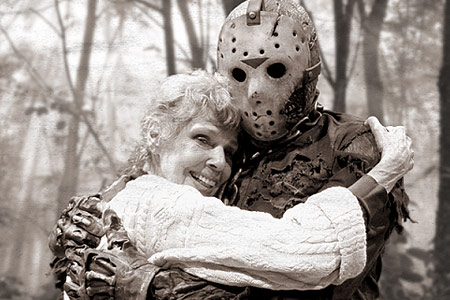
Although stemming primarily from the excellent Halloween, the true Slasher film really arrived with the phenomenally successful Friday the 13th, in 1980. Seeing how much money could be made on little investment and even less talent, every hack producer (no pun intended) started churning out these flicks by the dozen until, less than five years after the craze had begun, the genre had become a joke even to itself.
But still they came, and still they were profitable. Today some are even considered sort-of classics, despite their manifest lack of class. It is not enough to simply dismiss them, as is so easy (and apparently sensible) to do, for clearly they have struck a chord and somehow it is fitting that they should be a particularly loud voice in the story of the Eighties.
Every age and particularly those that produce great works of imaginative art has its own particular fear. In the 1950s, the first Golden Age, the fear was science; the fear of what man could or would do in the future. In the wake of the most destructive war in history, the atom bomb, and unprecedented advances in technology, men wondered where it all would lead. This fear drove the great (and less great) Science Fiction and monster films of the period.
The 1980s, meanwhile, were a period of relative calm following two tumultuous decades of social upheaval. The people of the eighties had endured Vietnam and the associated protests, Watergate, the Civil Rights movement, the Sexual Revolution, and a massive, relatively sudden shift from the older paradigm of their parents to a new, more permissive, relative, and inconsequential one. They were coming off an economic recession. Now they were enjoying a time of economic prosperity, an immensely popular president, and a period of relatively little war or upheaval, at least as far as Americans were concerned.
The primary fear of the eighties, therefore, was fear of the past. The fear that they were forgetting important things, the fear that what had happened during those turbulent years would require an accounting, the fear that those things they thought dead were not quite so dead after all, and the nagging fear that the issues that had so divided the nation had never really been settled. In short, it was essentially “did I leave the stove on” writ large.
We see this worry about the past in almost all the great films of the era: Back to the Future mixes nostalgia for the last relatively peaceful decade with a young man’s disappointment with his parents and desire to change the past for the better. Ghostbusters and the Evil Dead films (among others) deal with the rise of ancient evils upon the present. Fright Night sees an old-school monster –a vampire – returning and forces its heroes to take past traditions (i.e. religious faith and its symbols) seriously to defeat it. What was a game to the people of the eighties must become deadly serious to defend against this ancient evil. A Nightmare on Elm Street is about the very memories of a defeated force of evil attacking the survivors. Even movies set in the future, such as Aliens and The Terminator deal with the past. Aliens is a Vietnam movie in space, expressing the shadow that conflict still held and the fear that it might be repeated in the future. The Terminator is about two warring forces attempting to change their past by returning to our present, so the whole film is about the shadow the present shall cast upon the future in its turn.
But perhaps no films express this fear as consistently as the Slasher movies, for whom fear of the past was their main theme. The basic outline of a Slasher movie remained largely the same for almost all of the many, many such films that were released: at some point in the past a crime was committed which was somehow not adequately dealt with. Possibly an innocent (or even not so innocent) man was maimed, tormented, or seemingly killed. Years later, on the anniversary of the event, either the victim or the perpetrator (or someone connected with them) returns to mete out punishment on those involved and anyone who gets in his way.
The figure of the Slasher represents fear of the past: of crimes being discovered, of past mistakes returning, of past sins being punished. Surely for the teenagers experimenting with drugs or having unprecedented levels of sex such fears were often only too real. For the parents the fear that old tragedies were being forgotten and that old mistakes could burst out at any moment must have been equally real.
The sixties and seventies could perhaps be seen as a battle for and against tradition. A battle which the ‘for’ crowd lost. The Slasher film expresses the nervous fear of the victors by asking three questions: “What have we killed?” “Are we sure it is dead?” and “What if it isn’t?”
Consider, as an example, the most exemplary (meaning they are a good example, not that they are good in any other way) films of the genre: The Friday the 13th series. The fear of the past saturates these films. The first movie tells of an old summer camp being re-opened after having been closed for two decades following a tragedy that had occurred there…and that turns out to have been the result of an earlier, forgotten tragedy in its turn.
Those involved in the camp’s re-opening do so over the warnings of the local townsfolk, who are sure nothing good can come from stirring up those old memories again. And of course they are right, as the counselors are picked off one-by-one.
The townsfolk are concerned because the camp was closed in the first place following the murder of two counselors and as far as they are concerned the tragedy is still too fresh in the memory of the area to do anything as flippant as start up the summer-camp again. At the end, though, the shadow of the past grows even darker when we meet Mrs. Voorhees.
“Did you know that a boy drowned here?” she asks Alice, who is now the only survivor. No, Alice didn’t. Apparently, no one knew or cared about Jason Voorhees’ death. The opening scene implies that the counselors’ whose neglect resulted in his death weren’t even fired. It is their deaths, not his, that close the camp. Here, therefore, we have the really forgotten tragedy, the even from the past that is being defiled and ignored until it forcibly returns to remind the present that it happened. Only one person cared about that little deformed boy, and the disregard everyone showed his death drove her insane.
The fear here is the question of what tragedies have been ignored. What might the consequences be of such neglect? The popular urban legend of the time of American POWs still being held in Vietnam spoke to a similar fear; the fear of forgetting and of what is being forgotten.
As the series went on, Jason (as far as he could be called a symbol at all) continued to represent this reminding, retributive force. He is localizes, bound to Camp Crystal Lake and its surrounding area (although he can and does venture beyond, it is always against his will and he always returns). The transgression that evoke his wrath is the fact that people keep returning to this place; it is the sight of a tragedy and they repeatedly ignore what happened there.
Much has been made – I think too much – of the idea that Slashers “punish” those who transgress moral boundaries. Put crudely, the promiscuous die, the virgin survives. This is true to an extent, but not to the extent most commentators take it. For instances, it is clear that the “virgin is spared” idea is not at all supported by the films themselves: the Slasher attacks the virgin as fiercely as he does anyone else. Clearly the “have sex and die” idea is something that comes from the script or directing, not as a motivation for the Slasher. The Final Girl (as she is called) is not “spared,” what saves her is that she fights back. Rather, the quality that really saves the Final Girl is often simply awareness: she pays attention, notices when things are going wrong, often sees the Slasher before it attacks her. This ties in with the fear of the past: the Final Girl tends to be the only one who takes the past seriously by discovering the Slasher’s history, evincing understanding for his motives, and even sometimes trying to make amends. Often she uses what she has learned to help her defeat the Slashers (for perhaps the best example of this, see Friday the 13th part 2). The Final Girl, therefore, makes an effort to remember and acknowledge the past and it is this, more so than her “virginity” that saves her.
In addition, the Final Girl oftentimes has some tragedy in her past, or at least actually has a past, in marked contrast to her fellows. Alice in the first Friday is implied to be trying to get away from something. Chris in Part 3 is traumatized by a childhood encounter with Jason (nonsensical, but it counts). Tommy Jarvis, who becomes Jason’s nemesis, struggles with the trauma of his first bloody encounter with Jason in 5 and 6 (the two films being mutually exclusive). Tina of Part 7 lives in the shadow of accidentally killing her father with her psychic powers while her would-be boyfriend (who also survives) recounts a troubled past. Rennie of Part 8 also suffers from a childhood encounter with Jason (also nonsensical), and the hero of Part 9 is attempting to rectify the failures in his past, which include a child he’s never seen, when he is sidetracked into fighting Jason. In Freddy vs. Jason, meanwhile, Final Girl Lori suffers from twin past tragedies, both of which are revealed to have been caused by Freddy (more on that film later). Note also how often the past traumas and tragedies are linked directly with the Slasher himself, who becomes a kidn of personification of the lingering or hidden damaging effects of such events and of the consequences of forgetting or trying to repress them.
Jason represents retribution and reminding; the danger of forgetting tragedies and transgressing old boundaries. The other great horror icon of the decade, Freddy Krueger, represents the opposite fear; fear of remembrance, of things thought settled that are not really settled, problems not fully dealt with, relapses, chickens come home to roost. Jason is the present looking back, Freddy is the past looking forward. Jason represents the forgotten veteran, the abandoned morality, the defaced monument. Freddy represents the old drug addiction you never quite overcame, the venereal disease you never knew you had, the psychological problem you thought had been cured. In short, Freddy is the personification of the consequences of the drug-and-sex culture of the past two decades.
Do not think I am being too complimentary. I don’t think for a moment expect that the makers of Friday the 13th and all its bastard progeny had any of this in mind during the making of the films; they were just business, a get-rich-quick scheme. But they were products of their time and they were what the public wanted and they wouldn’t have been half as successful if they didn’t’ tap into something deeper than “gore and boobs,” if only accidentally.
The Nightmare films, at least at first, are of a different breed. Sean S. Cunningham, who made Friday, was a businessman, an entrepreneur. Wes Craven was an artist. So while I doubt my interpretations were anywhere near Cunningham’s mind, I suspect strongly that Craven knew exactly what he was doing.
I have given one brief interpretation of Nightmare elsewhere, and there is no time now to give it its full due. Suffice to say, Freddy is not only a bad memory come to life, but he preys on victims who are already leading lives of, at best, thinly disguised disorder and lives beset with mistakes and sins, all of which are magnified in the pressure brought on by Freddy.
For example, Nancy’s mother is shown to have a drinking problem, which evidently is already a source of strain on her marriage (note the stiff greeting her and her husband exchange in their first scene together). As the situation grows worse and worse, so does her drinking, until finally her drunkenness contributes to the film’s most gruesome death. Similarly, first victim Tina has a neglectful mother who abandons her to go on a weekend trip with her piggish boyfriend, while Tina’s own boyfriend is a juvenile delinquent whose past makes him the chief suspect in Tina’s murder…and whose own death is therefore passed over without comment. Freddy is not just a bad memory returned to life, but he brings other bad memories with him. He is literally the past attacking the present.
Perhaps no film explores these themes better or more directly than Freddy vs. Jason, the long-awaited crossover of the two series, the finale for both of them, and one of the best films in either.
Interestingly, both Freddy and Jason are memories in this film for the audience as well as the characters. By the time it was released, Freddy hadn’t been on screen for nine years, while Jason had been absent for ten years, not counting Jason X the previous year, which holds the dubious-yet-impressive distinction of being possibly the stupidest film in the whole series. In the world of the film, Jason has been absent for an indeterminate amount of time (long enough for everyone to assume he’s dead), while Freddy has been absent for seven years, thanks to the extreme efforts of the Springwood authorities to defeat him the only way they can: by forgetting him.
The forgotten Freddy, however, has struck a plan to get around this by reviving Jason, the monster of remembrance, to force the people of Springwood to remember him. When Jason starts killing the local population, the authorities panic and assume it’s Freddy again…meaning that, very soon, it will be.
The plot of the film, therefore, rests on the tension of forgetting and remembering of the past. Its Final Girl, Lori, as has already been mentioned, is emotionally stunted by twin traumas in her past: her mother’s sudden death and the subsequent disappearance of her boyfriend. As the film goes on, she discovers partial truths about these events which push her even further into danger by directing her away from people who could have protected her (her father, the police) and causing her and her friends to try to take on Freddy and Jason themselves. In the end, though, she discovers the truth that Freddy was responsible for both of the tragedies by killing her mother, which her boyfriend witnessed, but misconstrued (possibly by Freddy’s intention) what he was seeing to be Lori’s father killing her, resulting in his sudden removal for fear that he has found out about Freddy (all the teens who knew about Freddy have been institutionalized to prevent them telling others about him). The unknown elements in her past, and the subsequent half-remembrances, lead her further and further into danger. It is only after she learns the whole truth that she is able to take charge…and to defeat Freddy once and for all, symbolically ending the past’s reign over her present.
In the meantime, though, Freddy has been having problems of his own. Having unleashed Jason to remind Springwood about himself, he never stopped to consider what might happen afterwards…or that, for someone who is literally a bad memory, releasing an engine of retribution might not be the best idea, since what is retribution if not a counterforce to bad memories? Jason, true to his nature, refuses to be shut down: he refuses to let Freddy forget about him either. As Freddy himself puts it, “HE JUST WONT STOP!”
In response, Freddy digs up horrors in Jason’s past: specifically, his death by drowning and his relationship with his mother. Freddy, therefore, attacks Jason with Jason’s own past. And it works, at least at first. The trouble is, Jason has things to remind Freddy about too. Freddy, in life, was child-murderer and Jason, it is shown, is a child at heart (a feral, deranged child, granted). When they next meet, it is on Jason’s terms…and he makes it abundantly clear that he remembers what Freddy did to him. Freddy has revived and then tormented an indestructible force of retribution, and now he finds it visiting his own sins upon himself. Jason the child-man rips Freddy the child-murderer to pieces and there is nothing Freddy, for all his power, can do about it. Retribution meets Memory.
In the end, though, they can’t kill each other. How can Memory defeat the force of Remembrance or Retribution destroy Memory? What can happen, and what does happen, however, is that Retribution contains Memory. The last shot of film is Jason emerging from the lake, as invulnerable as ever, with what’s left of Freddy firmly in his possession. The last shot of the last true Slasher film is of the personification of Bad Memories secure in the power of the force of Remembrance and Retribution, not forgotten, and with an implicit warning not to try to forget again, but faced and dealt with at last.
The Slasher movies were the rather repulsive expression of a society living under the shadow of its past deeds and uncertain about what exactly it had done. Their theme, essentially, is that the past is often frightening and rife with sins and mistakes, but trying to forget it or shove it aside can be a very dangerous thing, as it has ways of forcing you to remember it. The only way to deal with the past is to face it head on, no matter how horrific it might be. Only then can we move on and continue to live.

Sunday, March 13, 2011

MST3K – 303: Pod People

Here we have one of the most famous episodes of the series: Pod People. As Dr. F. says, it has nothing to do with pods, it has nothing to do with people, it has everything to do with hurting.
The film was originally conceived as a straight-up monster movie, an Italian-French co-production. The problem came when “E.T.” came out right before production, and the producers, wanting to cash in on the massive success of that movie, forced the director to awkwardly shove in a subplot about a little boy befriending one of the monsters. The result is a movie that lurches between three or four plot lines and scyzophrenicly wavers between portraying the monsters as inhuman killing machines or misunderstood innocents. Meanwhile, the aliens look like ape suits with elephant masks attached (shades of “Robot Monster”), the little boy has some very odd mannerisms and is obviously dubbed by a woman, the teenage band members (obviously the original stars before the boy was written in) carefully explain why their leader’s girlfriend shouldn’t mind him sleeping with a groupie to further his own career, a couple of grouchy hunters add nothing whatsoever to the production, and the aliens display vast psychic powers but only kill people with karate chops.
Riffwise…well, it’s funny, to be sure, but it’s never been one of my favorites. The poor picture quality, lots of fog, soft, new-age music, and relatively small number of ‘laugh-out-loud’ moments makes this a bit of a chore to sit through. It took me three or four sessions to gather this review (although granted I had a lot of other work to do in the meantime). There are a number of very funny riffs on “Trumpy” (the alien befriended by the kid), but when he’s off screen the riffs die down a little. The end effect is more amusing than really funny to me.
The host segments are pretty strong, although nothing too memorable, but they’re amusing and don’t outstay their welcome. The episode also ends with a rather iconic song, ‘Clown in the Sky,’ which is even more bittersweet now that MST3k has gone forever from the airwaves.

Thoughts while watching:

Opening: Crow practices his one-man show, Robot on the Run as part their art show. Servo’s soliloquy is cut short when he can’t remember his line.

Invention Exchange: Joel has a new guitar chord for big finishes. It causes the guitar to explode. The Mads have the public-domain karaoke machine (which I could actually see working). Both inventions are more amusing than funny, though the blasted ‘bots are good.

Like “Cave Dwellers” and “Godzilla vs. the Sea Monster”, this movie’s credits play over footage of a different movie (in this case, Roger Corman’s “Galaxy of Terror”)

Crow (as a man prepares to hit the monster with a shovel): “I believe I’ll use my putter. Four!”

(the monster attacks a girl)
Joel: “This is the Swamp Thing versus the Sweet Thang.”

The film proper starts with a retreating star-field.
Servo: “Boldly backing away from where no man has gone before.”

And we cut to a really foggy forest where some grouchy poachers pull up.

Crow (on a hunter): “Hey, does he look dorky enough?”

Poachers poach some eggs…

Meanwhile, we cut back and forth with a comet heading towards earth.

Now we cut to a kid being awakened by his pet cat.

Kid: “Naughty kitty…”
Joel: “You must be punished.”

Then the lights flicker and the kid looks through his telescope to see a weird green pulsing.

Servo (as the kid): “Hm. What pretentious crap.”

Back to the poachers…

Kid…

Poachers…

One of poachers says he saw something crash, the others don’t believe him, he goes off to investigate by himself.

And Joel tries to push one of the poachers over!

Cut to a pink cave, which they identify as Yoda’s home…then as Crow’s sinuses…then as Smuckers Jelly.

Poacher investigates the cave, which is filled with big eggs.
Crow: “Now Mr. Science is going to show us the white blood cells.”

And he drops the egg, and decides to randomly start smashing up all the eggs.

Joel: “I guess we know which came first now, don’t we?”

He’s stopped by an advancing point-of-view shot…
Servo: “BAWK! BAWK! BAWK! CLUCK! CLUCK! CLUCK!”

And the Poachers find the truck gone and realize they have to stay out there (since apparently they can’t find the truck about a hundred yards off).
Joel: “Are you comfortable sharing a sleeping bag with me?”

Cut to some deer…
Joel: “Bambi, humans are basically good…”
Cut to the poachers aiming at them.
Servo: “Oh, check that…”

Joel makes a few quips on the lead poacher’s blood lust.

Poacher: “I want to get the hell out of here!”
Servo: “I’m doing a one-man show: ‘Leslie Nielson, Leslie Nielson, Leslie Nielson.’”

Servo: “You know, even the movie ‘The Fog’ didn’t have this much fog.”

Cut to a helicopter shot of the hills with fog coming up…
Servo: “It’s Julie Andrews…and she’s on fire!”

Cut to the kid’s eyes peering through a microscope.
Crow: “Ah! It’s the cameraman, he’s looking through the wrong lens!”

Kid tries to get his mean, drunk uncle interested in his centipede.
Crow: “He’s a loving and giving caregiver.”

And we cut to a recording studio.
Servo: “Ah, finally, a movie for our generation: swinging.”

Singer: “Hold it! It’s stinks!”
Crow: “We agree.”

And back to the woods.

Crow: “We’re just as confused as you are, folks.”

Hunters watch the rangers leave…

And back to the studio, where the guys express their confusion over the mumbled lyrics.

Crow: “Lyrics by Mrs. Johnson’s Kindergarten Class.”

They dub it “Hideous Control Now!”

And some people watching assure us “he’s the best.” Sure.

The song just kind of ends and the band leader is mad about something.

Song leader (named Rick) starts chewing out his band.

Recorder: “You want to hear it again?”
All: “No, no!”

Everyone plans to head up to the mountains (has this ever turned out well for any fictional character?)

One of the sluttier girls decides to dump her boyfriend because he can’t take off work for the weekend. Huh?

First Host Segment: Hideous Control Now. They reenact the song scene with the lyrics as they understood them. It’s pretty amusing, especially Gypsy coming in late every time and the Mads acting as the recorders.

Back in the movie the kid wants to go out to find more “specimens” as he calls them, then we cut right back to the studio where Rick and his girlfriend are making up and making out.

Girl: “You think the weather’s going to hold?”
Servo: “No, just stop.”

Girl: “Not a soul for miles.”
Crow: “I’m not bringing mine.”

Turns out Rick is bringing the chick he’s cheating with, along with his girlfriend. He’s just sleeping with her to get a better chance at selling his records.

And his friends convince his girlfriend to stay with him and not mind being used.

Joel: “You see, cheating is hip!”

Crow: “Hey, try to be nice to your boyfriend’s girlfriend.”

And back to the kid, who’s wandering around the woods and finds the cave.

Crow: “Boy I hate Kenny!”
Joel: “This isn’t Kenny, we like this kid.”

And back to the band driving up to the mountains while another bad song plays.

Singer: “What should I do?”
Crow: “Retire.”

Crow: “Hey, look, we paid for the van, we’re gonna film it!”

Cut to the cave (with its red, foggy entrance)
Joel: “Oh, great we were saved by the Gates of Hell.”

Crow (on the kid): “What’s he gonna do, borrow a cup of sugar from Satan?”

The kid finds the smashed eggs.
Joel: “Wow. Specimen Jackpot!”

About this time they start doing a gag where they call out a list of names ending with “chief? McCloud!” It’s pretty amusing (and they do it a lot in this episode), but it’d be too much trouble to transcribe it, so I’ll just mention it here.

(the kid selects the only unsmashed egg)
Crow: “Oh, that’ll go nice in his mutant-alien-hell-beast-from-space collection.”

And the kid stumbles on the body of the dead hunter from earlier.

Cut back to the teens.

Rick and his chick go off into the woods, where she starts making out until his girlfriend catches them.

And back around the camp-fire, chick starts taunting girlfriend, who splashes water in her face (can’t blame her)
Crow: “Coffee?”

Chick runs off.
Guy: “Let her cool off.”
Crow: “Yeah, or get eaten by creatures.”
Servo: “Snap an ankle, die of exposure.”

And indeed, the chick runs into the poachers, who start chasing her for no reason.

(back around the campfire)
Crow: “And there on the handle was…you’re not listening!”

(back to poachers chasing chick)
Poacher 1: “She’s a lot faster than I thought.”
Poacher 2: “Yeah, well you’re a jerk.”
Servo: “Ooh, touchĂ©.”

And chick runs into one of the monsters, causing her to scream and run off a cliff.
Inexplicably, the others hear her (even though they didn’t hear her screaming when she ran into the poachers)

Girl: “What was that?”
Servo: “Sounded like Laura leaping to her death.”

They find her and carry her off.
Crow: “Yeah, quick, move her spine around a lot.”

Teens bring chick back to the van, try to think of what to do. Girlfriend blames herself, blah, blah, blah.

Cut to kid’s house.
Servo: “Meanwhile in ANOTHER movie. *sigh* Patience, gentle viewer, this will all make sense in the end. Not.”

Amusing bit where the kid examines the egg.

Kid talks to his pets, takes the egg to bed with him.

Joel: “Right, he’s trying to hatch the egg. What is he, Horton?”

Back to the teens.
Servo: “So, is this movie A?”
Joel: “Beats me.”
Servo: “Let’s see, the hunters are in movie A, the kid is in movie B…”
Crow: “This must be movie C.”

Teens knock on the door to the kid’s cabin, kid’s mean uncle rebuffs them (he says something about ‘this time of night’ despite the fact that it’s clearly afternoon. They don’t even tint the screen dark at all!)

Mother comes and lets them in.

They just toss her onto the bed!

Mother: “With a good night’s rest she’ll be as right as rain.”
Joel: “Yeah, that’s what cures a crushed spine.”

Kid finds the egg has hatched (in his bed. Ew).

Second Host Segment: Joel sets up a wall of keyboards to make new-age music: Music from Some Guys in Space. Mostly it’s a chance to mock New-Age Music. It’s kind of amusing and doesn’t go on for too long (Crow’s sandwich is probably the best part).

In the movie we rejoin the poachers, who are camped out around a fire.

Lead Poacher: “Haven’t you screwed things up enough already?”
Crow: “Well, he did write the script…”

And the monster makes its appearance. It looks like a monkey-costume with an elephant’s head attached.

Poacher: “It looks like a cross between a pig and a bear…”
Crow: “A pear?”

The poachers decide to capture it (deducing on no evidence whatsoever that it’s harmless).

Poacher (to the monster): “You must be hungry. Have some.”
Crow: “It’s one of you, only gamier.”

Lead hunter jumps monster with a net, get’s kacked. Other hunter shoots it with a dart, which the monster just knocks off.

Crow: “Hey, that nose must be handy in hard-to-reach areas.”

Back to the kid.
Joel: “Hey, what gives? I’m on the milk-carton.”

The kid is feeding “Trumpy” as he calls him.

Kid: “You know what playing is, Trumpy?”
Crow: “Yes. It’s where I break you in half.”

Incidentally, Crow comes up with the funniest voice for Trumpy.

Cut away again.
Servo: “Meanwhile, in movie C.”
Crow: “I think this is movie D. D for dumb.”

Now we just cut back to kid and Trumpy, who is fully grown already and apparently eating the kid out of house and home.

Girl wakes up.
Servo: “Oh, what a nightmare. I dreamt I was a crappy actress in a horrible monster…film…hey, wait a minute!”

The girl notices something odd about the chick…
Servo: “Uh, hello, remember us, the audience? Can we see what it is, please?”

Mother shoos the kids out of the room (the chick is dead, by the way).
Crow: “Come on, breakfast is getting cold and she’s not getting any warmer.”

Now we get Crow’s famous “Potato Soliloquy,” which I would only spoil if I attempt to transcribe it. It’s one of the best bits they ever did.

Kid (to Trumpy): “Nobody must see you!”
Servo: “He doesn’t speak your language, dick-weed.”

Kid: “If you want to stay with me, you must do what I tell you.”
Crow: “I don’t think so.”

Trumpy vacuums up some peanuts.

Crow: “Oh, little potatoes.”

Kid: “These we’ll put away for later.”
Crow: “No! More!”
Kid: “Now we can play.”
Crow: “Like Hell! More food!”

Kid: “What do you know Trumpy?”
Crow: “Food! Eating! The Theater!”

Kid (showing Trumpy a jigsaw puzzle): “You see? The pieces fit together.”
Joel: “Oh, if only this film were so lucky.”

Back downstairs with the teens, one of whom is about to try going to radio for help with mean uncle.

And upstairs with kid and Trumpy.

Kid: “Do you have a mommy?”
Crow: “He was born of an omelet! Of course not!”

Trumpy makes the kid’s telescope view Africa for no real reason.

Kid: “You can do magic things!”
Crow: “It’s called ‘Evil,’ kid.”

And we get a completely random scene where Trumpy starts making the kid’s toys fly around the room and stuff.

Servo (as mother): “Tommy you stop warping time and space this instant.”

And we cut to teen and uncle on their way to a radio in the ranger’s cabin.
Servo: “Meanwhile in a winter movie somewhere.”

Joel: “Gosh, that last scene was goofy, I’m glad we weren’t in it.”

And back to the house with the teens, one of whom decides to try the T.V.

Girlfriend: “How can you kid around like this?”
Girl: “Because if I didn’t I’d be in hysterics…it doesn’t work.”
Joel: “I’m in hysterics!”

Kid goes back in his room to look for Trumpy, checks in his closet and…
Joel: “*SSSSSSSSSSLUURP*!”

Servo: “Face it, kid, Trumpy never loved you.”

Kid (to his cat): “Have you seen Trumpy?”
Joel (as cat): “He tried to eat me! He’s evil!”

Joel: “This is like the house of a million foyers.”

And back to the teen and uncle (and it’s no longer winter for some reason).

They approach cautiously, since no one’s home. The radio doesn’t work (of course). And they find the other poacher, dead.

Then they run into the monster, who kills the teen (mean uncle is attacked in his car, but we see he’ll get away).

Slutty girl helps mother cook and complains about how guys don’t want to sleep with her, then makes designs on the rangers if they show up.

Meanwhile, the kid keeps searching for Trumpy, who’s wandered off.

Joel: “Trumpy, bring me the girl! I desire to be read to.”

(kid looks for Trumpy with his telescope)
Joel: “Now Trumpy and I will do my version of ‘Rear Window’”

Slutty girl gets attacked by monster in the trailer.
Servo: “I think she found Trumpy.”

And the kid sees it all.

Servo: “When good pets do bad things!”

Uncle arrives back home and takes a few pot-shots at the monster.

Uncle: “It’s that damned animal!”
Rick: “What animal?”
Crow: “The damned one!”

Servo (as kid): “Faster Trumpy, kill, kill!”

Third Host Segment: They reenact the goofy “magic Trumpy” scene, with the bots as Trumpy. The ‘Mads look on in disbelief. It’s pretty funny, and we get a better look at the SOL set.

Rick (to mother): “I’m getting out of here, and if I were you I’d take the kid and leave.”
Servo: “Kid, what kid…oh, my God!”

Meanwhile the kid is wandering the woods looking for Trumpy (after he thinks he just saw Trumpy killing someone).

Random scene where Rick and uncle have an alpha-male battle which culminates in Rick blasting one of uncle’s liquor bottles.

And the kid arrives back at the house.

Servo: “You know, I’m starting not to believe this movie. I believed it when Alf went on a killing spree, but this…”

Kid finds Trumpy in his room. Trumpy claims he didn’t kill anyone.

Kid: “Uncle Bill wants to kill you.”
Joel: “My advice? Don’t let him!”

Kid: “What can we do?”
Servo: “You can put on a play in the backyard. Trumpy could be Cyrano!”

The kid decides that he and Trumpy will go hide in the woods.

Back to Rick and uncle. Uncle offers him a drink.
Crow: “Mint Julep?”
Servo: “*urp* No thanks, I’ve had twelve.”

Cut to girl in the shower.
Joel (singing): “Hmm, hmm, I’m in the shower, nothing will happen to me…”

Kid dressed Trumpy up in a parka.
Servo: “There, now you look like Admiral Perry playing the Elephant Man.”

Girl in shower attacked and killed by monster.

Servo: “She’s zestfully dead.”

Joel (as teens): “You know, this may sound crass, but we’re getting good at this.”

Crow (as Trumpy): “You’re my alibi, kid.”

Kid insists that the monster wants to be our friend (he’s channeling Kenny here).

Rick and uncle go out to hunt monster.

Trumpy wanders into the room, and the mother and girlfriend run…right past him instead of away from him.

Joel (as kid): “What’s he’s done is good.”

And now they’re all out in the woods, packing, and looking for the monster in the fog.

Kid: “We must go faster.”
Crow: “Yeah, yeah, keep your shirt on! I’m wearing a big stuffed shirt!”

And kid runs into monster, immediately forgetting his assertion that the monsters want to be friends.

Servo: “I’m gonna batter-fry you, kid!”

Kid: “Mommy! Trumpy!”
Servo: “Kid, you were set up.”

Joel: “This is more intense than when Brad Brady got lost in the Grand Canyon.”

Trumpy shows up to vouch for the kid.

Kid: “I just want to help you.”
Joel: “I conspire against my own.”

Uncle gets killed by monster, monster gets killed by Rick.

Crow: “Time to take the mask off and see who it is. Do you folks at home know?”

Mom and girlfriend run through the woods, Mom trips.
Crow: “Oh, my ankle! It’s all bendy-wendy!”

The monster self-buries.

Then kid and Trumpy have a tearful good-bye…

Kid: “I’ll never forget you, Trumpy.”
Servo: “The way you callously knocked-off fifteen people. I’ll never forget that. Don’t ever change, Trumpy.”

Then the kid switches to yelling at Trumpy and telling him he hates him.

Joel: “Oh, that kid’s really having mood-swings.”

And Trumpy is left alone in the woods.
Crow: “I’ll…just…wait here then.”

Then Trumpy wanders off.
Crow: “I’m outta here, this place sucks.”

And we get the credits again with “Galaxy of Terror” footage.

Final Host Segment: “Clown in the Sky.” This is a rather iconic song for them, very well sung by Joel. It’s actually pretty touching, in a funny way. Oddly, it opens with Joel tearing Crow apart, he doesn’t seem to mind much.

Stinger: “It Stinks.” Perfect, that’s all.

Movie Quality Rating:

1. Godzilla vs. the Sea Monster
2. The Crawling Eye
3. The Black Scorpion
4. Mad Monster
5. Lost Continent
6. Gamera
7. First Spaceship to Venus
8. Rocketship XM
9. Moon Zero Two
10. Godzilla vs. Megalon
11. The Crawling Hand
12. Catalina Caper
13. King Dinosaur
14. Jungle Goddess
15. Wild Rebels
16. The Corpse Vanishes
17. Ring of Terror
18. Untamed Youth
19. The Slime People
20. Project Moonbase
21. The Sidehackers
22. Women of the Prehistoric Planet
23. Robot vs. The Aztec Mummy
24. Cave Dwellers
25. Pod People
26. Hellcats
27. Rocket Attack USA
28. Robot Holocaust
29. Robot Monster

Conclusion: An iconic episode that is rather decent than great in my eyes.

Final Rating: 6/10.